
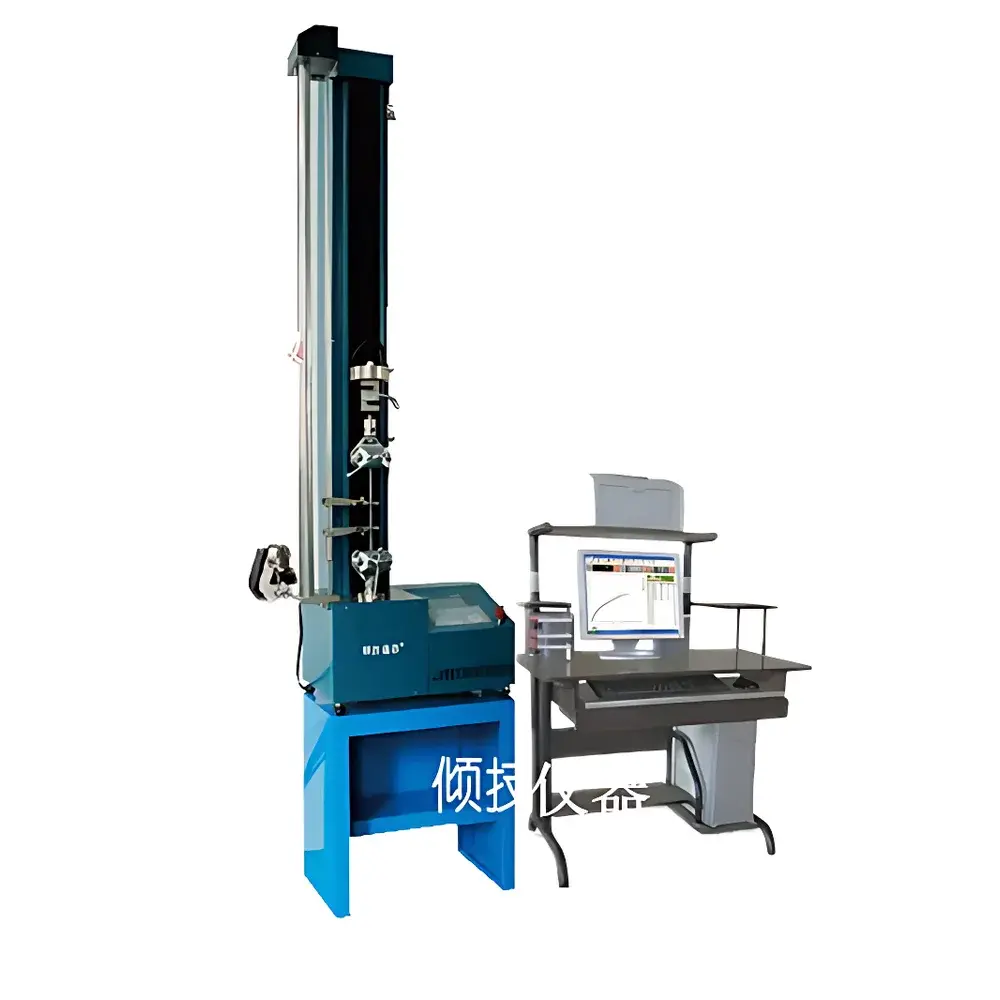
Qinsun QJ210A Desktop Microcomputer-Controlled Universal Testing Machine
| Brand | Qinsun |
|---|---|
| Model | QJ210A |
| Maximum Load Capacity | 10–500 kN (configurable) |
| Effective Test Width | 500 mm |
| Effective Tensile Travel | 600 / 800 mm |
| Test Speed Range | 0.001–1000 mm/min |
| Load Resolution | ±1/250,000 full scale (constant across entire range) |
| Load Accuracy | ±1% of reading |
| Displacement Accuracy | ±0.5% of reading |
| Strain Measurement Accuracy | ±0.5% of reading |
| Speed Accuracy | ±1% of set value |
| Safety Protection | Electronic limit switches, overload protection at 110% of rated load |
| Return Mode | Manual rapid return or programmable automatic return |
| Dimensions (W×D×H) | 960 × 650 × 2000 mm |
| Weight | 1200 kg |
| Compliance | ISO 6892-1, ASTM E4, ASTM E8, ASTM D638, ASTM D3039, ISO 527, ISO 178, JIS Z2241, DIN 50125 |
Overview
The Qinsun QJ210A is a desktop microcomputer-controlled universal testing machine engineered for high-precision mechanical characterization of metallic, polymeric, composite, and elastomeric materials under tension, compression, bending, peel, tear, shear, puncture, and low-frequency fatigue loading conditions. It operates on the fundamental principle of servo-controlled electromechanical actuation, where a precision ball-screw-driven crosshead applies calibrated force through a load cell while synchronized displacement and strain sensors record real-time deformation response. Designed to meet the metrological requirements of accredited materials testing laboratories, the system delivers traceable force measurement with constant resolution across its full dynamic range—ensuring consistent data fidelity whether evaluating brittle fracture in aerospace alloys or viscoelastic recovery in biomedical hydrogels.
Key Features
- Servo-motor-driven electromechanical architecture with closed-loop PID control for stable, repeatable speed and load regulation
- High-resolution load cell with ±1/250,000 internal resolution—maintained uniformly from 0.5% to 100% of selected capacity (10–500 kN)
- Adjustable test width (500 mm) and extended travel options (600 mm or 800 mm) accommodate standard and custom specimen geometries per ISO and ASTM specimen templates
- Programmable speed range spanning three orders of magnitude (0.001–1000 mm/min), enabling quasi-static tensile tests and high-rate impact simulations via ramp-and-hold profiles
- Dual-speed crosshead positioning (fast jog + fine adjustment) with electronic hard-stop limiters and hardware-based overload cutoff (110% of full-scale capacity)
- Windows-based control software supporting real-time curve overlay, dynamic scaling, point annotation, and post-test data interpolation without loss of original acquisition integrity
- Integrated safety interlocks including emergency stop circuitry, door-mounted safety switches (for optional enclosures), and automatic return-to-home after test completion
Sample Compatibility & Compliance
The QJ210A accommodates standardized specimens defined in ISO 6892-1 (metallic tensile), ASTM D638 (plastics tensile), ASTM D3039 (composite in-plane tension), ISO 178 (flexural properties), and ISO 8510-2 (peel adhesion). Grip configurations—including wedge-action, pneumatic, hydraulic, and specialized fixtures for film, wire, and textile testing—are fully interchangeable and mechanically registered to minimize alignment-induced bending moments. The system supports GLP-compliant operation when paired with audit-trail-enabled software modules compliant with FDA 21 CFR Part 11 requirements. All force calibration certificates are NIST-traceable and issued per ISO/IEC 17025 guidelines by authorized third-party calibration laboratories.
Software & Data Management
Control and analysis are executed via Qinsun’s proprietary Windows-native software suite, featuring dual-mode operation: guided wizard workflows for routine QC testing and advanced script-based test sequencing for R&D protocols. Raw data streams (force, displacement, extensometer strain) are acquired at ≥1 kHz sampling rate and stored in open-format ASCII (.csv) and binary (.qdt) containers. Curve manipulation tools include hysteresis loop integration, modulus calculation via tangent/secant methods, yield point detection using ISO 6892-1 Annex C offset methods, and automatic failure event tagging. Export functions support direct generation of ASTM/ISO-formatted reports with embedded metadata (operator ID, environmental conditions, calibration expiry, instrument serial number).
Applications
- Tensile property mapping of structural steels, aluminum alloys, and titanium grades per ASTM E8 and ISO 6892-1
- Mechanical validation of thermoplastic and thermoset composites used in automotive and wind energy sectors
- Adhesion strength quantification of pressure-sensitive adhesives, laminated packaging films, and medical device bonding interfaces (ASTM D903, ISO 8510)
- Compression testing of foams, elastomers, and orthopedic biomaterials under controlled strain rates
- Cyclic loading studies for fatigue life prediction in polymer matrix composites and solder joints
- Educational use in university materials science labs for hands-on instruction in stress-strain fundamentals and fracture mechanics principles
FAQ
Is the QJ210A compatible with external extensometers and video-based strain measurement systems?
Yes—the system provides analog and digital I/O ports (±10 V, TTL) for synchronization with clip-on axial extensometers, non-contact DIC systems, and thermal imaging cameras.
Can test sequences be automated for unattended overnight operation?
Yes—batch test scripting supports conditional branching, pass/fail logic gates, auto-grip adjustment, and email/SNMP alerts upon completion or fault detection.
Does the system support multi-axis load frame integration?
The QJ210A is a single-axis vertical testing platform; however, its modular base plate and controller architecture allow future expansion to biaxial configurations via OEM collaboration.
What documentation is provided for regulatory submissions?
Standard delivery includes Factory Acceptance Test (FAT) report, IQ/OQ protocol templates, calibration certificate with uncertainty budget, and software validation summary aligned with GAMP5 principles.
How frequently must the load cell be recalibrated?
Annual recalibration is recommended under normal usage; however, interval adjustments may be justified based on risk assessment per ISO/IEC 17025 Clause 6.5.2 and internal quality procedures.



