
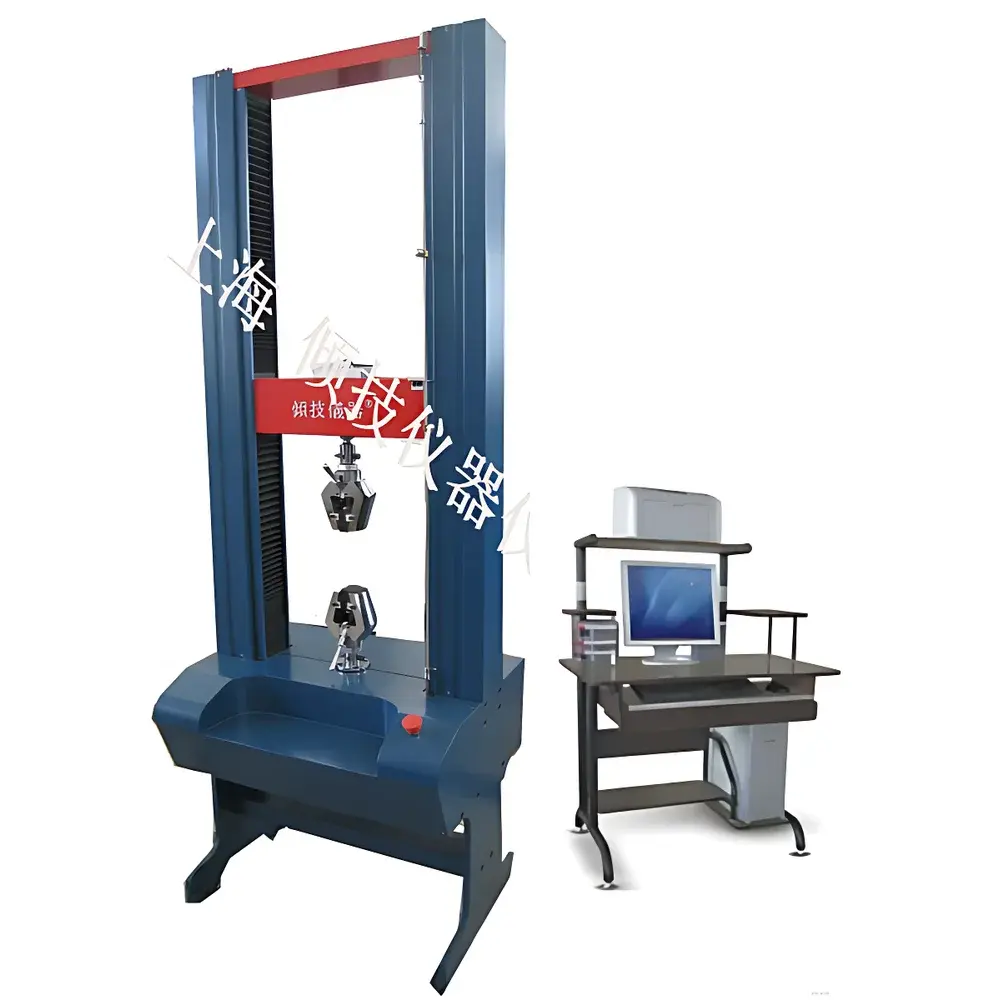
Qingji QJ211 Electronic Brake Pad Shear Testing Machine
| Brand | Qingji |
|---|---|
| Origin | Shanghai, China |
| Model | QJ211 |
| Maximum Load Capacity | 30 kN |
| Load Cell Accuracy | 0.01% |
| Test Accuracy | < ±0.5% |
| Control System | Full PC-based Windows OS Interface |
| Effective Test Width | ~420 mm |
| Effective Tensile Stroke | ~800 mm |
| Test Speed Range | 0.001–500 mm/min |
| Speed Accuracy | ±0.5% |
| Displacement Measurement Accuracy | ±0.5% |
| Strain Measurement Accuracy | ±0.5% |
| Safety Protection | Electronic stroke limit, emergency stop button, overload auto-shutdown |
| Machine Weight | ~140 kg |
Overview
The Qingji QJ211 Electronic Brake Pad Shear Testing Machine is a high-precision universal testing system engineered specifically for mechanical characterization of automotive friction materials—primarily brake pads—under controlled shear loading conditions. Based on servo-controlled electromechanical actuation and compliant with ASTM D638, ISO 527, ISO 37, JIS K6251, GB/T 1040, and other internationally recognized standards for polymer composites and structural materials, this machine delivers repeatable, traceable, and auditable mechanical data across tensile, compression, bending, peel, tear, puncture, and low-cycle fatigue modes. Its core architecture employs a dual-column rigid frame, precision-ground ball screws, and a closed-loop digital PID controller synchronized with high-resolution load cells (0.01% full-scale accuracy) and linear variable differential transformers (LVDTs), enabling accurate quantification of shear strength, interfacial adhesion, cohesive failure thresholds, and viscoelastic response under dynamic loading profiles.
Key Features
- Modular fixture system supporting standardized shear test configurations per SAE J661 and ISO 6310 for brake pad bonding integrity evaluation
- Multi-range load cell integration (up to 30 kN nominal capacity) with automatic range switching to maintain optimal signal-to-noise ratio across test regimes
- Real-time dynamic curve display and post-test interactive data interrogation via native Windows-based control software
- Programmable test sequences including ramp-hold-relax, cyclic shear, and displacement-controlled rupture protocols
- Dual safety architecture: hardware-based mechanical stroke limits combined with software-enforced electronic safeguards and emergency stop circuitry
- Full compliance with ISO 17025 calibration traceability requirements; load cell certification includes NIST-traceable documentation
- Integrated environmental readiness for ambient-condition testing in QC laboratories adhering to GLP and IATF 16949 process validation frameworks
Sample Compatibility & Compliance
The QJ211 accommodates standard brake pad specimens (e.g., 25 × 25 × 10 mm, 50 × 50 × 12 mm per SAE J2727), as well as custom geometries via adaptable shear fixtures—including double-lap, single-lap, and block-shear configurations. It supports metallic, semi-metallic, ceramic, and low-metallic friction composites. All test methods align with regulatory expectations for automotive component qualification: test reports include audit-ready metadata (operator ID, timestamp, environmental conditions, calibration status), satisfying FDA 21 CFR Part 11 electronic record requirements when configured with user access controls and electronic signatures. Compliance documentation covers ISO 9001:2015, ISO/IEC 17025:2017, and EU Regulation (EC) No 661/2009 on braking system type-approval.
Software & Data Management
The embedded Windows-native testing platform provides real-time graphical monitoring of force-displacement, stress-strain, and shear modulus vs. time curves. Data export is supported in CSV, XML, and PDF formats—with embedded metadata tags for LIMS integration. Curve analysis tools include tangent modulus calculation, yield point detection (0.2% offset method), fracture energy integration, and hysteresis loop quantification. The system maintains full audit trails: every parameter change, calibration event, or report generation is time-stamped and user-logged. Optional add-ons enable automated report templating compliant with AIAG CQI-9 heat-treatment verification workflows and OEM-specific PPAP submission formats.
Applications
- Shear strength evaluation of brake pad backing plate–friction material bonds per SAE J2727 Clause 5.3.2
- Interfacial adhesion testing of thermoset resin matrices under thermal aging (pre- and post-heat cycle exposure)
- Comparative assessment of bond durability after salt-spray corrosion conditioning (ASTM B117)
- Mechanical screening of new friction formulations during R&D phase development
- Quality conformance verification in Tier-1 supplier production lines operating under APQP and PPAP protocols
- Root-cause analysis of field failures involving delamination or shear-induced cracking
FAQ
Does the QJ211 support automated pass/fail judgment based on pre-defined specification limits?
Yes—the software allows configurable acceptance criteria per test method, triggering visual alerts and flagging non-conforming results in exported reports.
Can test parameters be locked to prevent unauthorized modification during production runs?
Yes—role-based access control (RBAC) enables administrator-defined permission tiers for operators, supervisors, and QA personnel.
Is third-party calibration certification available with initial delivery?
Yes—factory calibration includes ISO/IEC 17025-accredited certificate with uncertainty budget and NIST-traceable reference standards.
What maintenance intervals are recommended for long-term measurement stability?
Annual recalibration is advised; routine verification using certified reference load blocks is recommended prior to each shift.
How is software validation performed for regulated environments?
IQ/OQ documentation packages are available upon request, aligned with GAMP 5 guidelines and supporting 21 CFR Part 11 compliance validation.



