
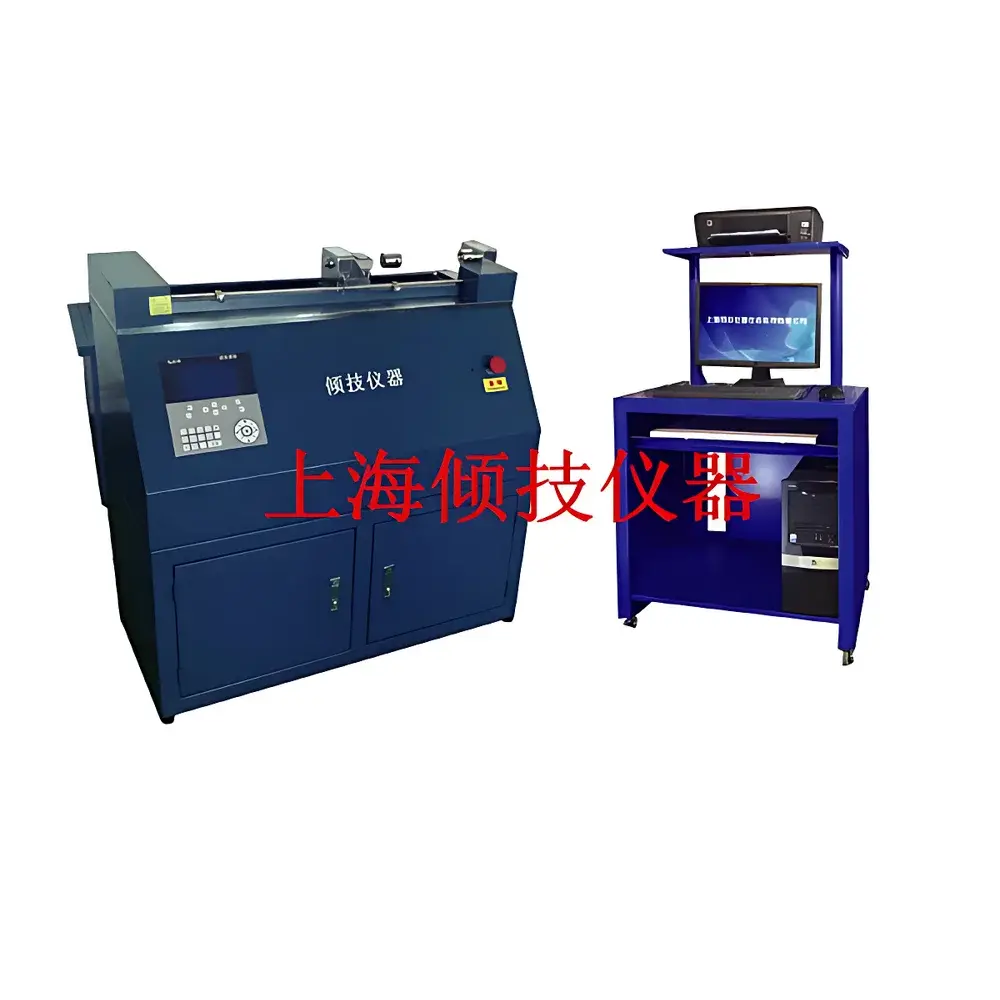
Qinji QJ310 Horizontal Desktop Tensile Tester
| Brand | Qinji |
|---|---|
| Origin | Shanghai, China |
| Manufacturer Type | Authorized Distributor |
| Country of Origin | China |
| Model | QJ310 |
| Load Capacity | 2500 N or 5000 N |
| Load Cell Accuracy | 0.01% FS |
| Measurement Accuracy | < ±0.5% |
| Test Speed Range | 0.001–300 mm/min |
| Effective Test Stroke | ≥200 mm |
| Power Supply | AC 220 V, 50/60 Hz |
| Dimensions (W×D×H) | 600 × 300 × 300 mm |
| Weight | ~40 kg |
Overview
The Qinji QJ310 Horizontal Desktop Tensile Tester is an electromechanical force measurement system engineered for precise axial tensile, peel, and pull-off testing of small- to medium-scale components in quality control and R&D environments. Its horizontal configuration optimizes workspace efficiency while enabling direct inline loading—ideal for evaluating mechanical integrity of electrical interconnects, wire harness assemblies, crimped terminals, molded connectors, adhesive bonds, LED sockets, and miniature electronic subassemblies. The system operates on a precision ball-screw actuation mechanism coupled with a high-stiffness load frame and calibrated S-type or inline load cell. Force is measured via strain-gauge-based transduction, displacement via high-resolution rotary encoder feedback, and motion control is achieved through closed-loop servo regulation. All measurements conform to fundamental principles outlined in ISO 527-1, ASTM D638, ASTM D903, and IEC 60512-2, supporting traceable, repeatable mechanical characterization under ambient laboratory conditions.
Key Features
- Horizontal desktop footprint (600 × 300 × 300 mm) minimizes floor space requirements while maintaining structural rigidity for stable force transmission.
- High-precision ground ball screw drive ensures smooth, backlash-free motion across the full speed range (0.001–300 mm/min), enabling both quasi-static and dynamic ramp testing.
- Load cell with 0.01% full-scale accuracy and < ±0.5% overall system measurement uncertainty meets Class 0.5 requirements per ISO 7500-1.
- Integrated 7-inch TFT LCD controller displays real-time force–displacement curves, peak load, yield point, elongation at break, and modulus calculations—without external PC dependency.
- RS232 and USB interfaces support bidirectional communication with Windows-based test software for automated protocol execution, multi-step test sequences, and compliance-ready reporting.
- Robust powder-coated steel chassis and CNC-machined mounting plates provide long-term dimensional stability and resistance to environmental wear in shared lab settings.
Sample Compatibility & Compliance
The QJ310 accommodates specimens requiring clamping widths up to 80 mm and gauge lengths adjustable between 10 mm and 200 mm. Standard fixtures include pneumatic or manual wedge-action grips, peel arms (90° and 180°), crimp-pull adapters, and custom-designed end-effector tooling for coaxial cable terminations and PCB-mounted headers. All mechanical testing procedures may be documented to satisfy internal QA protocols, ISO 9001 audit trails, and GLP-compliant record retention when paired with validated software. The system supports user-defined pass/fail criteria based on force thresholds, displacement limits, or slope-based event triggers—enabling automated go/no-go decisions during high-volume inspection.
Software & Data Management
The optional PC-based control suite (Qinji TestSuite v3.x) provides full instrument control, scriptable test methods, statistical process monitoring (SPC), and export to CSV, PDF, and XML formats. Audit trail functionality records operator ID, timestamp, parameter changes, and raw data checksums—meeting documentation rigor required under FDA 21 CFR Part 11 when configured with electronic signatures and role-based access control. Raw time-series data (force, displacement, time) is sampled at ≥1 kHz and stored with metadata including environmental temperature, calibration certificate ID, and fixture configuration—ensuring full traceability from test initiation to final report generation.
Applications
- Quantitative evaluation of crimp joint strength per USCAR-21 and JASO D001 standards.
- Peel adhesion testing of flexible printed circuits (FPCs) and pressure-sensitive tapes per ASTM D3330.
- Pull-out force verification for USB-C, HDMI, and automotive FAKRA connectors.
- Breakaway torque correlation for snap-fit housings using axial-to-torque conversion fixtures.
- Creep and stress-relaxation profiling under constant load (with optional dwell function).
- Material qualification of thermoplastic elastomers, silicone gaskets, and overmolded insulators used in medical device assemblies.
FAQ
Is the QJ310 compatible with third-party test software such as Bluehill or TestWorks?
Yes—via standard Modbus RTU or SCPI command sets over RS232; OEM drivers are available upon request.
Does the system include factory calibration certification?
Each unit ships with a UKAS-accredited calibration certificate (traceable to NIM, China) covering force and displacement axes, valid for 12 months.
Can the test speed be maintained accurately at 0.001 mm/min under full 5000 N load?
Yes—the servo controller maintains speed tolerance within ±0.1% of setpoint across the entire load and speed envelope.
What maintenance intervals are recommended for long-term accuracy?
Biannual verification of load cell linearity and ball screw lubrication; annual recalibration advised for ISO/IEC 17025 accredited labs.
Are custom fixtures available for non-standard components?
Qinji’s engineering team provides fixture design consultation and rapid prototyping services—lead time typically 10–15 working days.



