
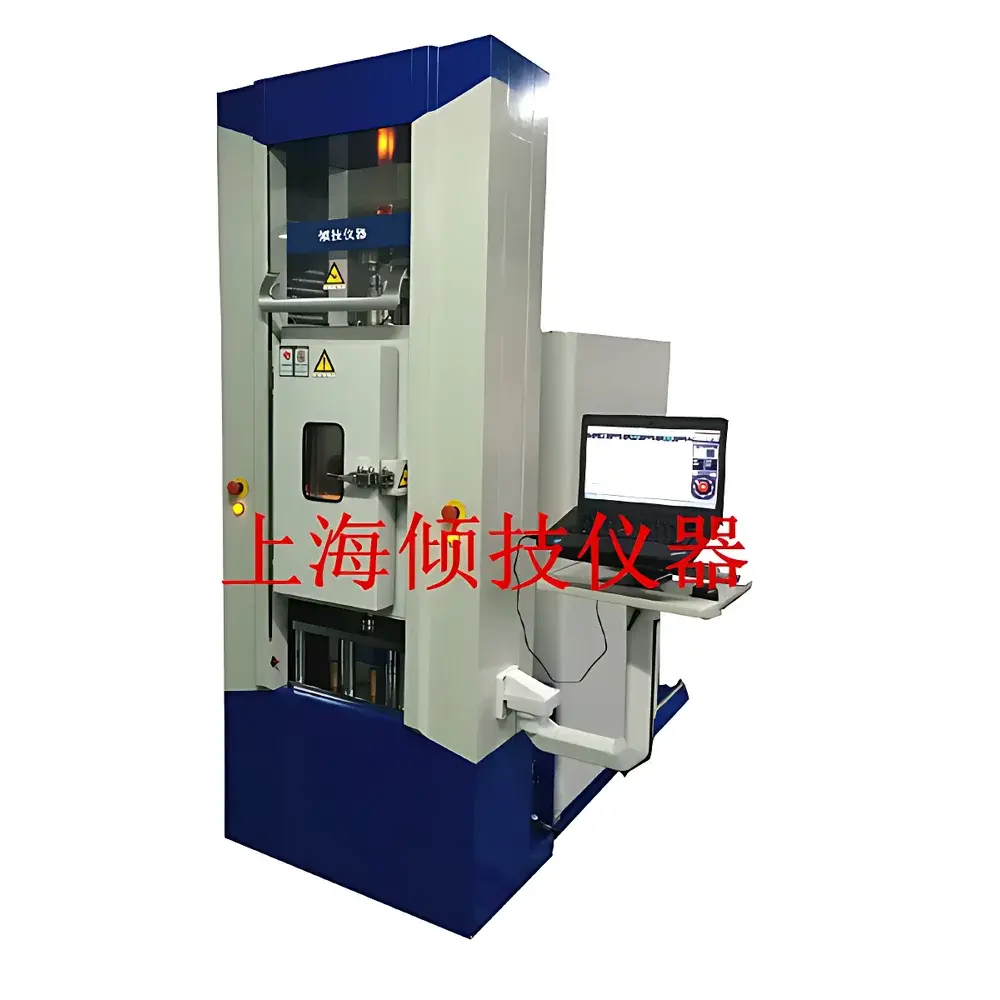
QJ216 Microcomputer-Controlled Electronic Universal Testing Machine with Integrated Low-Temperature Environmental Chamber
| Key | Origin: Shanghai, China |
|---|---|
| Manufacturer Type | Authorized Distributor |
| Origin Category | Domestic (PRC) |
| Model | QJ216 |
| Price | USD 11,200 (FOB Shanghai) |
| Load Capacity | 40 kN |
| Effective Test Width | 500 mm |
| Max. Tensile Travel | 600–800 mm (configurable) |
| Speed Range | 0.001–1000 mm/min |
| Speed Accuracy | ±1% of indicated value |
| Displacement Accuracy | ±0.2% of indicated value |
| Strain Measurement Accuracy | ±0.2% of indicated value |
| Force Resolution | ±1/250,000 full scale (constant across range) |
| Power Supply | 1.5 kW, 3-phase 380 V AC |
| Dimensions (W×D×H) | 960 × 650 × 2000 mm |
| Weight | 1200 kg |
Overview
The QJ216 Microcomputer-Controlled Electronic Universal Testing Machine with Integrated Low-Temperature Environmental Chamber is a dual-system instrumentation platform engineered for high-precision mechanical characterization of materials under controlled thermal conditions. It combines a servo-controlled electromechanical universal testing frame (40 kN capacity) with a fully integrated, independently regulated low-temperature environmental chamber—enabling static and dynamic mechanical testing (tensile, compression, flexure, peel, tear, shear, puncture, and low-cycle fatigue) across temperature ranges from –40 °C to +150 °C (chamber performance dependent on configuration). The system operates on a closed-loop PID control architecture, with real-time data acquisition synchronized between load cell, extensometer (optional), crosshead displacement, and chamber temperature sensors. All test protocols comply with fundamental metrological requirements defined in ISO 7500-1 (static calibration), ISO 5893 (dynamic testing), and ASTM E4 (load verification), ensuring traceability and repeatability in regulated laboratory environments.
Key Features
- High-resolution force measurement system with ±1/250,000 full-scale resolution maintained throughout the entire 0.5–40 kN operating range—no range switching or recalibration required.
- Bi-directional crosshead drive with dual-speed motor control (fast positioning and fine test-speed adjustment), supporting programmable ramp-hold profiles and cyclic loading sequences.
- Electronic limit switches and overload protection (110% FS cut-off) integrated into hardware safety interlock logic—compliant with EN ISO 13850 requirements for emergency stop functionality.
- Modular environmental chamber with forced-air circulation, platinum RTD temperature sensing (Class A tolerance), and independent PID temperature controller—capable of ramp rates up to 5 °C/min and steady-state stability of ±0.5 °C over 30 min at –40 °C.
- Windows-based control software with real-time multi-channel plotting, digital filtering (Butterworth IIR), and export-ready data formatting (CSV, XML, PDF reports).
- Full audit trail support: user login authentication, parameter change logging, test result timestamping, and electronic signature capability aligned with FDA 21 CFR Part 11 Annex 11 principles for GxP-compliant labs.
Sample Compatibility & Compliance
The QJ216 accommodates standard specimen geometries per ISO 6892-1 (tensile bars), ISO 178 (flexural test pieces), ASTM D638/D3039 (polymer composites), and ISO 1133 (melt flow index preforms). Grip systems include pneumatic wedge grips (up to 40 mm thickness), hydraulic vise clamps, and custom fixture interfaces (M6/M8 threaded mounting). The integrated chamber features a double-wall insulated viewport, internal sample lighting, and pass-through ports for extensometers or strain gauges. System validation documentation supports IQ/OQ protocols per ISO/IEC 17025:2017 and meets essential requirements for GLP and ISO 9001-certified quality systems. Calibration certificates are provided with NIST-traceable load cells and temperature sensors.
Software & Data Management
The proprietary Windows application delivers deterministic real-time control with sub-millisecond sampling intervals (up to 10 kHz). Users define test methods using hierarchical templates compliant with ISO 10360-5 (measurement uncertainty modeling) and generate automated reports including stress–strain curves, modulus calculation (secant/tangent/Young’s), yield point detection (0.2% offset), and statistical summaries (n ≥ 5 replicates). Raw data files store metadata (operator ID, chamber setpoint, ambient RH, calibration expiry) and support post-test reprocessing—including curve smoothing, baseline correction, and derivative analysis (dF/dt, dε/dt). Data archives are encrypted and version-controlled; backup routines integrate with network-attached storage (NAS) or cloud-synced repositories meeting GDPR and HIPAA data residency policies.
Applications
This system is routinely deployed in polymer R&D labs for cryogenic tensile behavior of PEEK, polyimide, and thermoplastic elastomers; in aerospace QA for aluminum alloy fracture toughness below –20 °C; in medical device manufacturing for validating suture tensile strength at simulated body temperature and hypothermic storage conditions; and in battery material development for evaluating separator membrane elongation at low SOC states. It also supports accelerated aging studies where mechanical degradation is coupled with thermal cycling (e.g., 500 cycles between –30 °C and +85 °C per ISO 16750-4), enabling correlation of microstructural changes (via post-test SEM/EDS) with macroscopic property loss.
FAQ
Does the low-temperature chamber operate independently from the testing frame controls?
Yes—the chamber uses a standalone industrial-grade controller with RS485 Modbus communication, allowing asynchronous temperature ramping while the frame executes mechanical protocols.
Can third-party extensometers be interfaced via analog or digital inputs?
Yes—two isolated analog input channels (±10 V, 16-bit ADC) and one TTL encoder interface support LVDTs, clip-on extensometers, and video-based DIC systems.
Is remote diagnostics and firmware updates supported?
Yes—secure SSH access and TLS-encrypted OTA update capability are available upon enterprise license agreement.
What is the typical lead time for factory acceptance testing (FAT)?
Standard FAT duration is 5 working days; optional witness testing by end-user representatives may extend this by 2 days.
Are CE and RoHS declarations available for export to EU markets?
Yes—full technical construction file (TCF), EC Declaration of Conformity, and RoHS 2011/65/EU compliance documentation accompany each shipment.



