
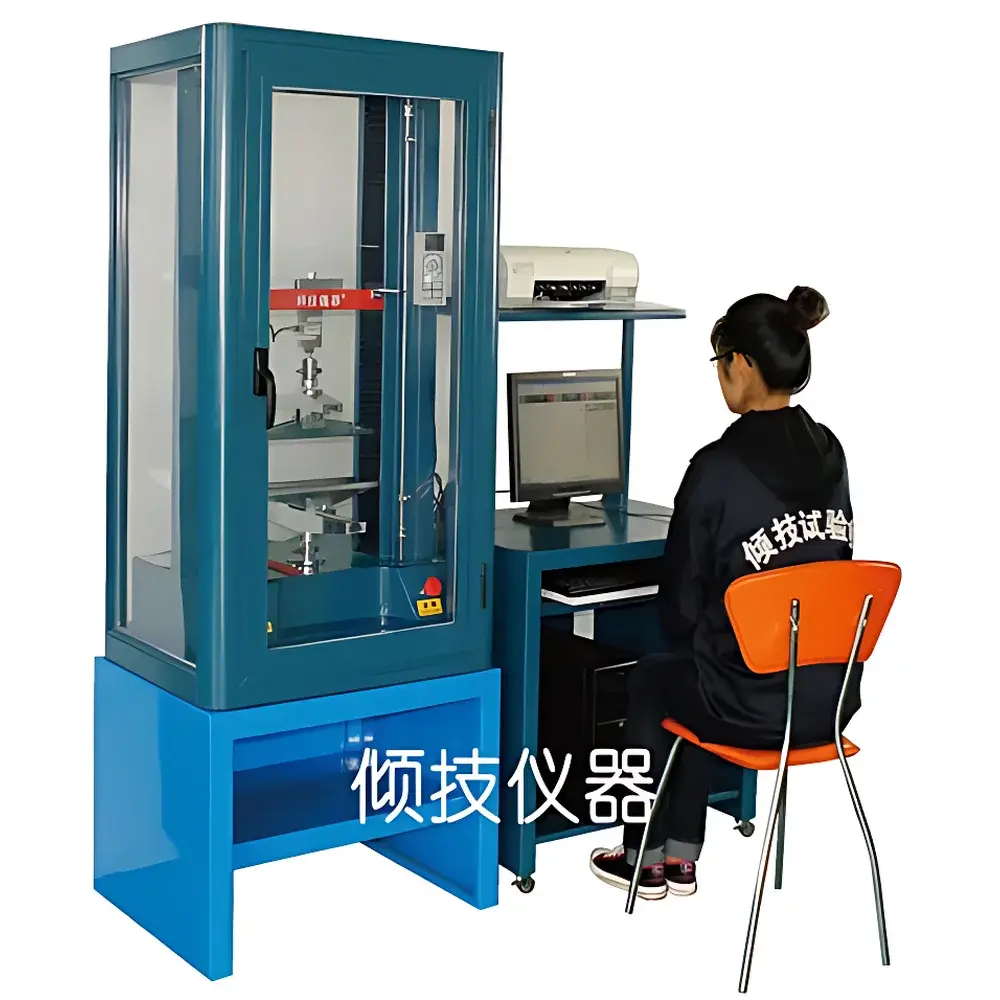
Qinji QJ211S Glass-Specific Three-Point & Four-Point Bending Tester
| Brand | Qinji |
|---|---|
| Origin | Shanghai, China |
| Model | QJ211S Glass-Specific |
| Max Load | 10 kN |
| Accuracy Class | 0.5 |
| Effective Test Width | 320 mm |
| Stroke (Tensile) | 500/800 mm |
| Speed Range | 0.01–300 mm/min |
| Speed Accuracy | ±0.5% of reading |
| Force Resolution | 500,000 counts (full-scale, no range switching) |
| Displacement Accuracy | ±0.5% of reading |
| Strain Measurement Accuracy | ±0.5% of reading |
| Load Cell | High-Precision U.S.-Sourced Sensor |
| Controller | Panasonic Full-Digital AC Servo System |
| Control Mode | Full-Digital Closed-Loop (Constant Load, Constant Displacement, Constant Strain) |
| Safety Protection | Software Diagnostics, Electronic Limit Switches, Overload Protection (110% FS), Automatic Return Post-Test |
| Weight | ~145 kg |
Overview
The Qinji QJ211S Glass-Specific Three-Point & Four-Point Bending Tester is an electromechanical universal testing system engineered for high-precision flexural characterization of brittle and semi-brittle planar substrates—particularly chemically strengthened glass used in consumer electronics displays, optical lenses, architectural glazing, and medical device covers. It operates on the fundamental principles of beam bending mechanics per ASTM C1499 (Standard Test Method for Monotonic Quasi-Static Flexural Strength of Advanced Ceramics at Ambient Temperature) and ISO 178 (Plastics — Determination of Flexural Properties), adapted for thin, rigid, isotropic glass plates with controlled edge conditions. Unlike general-purpose tensile testers, the QJ211S integrates geometry-optimized support and loading fixtures to minimize stress concentration artifacts and ensure compliance with standardized span-to-thickness ratios (e.g., 16:1 for four-point bending per ASTM C1499). Its dual-mode capability—switching between three-point (single-load-line) and four-point (two outer supports + two inner load points) configurations—enables differentiated evaluation of surface-dominated fracture initiation versus bulk-dominated flexural strength, critical for quality assurance in glass cover manufacturing.
Key Features
- High-fidelity force measurement system featuring a U.S.-sourced precision load cell with 500,000-count resolution across full 10 kN capacity—no range switching required, ensuring consistent signal fidelity from 0.02% to 100% of full scale.
- Full-digital closed-loop control architecture powered by a Panasonic AC servo motor and drive, enabling precise regulation of displacement rate (0.01–300 mm/min) with ≤±0.5% speed accuracy and real-time adaptive load compensation.
- Dual-mode mechanical fixture platform supporting rapid reconfiguration between three-point and four-point bending geometries without recalibration; all tooling conforms to ISO 178 and ASTM C1499 dimensional tolerances for support span, loading span, and roller radius.
- Integrated high-resolution displacement transduction and strain monitoring, both traceable to NIST-traceable references, with ≤±0.5% linearity error over full travel (500 mm standard / 800 mm optional).
- Comprehensive safety architecture including electronic hardware limit switches, software-based overload cutoff (triggered at 110% of rated load), automatic post-test return, and dual-mode emergency stop (mechanical + software).
- Modular夹具 design accommodating custom specimen dimensions (up to 320 mm effective test width); optional accessories include anti-slip ceramic-coated rollers, low-friction PTFE bearing inserts, and edge-support alignment gauges for repeatable positioning.
Sample Compatibility & Compliance
The QJ211S is validated for flat, transparent, non-porous substrates with thicknesses ranging from 0.3 mm to 6.0 mm and lateral dimensions up to 300 × 300 mm. It routinely tests alkali-aluminosilicate chemically strengthened glass (e.g., Gorilla Glass®, Dragon Trail™), soda-lime float glass, borosilicate optical glass, and tempered display panels. All test protocols align with internationally recognized standards including ASTM C1499 (four-point bending strength), ASTM C158 (breaking strength of glass), ISO 178 (flexural properties of plastics—adapted for glass analogues), GB/T 1042 (Chinese standard for glass flexural strength), JIS R3205, and EN 1288-3 (glass in building—determination of bending strength). The system’s control firmware and data audit trail support GLP-compliant operation when paired with validated PC software and calibrated peripherals.
Software & Data Management
The QJ211S runs on a Windows-based, full-featured test management suite that provides real-time graphical display of load–displacement, stress–strain, and deflection–time curves during active testing. All raw data—including time-stamped force, position, and calculated stress values—are stored in open CSV and XML formats for third-party analysis. The software implements configurable test templates compliant with ASTM and ISO reporting structures, supports multi-curve overlay, dynamic zoom/pan, point-and-click yield point detection, and automated report generation with embedded digital signatures. Audit trails record operator ID, calibration timestamps, parameter changes, and test start/stop events—meeting foundational requirements for FDA 21 CFR Part 11 readiness when deployed in regulated environments (e.g., medical glass qualification under ISO 10993-1).
Applications
- Quality control of smartphone and tablet cover glass batches for flexural strength consistency and defect sensitivity screening.
- Development validation of new ion-exchange strengthening processes by correlating surface compression depth with macroscopic bending resistance.
- Comparative evaluation of edge treatment methods (e.g., CNC grinding vs. laser polishing) on fracture initiation thresholds under four-point loading.
- Mechanical reliability assessment of laminated glass assemblies (e.g., touch sensor + cover glass stacks) under quasi-static flexure.
- Research into environmental degradation effects (humidity, thermal cycling) on long-term flexural performance using programmed cyclic bending protocols.
- Supporting failure analysis workflows via post-fracture fragment mapping and Weibull modulus calculation from grouped strength data sets.
FAQ
What standards does the QJ211S natively support for glass bending tests?
ASTM C1499, ASTM C158, ISO 178, GB/T 1042, JIS R3205, and EN 1288-3 are preconfigured in the software; custom test methods can be defined via editable parameter libraries.
Can the system perform tests other than bending?
Yes—when equipped with appropriate fixtures, it executes tensile, compression, shear, puncture, and peel tests per ASTM D638, D695, D5321, and D1876, maintaining 0.5-class accuracy across all modes.
Is the controller compatible with third-party DAQ or PLC integration?
The system provides RS232, Ethernet, and analog ±10 V output interfaces; Modbus TCP and EtherCAT protocol support is available via optional firmware upgrade.
How is traceability maintained for calibration and verification?
Each unit ships with a factory calibration certificate traceable to CNAS-accredited laboratories; internal verification routines include reference load cell checks and encoder linearity verification per ISO 7500-1.
What maintenance is required during routine operation?
Biannual lubrication of lead screws and visual inspection of roller surfaces; load cell and encoder recalibration recommended annually or after 10,000 test cycles, whichever occurs first.



