
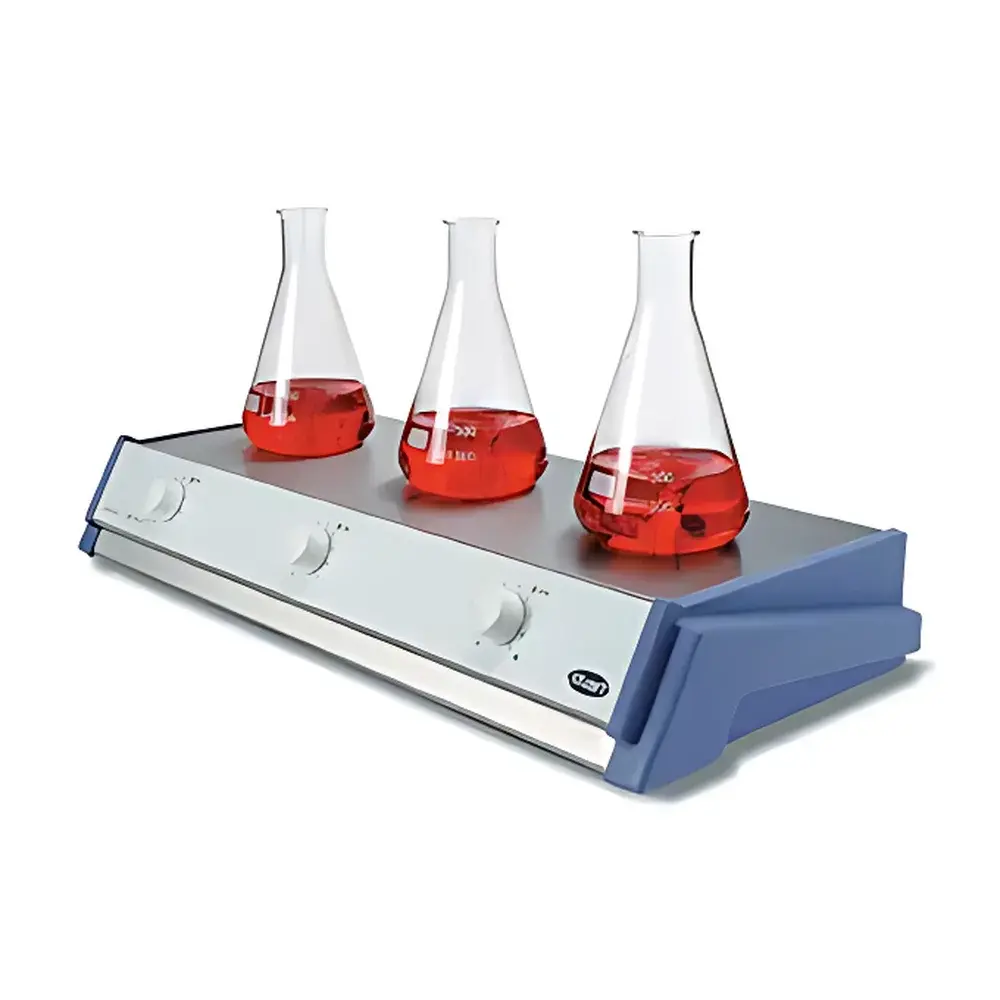
Stuart SB161-3 Triple Position Magnetic Stirrer
| Brand | Stuart |
|---|---|
| Origin | United Kingdom |
| Model | SB161-3 |
| Dimensions (W×D×H) | 600×270×110 mm |
| Heating Plate Size | 550×210 mm |
| Stirring Speed Range | 100–1500 rpm |
| Max. Stirring Volume | 15 L |
| Power Supply | 230 V / 50 Hz, 150 W |
| Net Weight | 7 kg |
| Material | Stainless Steel Top Plate |
| Control | Three Independent Speed Controls |
| Standard Accessories | Three 25 mm PTFE-coated Stir Bars |
Overview
The Stuart SB161-3 Triple Position Magnetic Stirrer is a compact, benchtop laboratory instrument engineered for simultaneous, independent magnetic stirring of up to three samples under consistent thermal and mechanical conditions. Designed around the principle of electromagnetic induction, the unit generates a rotating magnetic field beneath a non-magnetic stainless steel work surface—eliminating eddy current losses associated with aluminum plates and ensuring high-efficiency torque transfer to PTFE-coated stir bars. Unlike single-position or shared-control multi-stirrers, the SB161-3 integrates three isolated drive circuits, each powering its own permanent magnet array. This architecture enables precise speed regulation across all positions without cross-interference, supporting reproducible mixing in applications ranging from buffer preparation and reagent dissolution to kinetic reaction monitoring and culture media conditioning.
Key Features
- Three fully independent speed controls—each with dedicated digital adjustment and LED speed indication—allow concurrent operation at distinct rotational speeds (100–1500 rpm) without signal coupling or load imbalance.
- Electropolished stainless steel top plate (550 × 210 mm heated zone within a 600 × 270 mm footprint) provides superior corrosion resistance, thermal stability, and optimized magnetic flux density versus conventional aluminum surfaces.
- High-torque magnet drive system delivers consistent agitation in vessels up to 2 L per position, with verified performance up to 15 L total volume when using standard 25 mm PTFE stir bars and appropriate vessel geometry.
- Bench-friendly form factor (600 × 270 × 110 mm) maximizes workspace efficiency while maintaining structural rigidity and vibration damping—critical for long-duration, low-noise stirring protocols.
- 150 W power rating supports stable operation under continuous load; integrated thermal cutoff protection prevents overheating during extended use or accidental dry-heating scenarios.
Sample Compatibility & Compliance
The SB161-3 accommodates standard laboratory glassware including round-bottom flasks (up to 2 L), beakers, and graduated cylinders. Its open-platform design allows unrestricted access for pH probes, temperature sensors, or reflux condensers. The stainless steel surface is compatible with common solvents (e.g., water, ethanol, acetone, dilute acids/bases) and withstands routine cleaning with isopropanol or mild detergent solutions. While the unit does not include integrated heating control, its heated plate complies with IEC 61010-1:2010 safety requirements for electrical equipment used in laboratory environments. No CE marking is required for non-heating-only configurations; however, the full assembly (heater + stirrer) bears UKCA certification for conformity with GB/EN 61010-1. The device meets general GLP documentation standards for equipment qualification when deployed in regulated workflows—its discrete control channels facilitate individual calibration records per position.
Software & Data Management
The SB161-3 operates as a standalone analog-electronic instrument with no embedded firmware, network interface, or data logging capability. Speed settings are manually adjusted via front-panel rotary dials with tactile feedback and 10-rpm resolution. For laboratories requiring audit trails or electronic recordkeeping, external validation tools—including calibrated tachometers, digital RPM loggers, or time-lapse video analysis—may be employed to document operational parameters. When integrated into validated systems (e.g., USP compounding suites or ISO 17025-accredited testing labs), users typically establish written procedures defining acceptable speed tolerances (±25 rpm), calibration frequency (semi-annual or per-use verification), and maintenance checks (magnet alignment, surface flatness, electrical insulation resistance).
Applications
- Parallel preparation of multiple buffer solutions or calibration standards in QC/QA laboratories.
- Simultaneous dissolution testing of pharmaceutical excipients across varying pH or ionic strength conditions.
- Controlled mixing during enzymatic assays where temperature-sensitive reactions demand uniform agitation without mechanical shear.
- Environmental sample homogenization prior to filtration or extraction—particularly in EPA Method-compliant water analysis workflows.
- Teaching laboratories requiring robust, low-maintenance instrumentation for undergraduate chemistry and biology curricula.
FAQ
Does the SB161-3 include a built-in temperature controller?
No—the unit features a heated plate but lacks integrated temperature sensing or PID regulation. Users must pair it with an external thermometer and manual adjustment or use it in non-heated mode.
Can I use non-PTFE stir bars with this stirrer?
Stainless steel or ceramic stir bars may be used, but PTFE-coated bars are recommended for chemical compatibility, reduced wear, and optimal magnetic coupling at higher speeds.
Is the stainless steel surface resistant to hydrochloric acid exposure?
Brief incidental contact is tolerated; however, prolonged exposure to concentrated HCl requires immediate rinsing with deionized water to prevent pitting corrosion.
What is the minimum recommended vessel bottom thickness for effective coupling?
Glassware with bottom thickness ≤ 8 mm ensures reliable magnetic transmission; thicker-walled reactors (e.g., jacketed vessels) may require larger-diameter stir bars or reduced maximum speed.
How often should the unit undergo preventive maintenance?
Inspect magnets and surface integrity quarterly; verify electrical grounding and insulation resistance annually per ISO/IEC 17025 Clause 6.4.4 guidelines.



