
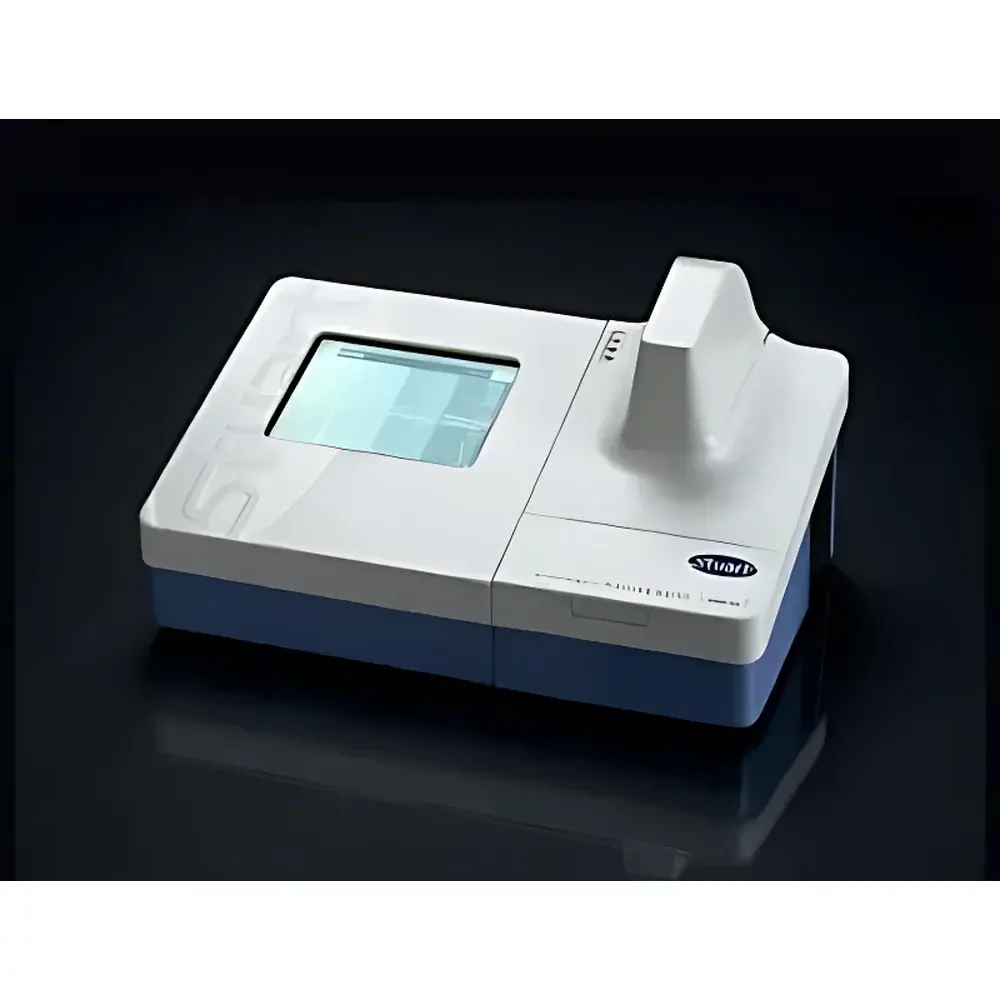
Stuart SMP40 Automated Melting Point Apparatus
| Brand | Stuart |
|---|---|
| Origin | United Kingdom |
| Model | SMP40 |
| Temperature Range | Ambient to 400 °C |
| Temperature Resolution | 0.1 °C |
| Heating Rate | 0.1–10 °C/min (adjustable in 0.1 °C increments) |
| Cooling Time (350 °C → 50 °C) | ≤10 min |
| Heating Time (50 °C → 350 °C) | ≤6 min |
| Sample Capacity | 3 capillaries simultaneously |
| Display | 5.7″ color VGA touchscreen |
| Sensor | PT100 platinum resistance thermometer |
| Data Storage | 200 measurement records with embedded AVI video |
| Compliance | Pharmacopoeial standards (USP <741>, EP 2.2.14, JP 2.60), GLP-ready, includes traceable calibration certificate |
| Dimensions (W×D×H) | 175 × 210 × 328 mm |
| Net Weight | 3.2 kg |
| Power Supply | 230 V / 50 Hz / 60 W |
| Capillary Storage Compartment | Yes |
| Glass Tool Storage Compartment | Yes |
| Antimicrobial Surface Coating | Biocote® silver-ion technology |
Overview
The Stuart SMP40 Automated Melting Point Apparatus is a precision-engineered thermal analysis instrument designed for reliable, repeatable, and pharmacopeia-compliant determination of solid-phase transition temperatures. Utilizing digital image analysis coupled with high-stability PT100 temperature sensing, the SMP40 captures real-time optical changes during sample melting—detecting onset, clear point, and interval endpoints with 0.1 °C resolution across a broad operational range (ambient to 400 °C). Its core methodology aligns with standardized visual-melting principles defined in USP , European Pharmacopoeia 2.2.14, and Japanese Pharmacopoeia 2.60, ensuring regulatory acceptability in QC laboratories supporting pharmaceutical development, raw material release, and stability studies. Unlike analog or semi-automated units, the SMP40 integrates closed-loop thermal control, synchronized video capture, and intelligent orientation-aware display—making it suitable for both benchtop and fume hood environments without compromising measurement integrity.
Key Features
- Triple-sample capacity enables parallel analysis of up to three capillaries per run—enhancing throughput while maintaining inter-sample comparability under identical thermal ramp conditions.
- 5.7″ color VGA touchscreen with auto-orientation detection supports ergonomic operation in both landscape and portrait modes—ideal for seated or standing workflows within constrained lab spaces.
- Integrated Biocote® antimicrobial coating on all external surfaces reduces microbial colonization risk—critical for GMP-aligned environments where equipment hygiene directly impacts data credibility.
- Modular split-body architecture physically isolates the heating block and optical chamber from the control unit—facilitating flexible placement inside chemical fume hoods and minimizing thermal cross-talk during rapid heating/cooling cycles.
- Dedicated storage compartments for pre-filled capillaries (200-unit capacity) and glass cutting tools ensure procedural consistency and reduce handling errors during routine sample preparation.
- Full video recording (AVI format) synchronized with temperature profiles allows retrospective validation of melt behavior—including recrystallization, decomposition, or polymorphic transitions not discernible from endpoint-only data.
Sample Compatibility & Compliance
The SMP40 accepts standard 1.0 mm OD glass capillaries (supplied in three configurations: double-sealed, single-sealed, and open-ended), compatible with crystalline organic compounds, APIs, excipients, polymers, and metallurgical reference standards. All measurements are traceable via a factory-issued calibration certificate referencing NIST-traceable reference materials and instrument-specific serial number. The system meets Good Laboratory Practice (GLP) requirements through audit-ready data logging—including timestamps, operator ID (via optional network integration), ramp parameters, and video metadata. It supports 21 CFR Part 11 readiness when deployed with validated third-party LIMS or ELN platforms—ensuring electronic records retain integrity, authenticity, and long-term retrievability.
Software & Data Management
Data acquisition and review are managed locally via the embedded touchscreen interface. Each measurement record stores temperature-time curves, annotated melt points, and full-resolution AVI video (up to 200 sessions). Export occurs via USB 2.0 to FAT32-formatted flash drives using Microsoft ActiveSync-compatible protocols—enabling direct import into Excel, MATLAB, or validated QA databases. No proprietary software installation is required on host PCs. Video playback functionality is built-in, permitting immediate verification of sample homogeneity, bubble formation, or discoloration events that may indicate degradation prior to melting. All stored files include embedded EXIF metadata: instrument ID, date/time stamp, user-defined sample ID, and thermal program parameters.
Applications
- Pharmaceutical quality control: Release testing of active pharmaceutical ingredients (APIs) and finished dosage forms per ICH Q5A and Q6A guidelines.
- Chemical synthesis validation: Monitoring purity and batch-to-batch consistency of intermediates and final products.
- Academic research: Polymorph screening, eutectic mixture characterization, and thermal stability assessment of novel crystalline materials.
- Regulatory submissions: Generating compliant melting point data packages for FDA, EMA, and PMDA filings—particularly where visual documentation strengthens analytical justification.
- Materials science: Characterizing phase transitions in organic semiconductors, metal-organic frameworks (MOFs), and specialty waxes.
FAQ
Does the SMP40 comply with pharmacopoeial requirements for melting point determination?
Yes—the SMP40 conforms to USP , Ph. Eur. 2.2.14, and JP 2.60 methods, including specifications for temperature accuracy, ramp rate control, and visual endpoint interpretation.
Can video recordings be exported and archived externally?
Yes—recordings are saved as standard AVI files and transferable via USB to any Windows- or macOS-based system without proprietary codecs.
Is calibration traceable to national standards?
Each unit ships with a UKAS-accredited calibration certificate referencing NIST-traceable reference substances and instrument-specific serial identification.
What safety features prevent operator exposure during high-temperature operation?
The integrated polycarbonate safety shield protects against accidental contact with the heated block; the split-body design further isolates thermal mass from the user interface.
How does the Biocote® coating contribute to laboratory compliance?
Biocote® reduces surface microbial load by >99.99% against common lab contaminants (e.g., E. coli, S. aureus), supporting ISO 14644-1 cleanroom practices and internal hygiene SOPs.



