
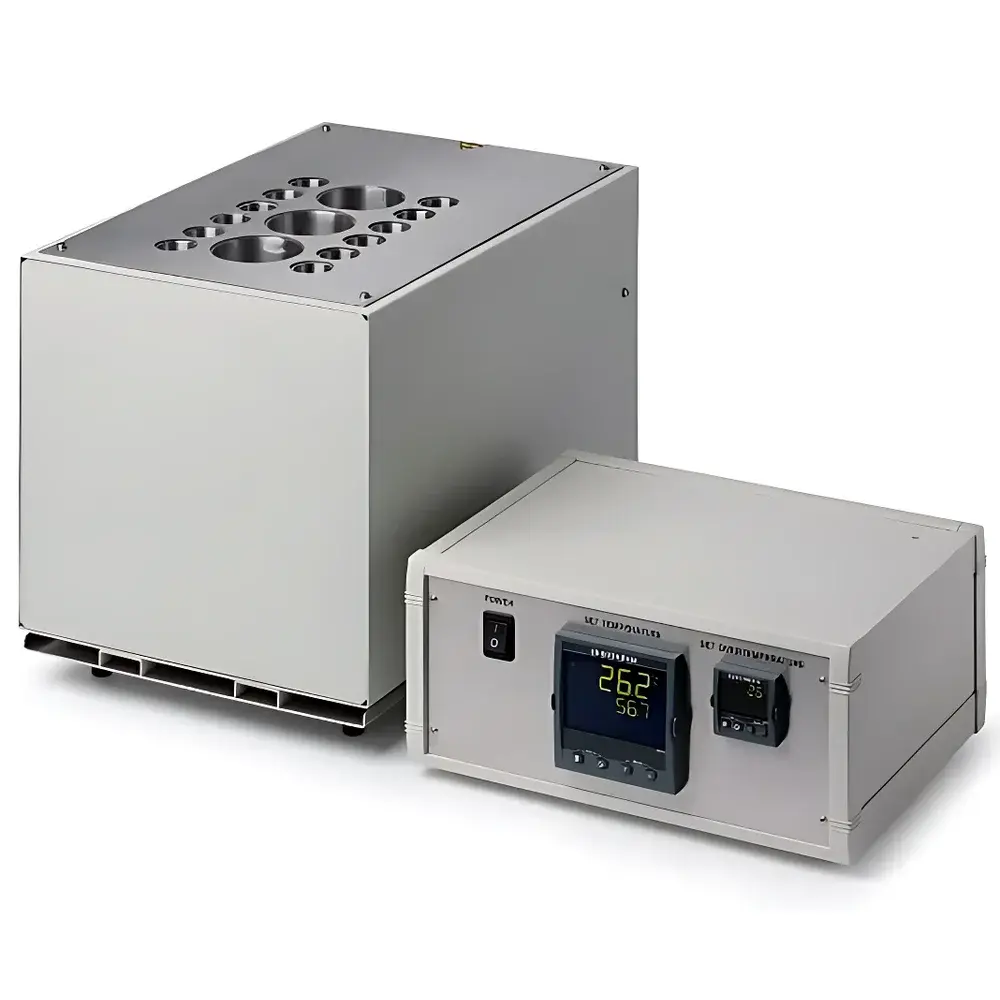
Grant BT-MOD1 Oil Aging Tester
| Brand | Grant |
|---|---|
| Origin | United Kingdom |
| Manufacturer Type | Authorized Distributor |
| Origin Category | Imported |
| Model | BT-MOD1 |
| Product Category | Laboratory Instrument |
| Test Scope | Oxidative Stability Assessment of Aviation Lubricants and Fuels |
| Compliance | UK Defence Standard 05-50 Part 61 (Gas Turbine Engine Synthetic Lubricants) |
| Temperature Range | Ambient +10 °C to 450 °C |
| Temperature Display Resolution | 0.1 °C |
| Module Temperature Uniformity | ±0.5 °C |
| Heating Capacity | 2500 W @ 230 V, 50/60 Hz |
| Control Unit Dimensions (L×W×H) | 290 × 261 × 150 mm |
| Heating Module Dimensions (L×W×H) | 460 × 310 × 275 mm |
| Operating Ambient | 10–35 °C |
| Safety Features | Dual-stage overtemperature cut-off with visual alarm (red LED flash) |
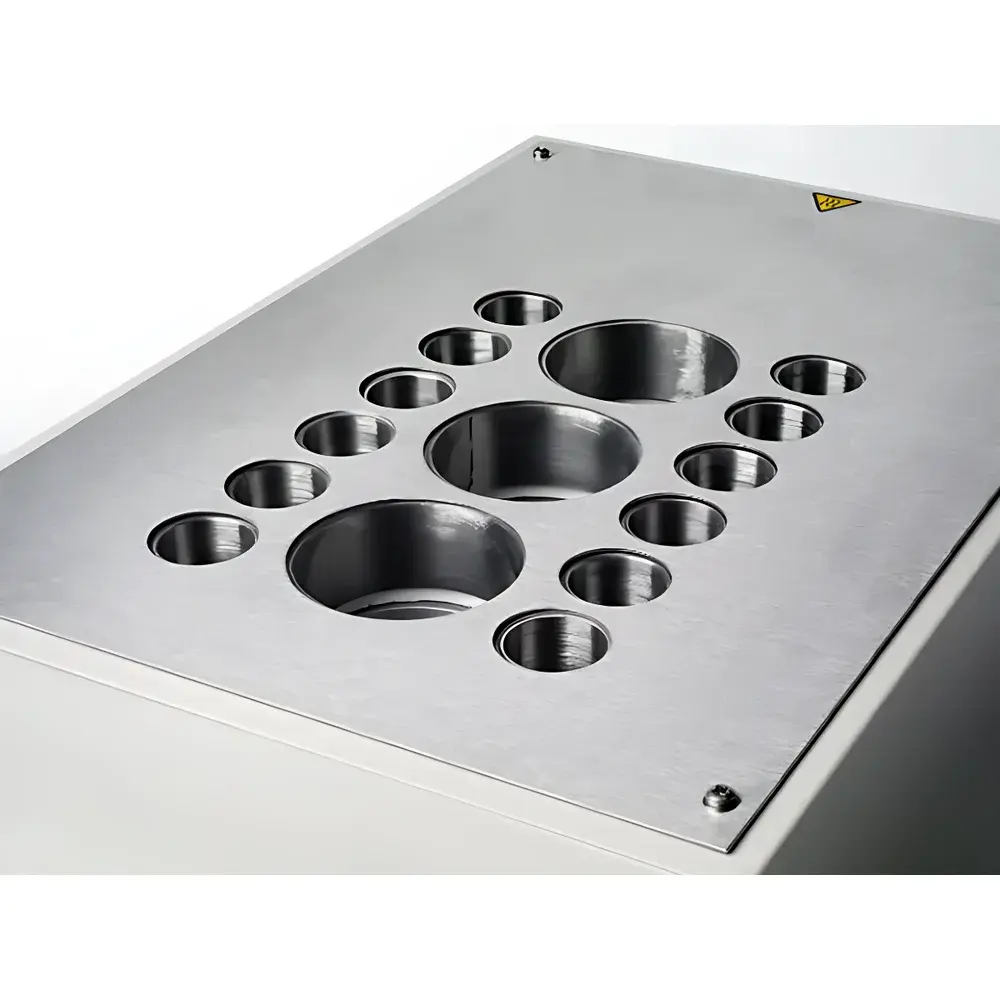
| Sample Configuration Options | 3 × Ø57 mm × 140 mm deep test vessels OR 12 × Ø28.5 mm × 140 mm deep air-cooled condenser tubes with oxidation induction ports |
Overview
The Grant BT-MOD1 Oil Aging Tester is a precision-engineered laboratory instrument designed specifically for accelerated oxidative stability testing of synthetic lubricants and aviation fuels under rigorously controlled thermal conditions. It operates on the principle of forced-air convection heating within calibrated, thermally isolated modules—enabling reproducible simulation of long-term thermal degradation pathways observed in gas turbine engine environments. Developed in strict accordance with UK Defence Standard 05-50 Part 61, the BT-MOD1 supports standardized evaluation protocols referenced in Defence Standards 1, 3, 9, 14, and 22—particularly those governing oxidation resistance, deposit formation, and volatility behavior of synthetic hydrocarbon and polyol ester-based lubricants. Its architecture reflects decades of collaboration between Grant Instruments and major UK aerospace engine manufacturers, ensuring compatibility with legacy and next-generation propulsion system qualification workflows.
Key Features
- Triple-zone modular heating platform supporting simultaneous testing of three large-diameter (Ø57 mm) sample vessels or twelve narrow-bore (Ø28.5 mm) oxidation-induction tubes with integrated air-cooled condensers
- Digital PID temperature control delivering ±0.5 °C uniformity across each heating module and 0.1 °C display resolution over a full operating range of ambient +10 °C to 450 °C
- Fail-safe dual-stage overtemperature protection: primary electronic cut-off at user-defined limit; secondary mechanical thermal fuse with red LED alarm indication
- Electromechanically isolated heating elements and ceramic-insulated chamber design minimize thermal cross-talk and ensure clean, contaminant-free test environments
- Compact benchtop footprint (control unit: 290 × 261 × 150 mm; heating module: 460 × 310 × 275 mm) optimized for ISO 17025-accredited laboratories and defence contractor QA labs
- Compliance-ready configuration: pre-validated against DEF STAN 05-50 Part 61 Annexes A, A.1, and A.2—including airflow calibration, thermal ramp profiling, and condensate recovery verification
Sample Compatibility & Compliance
The BT-MOD1 accommodates a broad spectrum of petroleum-derived and synthetically formulated fluids including polyalphaolefins (PAOs), diesters, triesters, and alkylated naphthalenes used in military and civil aviation applications. Its test vessel geometry and airflow dynamics are validated for use with ASTM D943 (RBOT), ASTM D2272 (RBOI), and modified DEF STAN 05-50 Part 61 procedures. The instrument meets essential requirements for GLP-compliant operation, including traceable temperature calibration (NPL-traceable reference sensors), audit-ready parameter logging, and physical safeguards against unintended thermal excursion. While not inherently 21 CFR Part 11 compliant, its digital control interface supports integration with validated LIMS platforms for electronic record retention in regulated aerospace MRO and OEM validation settings.
Software & Data Management
The BT-MOD1 operates via embedded microcontroller-based firmware with front-panel LED interface—designed for deterministic, low-interference operation in electromagnetically sensitive test bays and hangar environments. All temperature setpoints, dwell times, and thermal ramp profiles are stored in non-volatile memory with timestamped execution logs. Optional RS-232 or USB-to-serial interface enables connection to external data acquisition systems for automated reporting in accordance with MIL-STD-810G environmental test documentation frameworks. Raw thermal history files export in CSV format for post-processing using MATLAB, Python pandas, or commercial statistical analysis tools aligned with ISO/IEC 17025 Clause 7.7 data integrity requirements.
Applications
- Oxidative stability screening of synthetic turbine oils per DEF STAN 05-50 Part 61 and NATO AEP-82
- Deposit-forming tendency assessment in hydraulic fluids under sustained high-temperature exposure
- Volatility and evaporation loss quantification in jet fuel thermal management systems
- Accelerated aging studies for life-cycle prediction of lubricants in turboshaft and turbofan engines
- Qualification testing of alternative aviation fuels (SAF) and bio-derived ester blends under military specification constraints
- Supporting R&D efforts in Department of Defence (UK), MoD contractors, Rolls-Royce, Safran, and QinetiQ certified test facilities
FAQ
What standards does the BT-MOD1 explicitly support?
The instrument is engineered and verified for compliance with UK Defence Standard 05-50 Part 61, including referenced test methods in Defence Standards 1, 3, 9, 14, and 22, as well as Annexes A, A.1, and A.2.
Can the BT-MOD1 be used for ASTM D943 or D2272 testing?
Yes—its thermal uniformity, airflow control, and sample geometry meet the core apparatus requirements of both ASTM D943 (Rotating Bomb Oxidation Test) and ASTM D2272 (Rotating Pressure Vessel Oxidation Index), though users must implement method-specific accessories and procedural adaptations.
Is calibration certification included with delivery?
Each unit ships with a factory calibration certificate traceable to UK National Physical Laboratory (NPL) standards, covering temperature uniformity, display accuracy, and overtemperature cut-off thresholds.
What maintenance is required for long-term operational reliability?
Annual verification of thermal uniformity and sensor drift is recommended; no routine consumables are required—the heating elements and insulation are rated for >10,000 hours of continuous operation at 400 °C.
Does the BT-MOD1 support remote monitoring or network integration?
Native Ethernet or Wi-Fi is not provided; however, serial interface output allows integration with SCADA or LabVIEW-based monitoring systems via third-party protocol converters compliant with IEC 61131-3.





