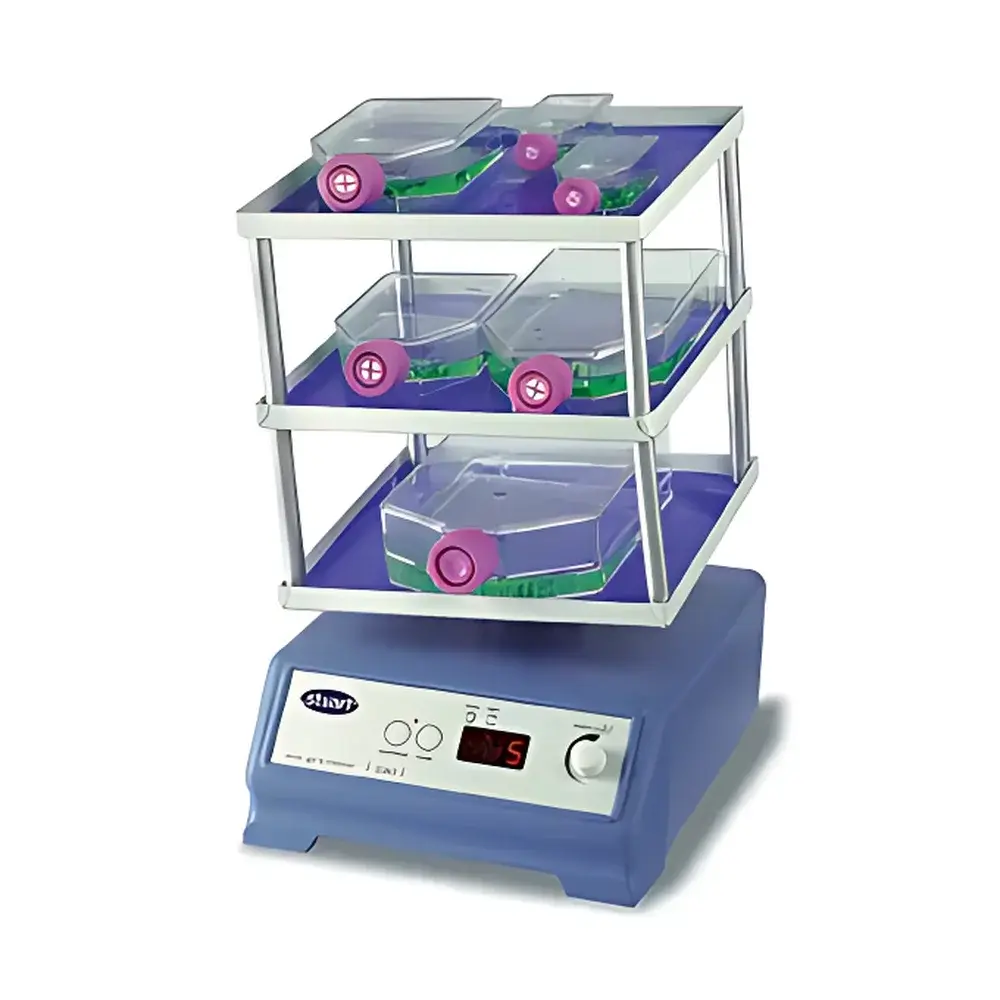
Stuart SSM3 & SSM4 Compact 3D Orbital and Rocking Shakers
| Brand | Stuart |
|---|---|
| Origin | United Kingdom |
| Model | SSM3, SSM4 |
| Shaking Motion | 3D orbital (SSM3) / Reversible rocking (SSM4) |
| Platform Dimensions | 235 × 235 mm |
| Speed Range | 5–70 rpm |
| Tilt Angle | 3–12° (SSM3, manually adjustable) / 7° fixed (SSM4) |
| Max Load Capacity | 3 kg per platform |
| Operating Temperature | +4 °C to 40 °C |
| Humidity Limit | ≤80% RH |
| Dimensions (W×D×H) | 240 × 300 × 165 mm (SSM3), 240 × 300 × 150 mm (SSM4) |
| Layer Height | 125 mm |
| Power Supply | 230 V / 50 Hz, 50 W |
| Net Weight | 5 kg |
| Multi-tier Compatibility | Yes (SSM3/1 kit supports up to 2 platforms) |
Overview
The Stuart SSM3 and SSM4 are compact, benchtop-compatible shakers engineered for precision-controlled agitation in life science laboratories. Designed for integration into incubators, cold rooms, or standard lab workspaces, these instruments deliver gentle yet reproducible motion profiles optimized for sensitive biological applications—including nucleic acid extraction, blotting procedures (Western, Southern, Northern), cell culture maintenance, and immunoassay plate washing. The SSM3 employs a true 3D orbital motion—generating uniform circular displacement with variable tilt angle—to minimize foam formation and ensure homogeneous mixing of low-volume samples in tubes, microplates, and small flasks. In contrast, the SSM4 utilizes a controlled reversible rocking motion that induces laminar wave-like fluid displacement ideal for adherent cell cultures in T-flasks, Petri dishes, and multiwell plates. Both models operate within a tightly regulated thermal envelope (+4 °C to 40 °C), making them suitable for use inside CO₂ incubators without compromising temperature stability or condensation control.
Key Features
- Digitally controlled speed (5–70 rpm) and timer (up to 99 h 59 min), each adjusted via precision optical encoder knobs and displayed on a high-contrast LCD screen
- Non-slip silicone-coated platform surface ensures secure positioning of tubes, microplates, and culture vessels during operation
- Tool-free modular stacking system (SSM3/1 accessory kit) enables rapid assembly of dual-platform configurations—increasing sample throughput threefold while maintaining consistent motion dynamics across layers
- Magnetic interlock mechanism secures stacked platforms at precisely 125 mm vertical intervals, eliminating mechanical drift or misalignment under load
- Robust die-cast aluminum housing and brushless DC motor architecture ensure long-term reliability, low acoustic emission (<45 dB(A)), and minimal heat dissipation
- Compliance with IEC 61000-6-3 (EMC emission) and IEC 61000-6-2 (immunity) standards for laboratory-grade electromagnetic compatibility
Sample Compatibility & Compliance
The SSM3 and SSM4 accommodate standard laboratory containers including 1.5–50 mL conical tubes, 96-well PCR plates, 6–24-well cell culture plates, T-25/T-75 flasks, and glass or polymer Petri dishes. Each platform supports up to 3 kg distributed load with center-of-gravity tolerance ≤20 mm off-center—validated per ISO 8573-1:2010 for mechanical stability under dynamic loading. Units conform to EN 61010-1:2013 safety requirements for electrical equipment used in laboratory environments and carry CE marking under the EU Low Voltage Directive (2014/35/EU) and EMC Directive (2014/30/EU). Optional documentation packages support GLP-compliant validation, including IQ/OQ protocols aligned with FDA 21 CFR Part 11 data integrity expectations for electronic records.
Software & Data Management
While the SSM3 and SSM4 operate as standalone instruments with embedded firmware, their digital control interface supports audit-trail-capable parameter logging when connected to external data acquisition systems via RS-232 (optional adapter). All setpoints—speed, time, and tilt position (SSM3)—are retained in non-volatile memory across power cycles. Firmware updates are delivered through Stuart’s certified service network and include version-stamped change logs traceable to ISO/IEC 17025-accredited calibration reports. For laboratories implementing LIMS integration, Stuart provides ASCII-formatted serial output specifications enabling direct parsing of runtime status (e.g., “RUNNING|SPEED=42|RPM|TIME_REMAINING=01:23:45”) into validated data pipelines.
Applications
- DNA/RNA isolation workflows requiring low-shear mixing to preserve fragment integrity
- Membrane-based transfer steps (electrophoretic or capillary blotting) where uniform buffer exchange is critical
- Maintenance of suspension cultures (e.g., hybridomas, insect cells) in roller bottles or shaker flasks
- Antibody-antigen binding kinetics studies in microplate format under controlled agitation
- Fixation and staining protocols for histology and immunocytochemistry where gravitational sedimentation must be mitigated
- Pre-analytical sample homogenization prior to HPLC, ELISA, or flow cytometry analysis
FAQ
Can the SSM3 and SSM4 be operated inside a CO₂ incubator?
Yes—both models are rated for continuous operation at ambient temperatures from +4 °C to 40 °C and relative humidity up to 80%, with no condensation-sensitive electronics exposed.
Is the tilt angle on the SSM3 truly adjustable during operation?
No—the 3–12° tilt is manually set prior to startup using the calibrated locking ring; real-time adjustment is not supported to maintain mechanical resonance stability.
What is the maximum stack height achievable with the SSM3/1 multi-tier kit?
The kit includes eight support pillars and two platforms, permitting a total of three levels (base + two stacked), with 125 mm spacing between each plane.
Does Stuart provide validation documentation for GMP environments?
Yes—upon request, Stuart supplies IQ/OQ templates, factory calibration certificates (traceable to UKAS), and risk assessments compliant with Annex 11 and PIC/S TR 13 guidelines.
Are replacement platforms or silicone mats available as spare parts?
Yes—Stuart part numbers SSM-PLAT (platform) and SSM-MAT (anti-slip mat) are stocked globally and shipped with full RoHS/REACH declarations.