
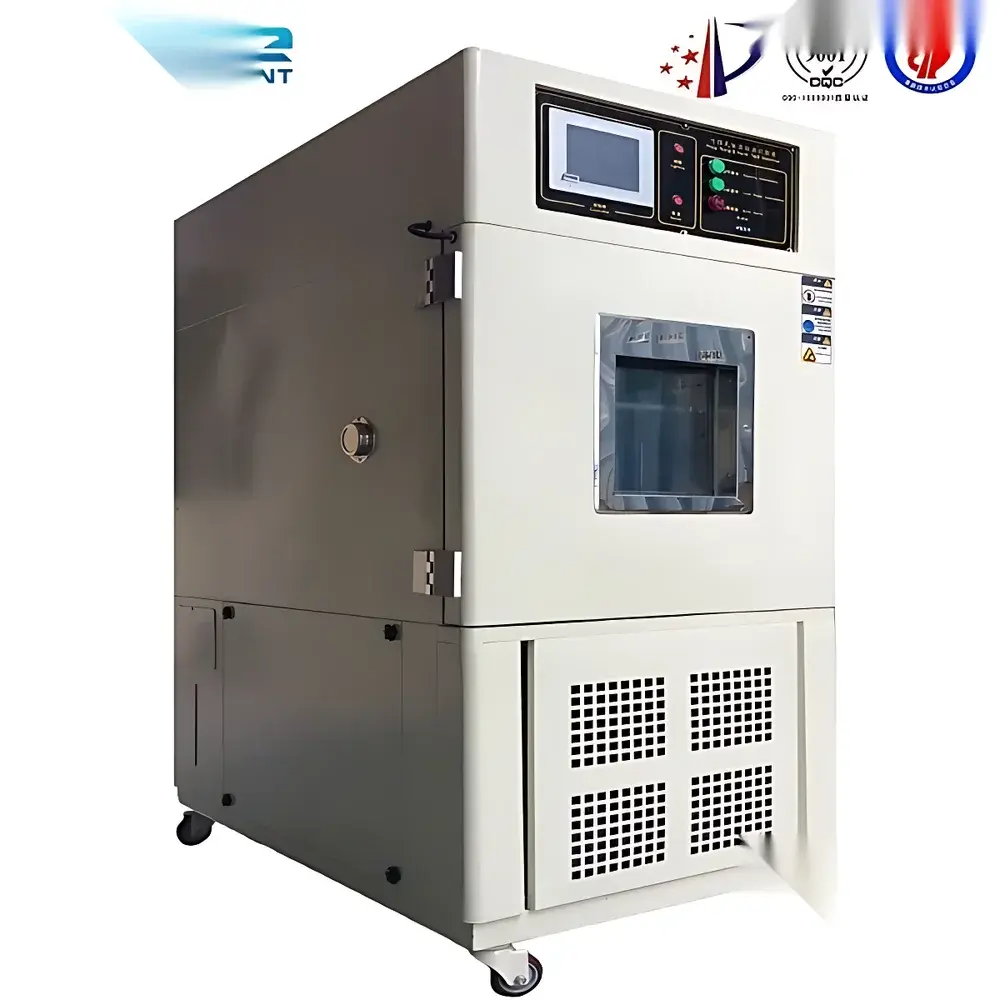
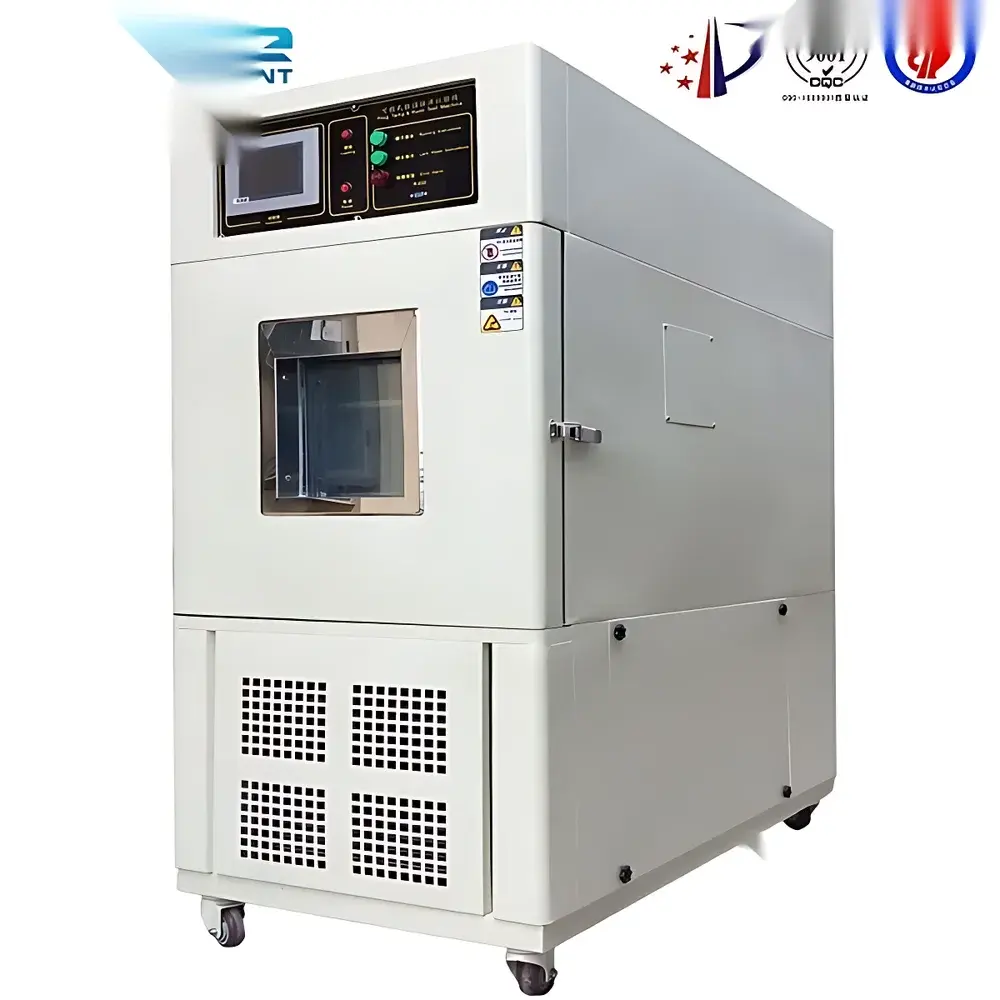
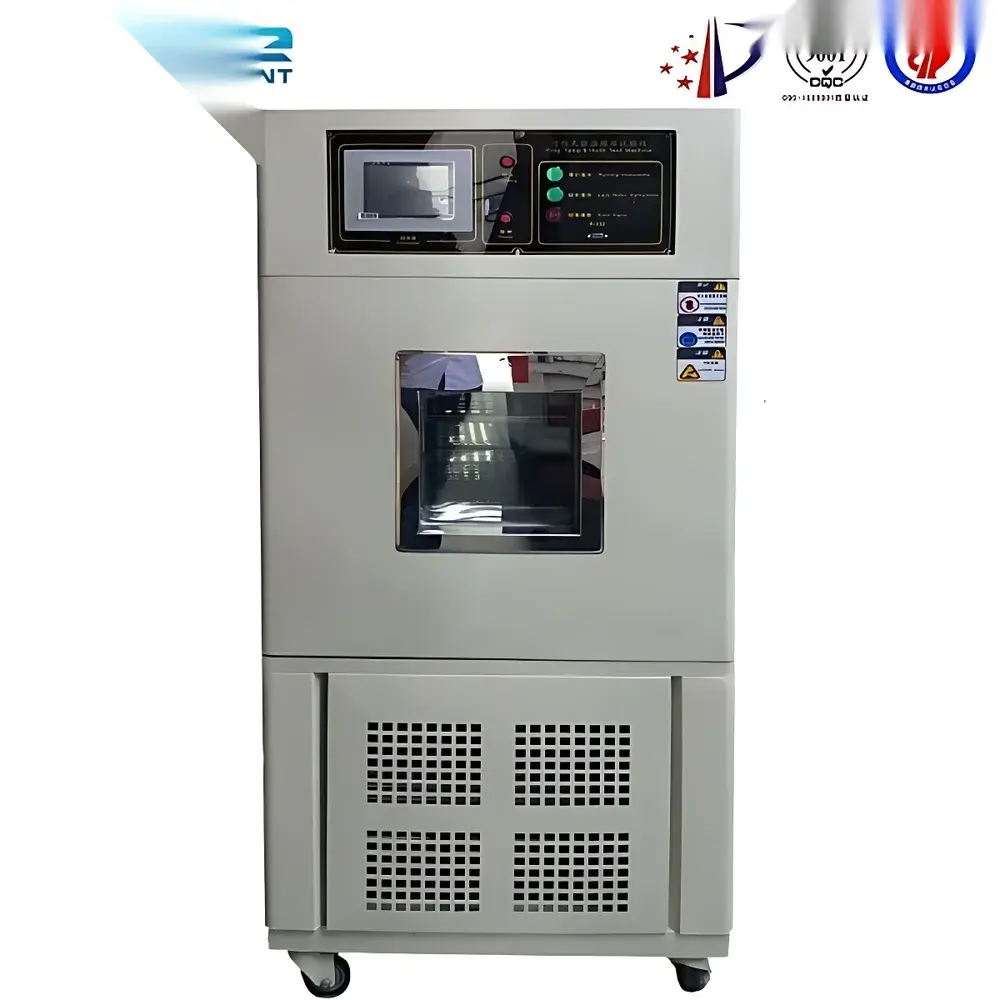
Navigation Instrument Testing Programmable Temperature and Humidity Environmental Test Chamber
| Brand | OEM / Private Label |
|---|---|
| Origin | Imported |
| Manufacturer Type | Authorized Distributor |
| Price | USD 2,650 (FOB) |
| Internal Dimensions (W×H×D, cm) | 40×50×40 to 100×100×100 |
| External Dimensions (W×H×D, cm) | 100×165×100 to 180×200×180 |
| Temperature Range | -70 °C to +150 °C (configurable in 4 grades) |
| Humidity Range | 20–98 %RH (optional 5–98 %RH) |
| Temperature Uniformity | ±0.5 °C |
| Humidity Uniformity | ±2.5 %RH |
| Temperature Fluctuation | ±2 °C |
| Humidity Fluctuation | +2–3 %RH |
| Resolution | 0.1 °C / 0.1 %RH |
| Ramp Rate | Heating ~4.0 °C/min |
| Refrigerant | R404A/R23 (ozone-friendly) |
| Construction Material | SUS#304 stainless steel (inner & outer chamber) |
| Viewing Window | Multi-layer tempered glass with conductive ITO film |
| Port | One Ø50 mm test port (left side) |
| Power Supply | AC 380 V ±5 %, 50 Hz ±0.5 Hz, 3-phase 5-wire |
Overview
The Navigation Instrument Testing Programmable Temperature and Humidity Environmental Test Chamber is an engineered environmental simulation system designed for rigorous reliability validation of navigation-grade electronic assemblies—including inertial measurement units (IMUs), GNSS receivers, AHRS modules, and integrated avionics subsystems. It operates on the principle of forced-air convection combined with precision vapor compression refrigeration and steam-based humidification, enabling stable, repeatable control of temperature and relative humidity across wide operational envelopes. Unlike general-purpose climate chambers, this model incorporates structural and interface features specifically aligned with MIL-STD-810G, DO-160G Section 4 (Temperature), Section 5 (Altitude), and Section 10 (Humidity) test requirements—making it suitable for pre-compliance screening and qualification-level testing in aerospace, defense, and high-integrity automotive electronics development labs.
Key Features
- Programmable microprocessor-based controller with full-color 7-inch capacitive touchscreen, supporting seamless English/Chinese language switching and intuitive multi-segment profile programming (up to 999 cycles, 999 steps per cycle)
- Double-gasketed door seal using high-tensile, high-temperature silicone rubber ensures chamber integrity under thermal shock and low-humidity conditions (leak rate < 0.5 Pa·m³/s per ISO 10110-7)
- SUS#304 stainless steel interior and exterior construction—electropolished finish minimizes particulate shedding and corrosion susceptibility during extended high-humidity exposure
- Multi-layer insulated observation window with embedded transparent ITO (indium tin oxide) heating film prevents condensation and maintains optical clarity throughout dynamic humidity transitions
- Dual-stage refrigeration system utilizing environmentally compliant R404A (low-temp stage) and R23 (ultra-low-temp cascade stage), optimized for rapid thermal transition without compressor overload or refrigerant migration
- Integrated safety architecture including over-temperature cut-off, humidity sensor failure detection, refrigerant pressure monitoring, and real-time fault logging with automatic power disconnection
Sample Compatibility & Compliance
The chamber accommodates navigation instruments up to 100 cm × 100 cm × 100 cm (internal volume: 1000 L), with standard Ø50 mm feedthrough port positioned on the left wall for signal/power cabling—compatible with MIL-DTL-38999 and AS50151 connector routing. Optional accessories include stainless steel adjustable shelves (SUS#304, load-rated 25 kg per shelf), castor wheels with locking brakes, and leveling feet for vibration-isolated floor mounting. The system complies with key international test standards including: GJB 150.3A–2009 (High Temperature), GJB 150.4A–2009 (Low Temperature), IEC 60068-2-1 (Cold), IEC 60068-2-2 (Dry Heat), IEC 60068-2-78 (Steady-State Damp Heat), and IEC 60068-2-30 (Cyclic Damp Heat). Calibration traceability follows ISO/IEC 17025 requirements, with optional NIST-traceable certificate documentation available upon request.
Software & Data Management
The embedded controller supports data logging at user-defined intervals (1 s to 60 min resolution) with internal storage for ≥30 days of continuous 1-second sampling. Export formats include CSV and Excel-compatible .xls files via USB 2.0 interface. Remote monitoring and profile management are enabled through Ethernet (TCP/IP) connectivity, compatible with LabVIEW™ drivers and Modbus TCP protocol for integration into centralized test automation platforms. Audit trail functionality meets GLP and GMP requirements per FDA 21 CFR Part 11—supporting user authentication, electronic signatures, and immutable event logs for temperature/humidity deviations, operator actions, and alarm history.
Applications
This chamber is routinely deployed in: environmental stress screening (ESS) of MEMS-based gyroscopes and accelerometers; thermal cycling validation of GPS/GLONASS/Galileo antenna modules; humidity-induced drift assessment of barometric altimeters; accelerated life testing of ruggedized UAV flight controllers; and verification of thermal management performance in satellite attitude determination systems. Its programmable ramp-and-soak profiles support complex test sequences such as MIL-STD-810G Method 502.5 (Temperature Shock), Method 506.6 (Rain), and Method 507.6 (Humidity)—all executed within a single chamber without manual intervention.
FAQ
What temperature and humidity ranges are supported for navigation instrument qualification testing?
Standard configurations cover −70 °C to +150 °C and 20–98 %RH; extended humidity range (5–98 %RH) and ultra-low temperature (−80 °C) options are available upon engineering review.
Is the chamber compatible with real-time telemetry during operation?
Yes—via the integrated Ethernet port and Modbus TCP interface, live temperature/humidity readings, setpoint status, and alarm flags can be streamed to external SCADA or MES systems.
How is calibration maintained over long-term use?
The system includes dual independent PT100 sensors (chamber air and wall-mounted) with auto-compensation logic; annual recalibration against NIST-traceable references is recommended and supported by certified service partners.
Can custom mechanical interfaces be added for specialized navigation hardware?
Yes—custom feedthroughs (e.g., RF coaxial, fiber-optic, vacuum-rated), internal mounting rails, and vibration-damped sub-chambers can be engineered per customer specifications.
Does the controller support compliance reporting for regulatory submissions?
Yes—the built-in report generator produces PDF-formatted test records containing timestamps, deviation summaries, pass/fail annotations, and digital signature fields compliant with ISO 17025 and FDA 21 CFR Part 11 Annex 11 requirements.



