
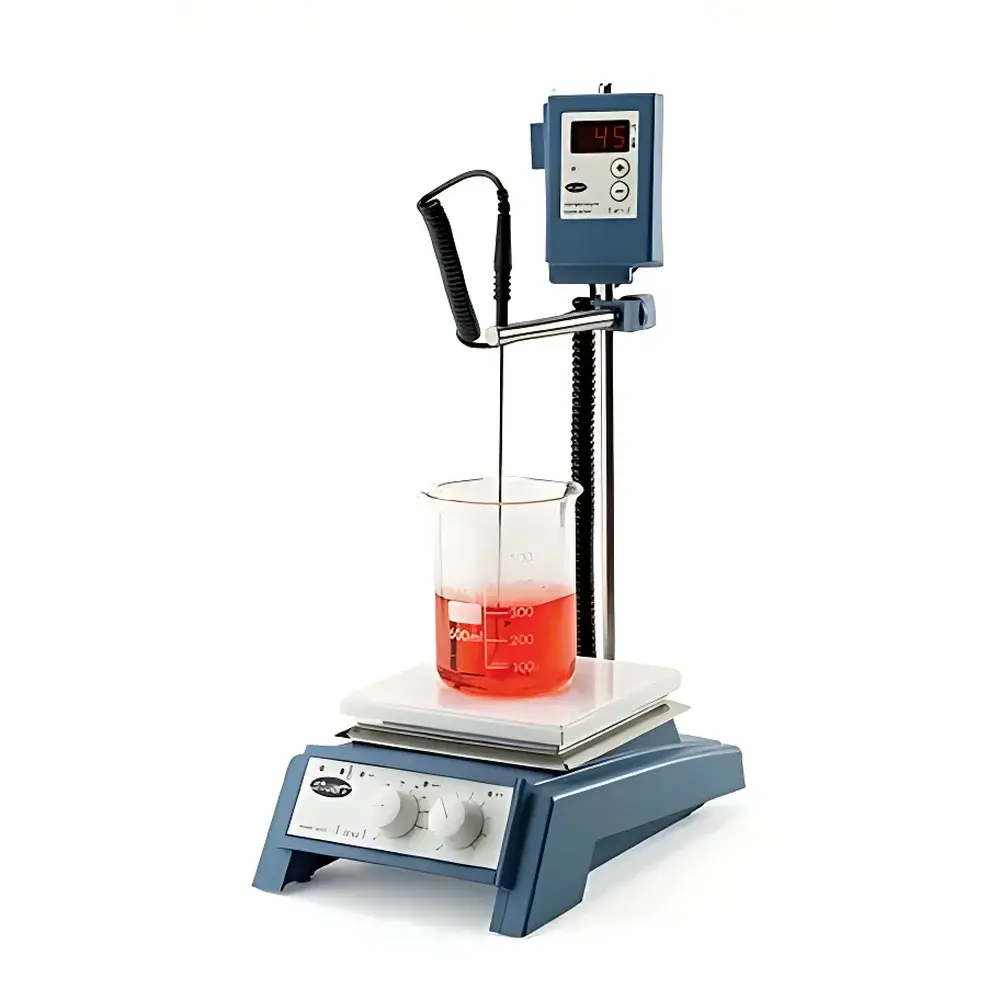
Stuart CC162 & SC162 Temperature-Sensing Magnetic Hotplate Stirrers
| Brand | Stuart |
|---|---|
| Origin | United Kingdom |
| Model | CC162 & SC162 |
| Top Plate Material | Glass-Ceramic (CC162) / Al-Si Alloy (SC162) |
| Heating Plate Dimensions | 160 × 160 mm |
| Effective Heating Area | 120 × 120 mm (CC162), 160 × 160 mm (SC162) |
| Stirring Speed Range | 100–1500 rpm |
| Max. Stirring Volume | 15 L |
| Heating Power | 500 W (CC162), 700 W (SC162) |
| Max. Plate Temperature | 450 °C (CC162), 325 °C (SC162) |
| External Dimensions | 190 × 300 × 110 mm |
| Net Weight | 3.4 kg |
| Power Supply | 230 V, 50 Hz |
| Compatible Controller | SCT1 Digital Contact Temperature Controller |
| Safety Features | Overheat Protection Circuit, Thermal Runaway Prevention, Splash-Resistant Housing, Visual “HOT” LED Indicator (>50 °C) |
Overview
The Stuart CC162 and SC162 are precision-engineered magnetic hotplate stirrers designed for demanding laboratory environments where simultaneous temperature control, robust mixing performance, and operational safety are critical. These instruments operate on the principle of electromagnetic induction to drive magnetic stir bars within vessels while delivering uniform conductive heating via integrated resistive elements. Unlike basic hotplates, both models feature intelligent thermal sensing architecture—when paired with the optional SCT1 digital contact temperature controller, they enable closed-loop feedback regulation based on direct sample temperature measurement rather than plate surface temperature alone. This configuration significantly improves thermal accuracy and reproducibility across applications requiring strict thermal protocols, such as dissolution testing, buffer equilibration, or polymerization initiation.
Key Features
- Two distinct top-plate configurations: CC162 employs a high-purity glass-ceramic surface offering exceptional chemical resistance (including HF, strong acids/bases) and thermal stability up to 450 °C; SC162 utilizes a cast aluminum-silicon alloy plate optimized for rapid heat transfer and mechanical durability at sustained temperatures up to 325 °C.
- Independent dual-circuit safety architecture: A dedicated overtemperature protection circuit monitors internal electronics and plate temperature independently from the main control system, preventing thermal runaway in case of controller failure or sensor disconnection.
- Real-time thermal status indication: An amber LED labeled “HOT” illuminates whenever the top-plate surface exceeds 50 °C—regardless of power state—to alert users during cooldown phases or accidental re-energization.
- High-torque brushless motor delivering consistent stirring performance from 100 to 1500 rpm, capable of homogenizing viscous solutions and suspensions up to 15 L in volume using standard PTFE-coated stir bars.
- Splash-resistant chassis design with sloped edges directs spilled liquids away from the control panel and ventilation slots, enhancing long-term reliability in wet-lab settings.
- All internal PCBs and connectors are conformally coated to resist corrosion from ambient humidity and incidental chemical vapor exposure—critical for shared instrumentation suites handling diverse reagents.
Sample Compatibility & Compliance
The CC162 and SC162 support a broad range of vessel geometries—including round-bottom flasks, beakers, and crystallization dishes—up to 150 mm in diameter. Their compatibility extends to common labware materials (borosilicate glass, PTFE, PP, and quartz), provided appropriate stir bar selection and speed calibration are applied. Both units comply with IEC 61010-1:2010 for electrical safety in laboratory equipment and meet EMC requirements per EN 61326-1:2013. When operated with the SCT1 controller and calibrated probe (SCT1/1 or SCT1/2), the system supports GLP-compliant temperature documentation workflows, including timestamped setpoint logging and deviation alerts—enabling traceability required under FDA 21 CFR Part 11 when integrated into validated processes.
Software & Data Management
While the CC162 and SC162 operate as standalone analog-controlled devices, their integration with the SCT1 digital temperature controller introduces essential data governance capabilities. The SCT1 provides real-time display of measured sample temperature, setpoint, and deviation; stores up to 100 sequential temperature readings with timestamps; and supports manual export via RS232 interface (optional cable required). Audit trail functionality includes user-initiated parameter changes, probe insertion detection events, and thermal alarm triggers—all recorded with date/time stamps. For laboratories implementing electronic lab notebooks (ELN) or LIMS, the SCT1’s ASCII-based serial output can be parsed programmatically for automated ingestion into quality management systems.
Applications
These hotplate stirrers are routinely deployed in analytical chemistry labs for buffer preparation and pH adjustment, in pharmaceutical QC for dissolution media conditioning, and in materials science for nanoparticle dispersion and sol-gel synthesis. The CC162’s glass-ceramic surface is preferred for corrosive reagent handling (e.g., concentrated HNO₃ digestions), whereas the SC162’s higher wattage and superior thermal conductivity make it suitable for rapid ramping of large-volume aqueous systems. Both models serve as core components in ASTM E2913-22 (Standard Practice for Determination of Viscosity Using Rotational Viscometers) pre-conditioning workflows and USP dissolution apparatus calibration procedures.
FAQ
Can the CC162 or SC162 maintain precise sample temperature without the SCT1 controller?
No—these units regulate only plate surface temperature in standalone mode. Accurate sample temperature control requires the SCT1 with a compatible probe (SCT1/1 or SCT1/2) to close the feedback loop.
Is the SCT1 controller compatible with third-party probes?
No—the SCT1 is calibrated exclusively for use with Stuart-branded probes (SCT1/1 stainless steel or SCT1/2 PTFE-shielded) to ensure NIST-traceable accuracy within ±0.5 °C.
What is the maximum recommended vessel height for stable stirring at 1500 rpm?
For optimal vortex formation and torque transmission, vessel height should not exceed 2.5× the internal diameter; e.g., ≤125 mm for a 50 mm ID beaker.
Do these units support continuous operation at maximum temperature?
Yes—both models are rated for uninterrupted duty cycles at their respective max plate temperatures, provided ambient conditions remain within 15–35 °C and relative humidity stays below 80% non-condensing.
How often does the SCT1 require recalibration?
Stuart recommends annual verification against a NIST-traceable reference thermometer; field recalibration is not user-serviceable and must be performed by an authorized service center.



