
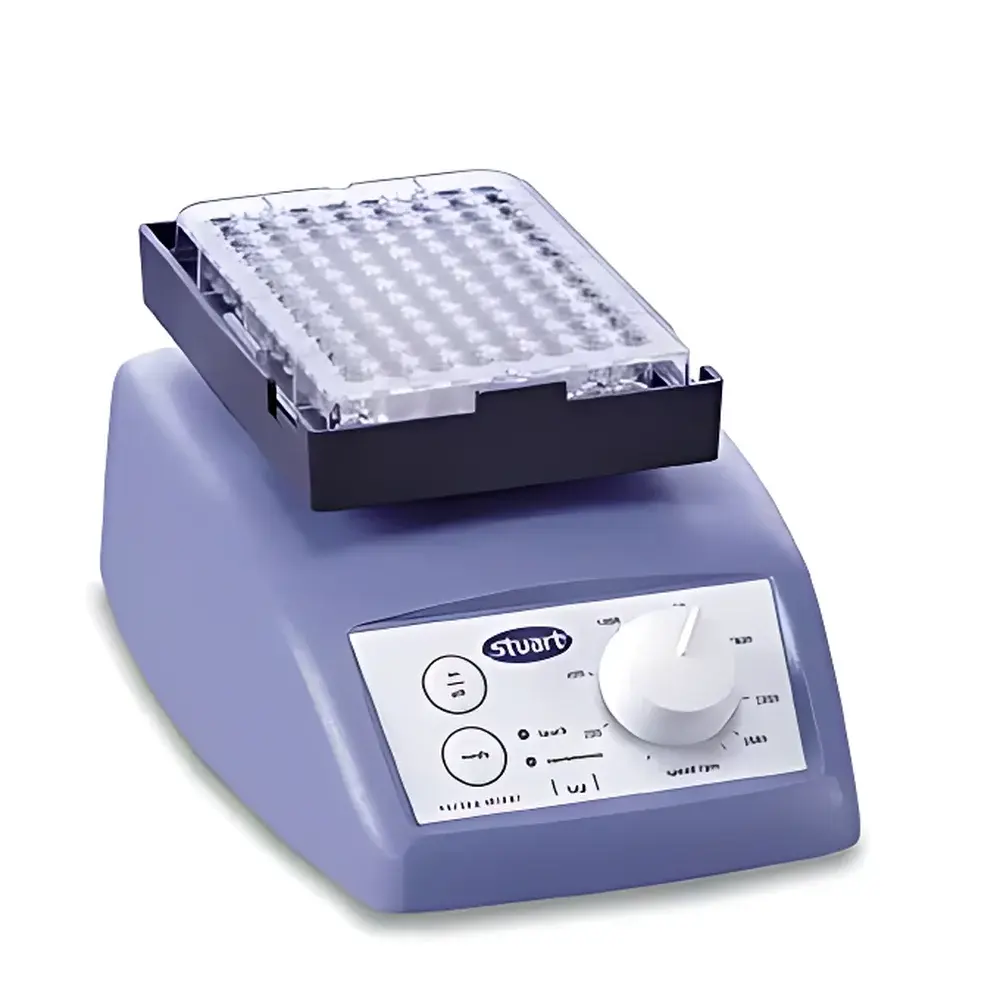
Stuart SA8 Advanced Variable-Speed Vortex Mixer
| Brand | Stuart |
|---|---|
| Origin | United Kingdom |
| Model | SA8 |
| Speed Range | 250–2500 rpm |
| Orbital Diameter | 4.2 mm |
| Operating Modes | Touch-Activated & Continuous |
| Dimensions (W×D×H) | 135 × 215 × 78 mm |
| Net Weight | 3.2 kg |
| Power Supply | 90–240 V, 50/60 Hz, 20 W |
| Compliance | CE, RoHS, UKCA |
| Accessories Available | SR2 Rod Holder (300 mm × 12.5 mm), SA8 Accessory Kit (microplate stand, 500 mL foam cup, multi-tube foam tray for 0.2/0.5/1.5 mL tubes, custom solid foam block) |
Overview
The Stuart SA8 Advanced Variable-Speed Vortex Mixer is an engineered solution for reproducible, high-efficiency sample homogenisation in research, clinical, and quality control laboratories. Based on the principle of orbital shaking—where a motor-driven eccentric drive generates controlled circular motion—the SA8 delivers consistent vortexing across a broad speed range (250–2500 rpm) with a fixed orbital displacement of 4.2 mm. This mechanical design ensures uniform energy transfer to samples in tubes, vials, microplates, and flasks without requiring manual intervention or repeated repositioning. Its compact footprint (135 × 215 × 78 mm) and low power consumption (20 W) make it suitable for benchtop integration in ISO 17025-accredited labs, GLP-compliant QC environments, and biosafety cabinets where space and thermal management are constrained.
Key Features
- Two operational modes: “Touch” mode for momentary activation upon downward pressure—ideal for quick checks or intermittent mixing—and continuous mode for unattended incubation-compatible protocols.
- Robust all-metal chassis with chemical-resistant polymer housing, enabling wipe-down decontamination between runs and compatibility with common lab disinfectants (e.g., 70% ethanol, 0.5% sodium hypochlorite).
- Integrated SR2 rod holder (optional but recommended for extended operation) provides stable vertical alignment for conical tubes and culture flasks up to 500 mL, minimising vibration-induced noise and positional drift.
- Digitally calibrated speed control with fine-resolution adjustment ensures repeatable rotational output—critical for applications requiring defined shear history, such as DNA shearing pre-library prep or immunoassay plate reconstitution.
- No external cooling or forced ventilation required; thermally stable motor design maintains consistent performance over multi-hour runs at maximum speed.
Sample Compatibility & Compliance
The SA8 accommodates a wide range of container formats via its modular accessory system. The standard SA8 Accessory Kit includes a rigid microplate stand (for 96-well plates), a contoured foam cup (for beakers and Erlenmeyer flasks ≤500 mL), and a dual-density foam tray supporting simultaneous processing of eight 0.2 mL PCR tubes, eight 0.5 mL microtubes, and sixteen 1.5 mL centrifuge tubes. All accessories are autoclavable (121 °C, 20 min) and compliant with ISO 8573-1 Class 3 compressed air purity requirements when used in cleanroom workflows. The device meets CE, UKCA, and RoHS directives and is designed to operate within ambient conditions specified by IEC 61010-1 (indoor use, pollution degree 2, overvoltage category II). It does not require validation under FDA 21 CFR Part 11, though audit trails for speed settings and runtime can be documented manually per GLP Annex 11 guidelines.
Software & Data Management
The SA8 operates as a standalone hardware platform with no embedded firmware, network interface, or proprietary software dependency. Speed selection and mode switching are performed via tactile rotary dial and momentary-contact switch—eliminating configuration drift, firmware updates, or cybersecurity vulnerabilities. For laboratories implementing electronic lab notebooks (ELN) or LIMS integration, operating parameters (speed, duration, mode) may be logged manually or via external time-lapse video capture synchronized with sample metadata. While the unit itself does not generate digital audit trails, its mechanical simplicity supports straightforward IQ/OQ/PQ qualification per ASTM E2500-13 and ISO/IEC 17025:2017 Clause 6.4.1 (equipment verification).
Applications
- Re-suspension of lyophilised reagents and cell pellets prior to downstream analysis (e.g., flow cytometry, ELISA, qPCR).
- Homogenisation of viscous biological matrices—including sputum, stool suspensions, and tissue homogenates—in diagnostic microbiology workflows.
- Pre-analytical mixing of whole blood samples with anticoagulants (EDTA, citrate) to prevent clot formation during transport or storage.
- Uniform dispersion of nanoparticles in aqueous colloids for DLS or TEM sample preparation.
- Standardisation of mixing steps in ISO/IEC 17025 method validations where inter-operator variability must be eliminated.
FAQ
Is the SA8 compatible with 15 mL and 50 mL conical centrifuge tubes?
Yes—when used with the optional SR2 rod holder, the SA8 securely grips tubes up to 50 mL height and stabilises them during continuous operation at speeds ≥1500 rpm.
Can the SA8 be operated inside a cold room or refrigerated incubator?
It is rated for operation between 5–40 °C and relative humidity ≤80% non-condensing. Prolonged use below 10 °C may reduce motor torque response; verify performance at target temperature during installation qualification.
Does the SA8 support programmable timed runs?
No—it lacks built-in timing functionality. For time-controlled protocols, external digital timers or integrated LIMS-triggered start/stop signals (via relay interface kits, sold separately) are recommended.
What maintenance is required for long-term reliability?
Annual inspection of the eccentric drive coupling and cleaning of the rubber cup surface with isopropyl alcohol is sufficient. No lubrication or recalibration is necessary under normal usage conditions.
Is the SA8 suitable for GMP-regulated manufacturing environments?
Yes—as a Class I electrical device with documented mechanical repeatability and minimal failure modes, it is routinely deployed in API intermediate blending and QC release testing per ICH Q7 Annex 19. Full validation documentation packages are available upon request from Stuart’s technical support team.



