
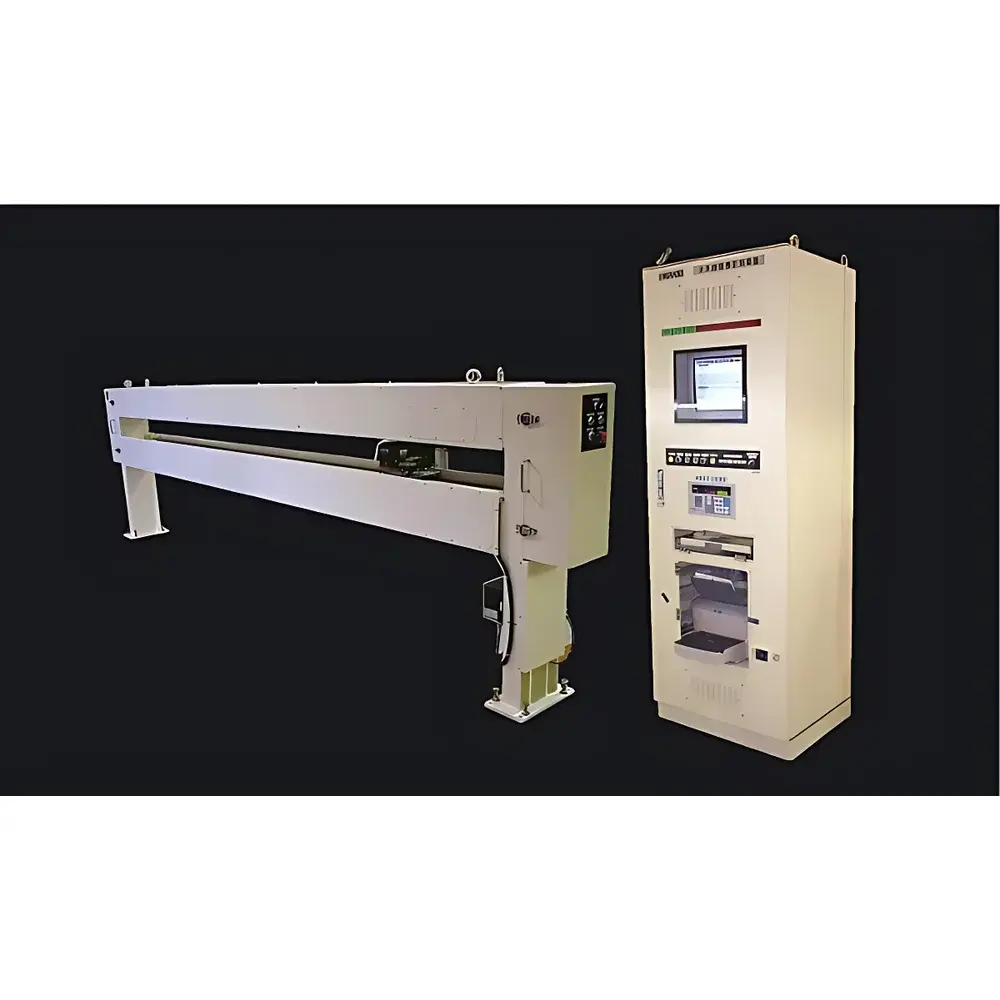
KURABO RX-350 Online Infrared Oil Film Thickness Gauge
| Brand | KURABO |
|---|---|
| Origin | Japan |
| Model | RX-350 |
| Measurement Principle | P-polarized three-wavelength diffuse reflectance infrared absorption |
| Measurement Range | 0–10 g/m² |
| Resolution | 0.01 g/m² |
| Spot Diameter | φ15 mm |
| Standoff Distance | ~80 mm |
| Minimum Measurement Time | 50 ms |
| Wavelength Selection | Rotary filter wheel (up to 6 filters) |
| Line Speed Compatibility | 1–10 m/min |
| Operating Temperature | 5–40 °C (non-condensing) |
| Power Supply | AC 100–240 V ±10%, 50/60 Hz, 200 VA |
| Output Options | Analog 0–10 V or 4–20 mA |
| Weight | Sensor Head 5.2 kg, Repeater 3.0 kg, Data Processor 6.0 kg |
| Dimensions (W×D×H) | Sensor Head 126×213×120 mm, Repeater 250×140×113 mm, Data Processor 275×300×165 mm |
Overview
The KURABO RX-350 Online Infrared Oil Film Thickness Gauge is an industrial-grade, non-contact measurement system engineered for real-time quantification of oil film mass per unit area (g/m²) on moving metallic substrates—primarily cold-rolled steel, galvanized steel, and tinplate—during continuous coil processing. It operates on the physical principle of near-infrared (NIR) absorption spectroscopy combined with P-polarized diffuse reflectance optics. Unlike specular-reflectance systems vulnerable to surface topography and electrostatic oil distribution anomalies, the RX-350 captures diffusely scattered IR photons from the coated surface, delivering stable signal intensity independent of local roughness or oil bead formation. The instrument employs three discrete NIR wavelengths selected via a motorized rotary filter wheel (supporting up to six spectral bands), enabling differential absorption analysis that inherently compensates for ambient light fluctuations, substrate emissivity drift, and thermal background noise. This multi-wavelength architecture ensures long-term baseline stability without routine recalibration—a critical requirement for unattended operation in hot-dip galvanizing lines, temper mill finishing units, and post-annealing oiling sections.
Key Features
- Non-contact, real-time measurement with 50 ms minimum sampling interval—capable of resolving transient thickness variations across high-speed production lines (1–10 m/min).
- P-polarized optical configuration optimized for metallic substrates, minimizing specular interference and maximizing signal-to-noise ratio from diffuse reflectance.
- Three-wavelength differential absorption algorithm eliminates environmental drift and enhances measurement robustness under variable lighting, temperature, and humidity conditions.
- Rotary filter wheel with up to six programmable spectral bands enables future method expansion—including multi-component oil analysis or substrate-specific calibration adaptation.
- Modular hardware design: compact sensor head (126 × 213 × 120 mm, 5.2 kg), low-latency repeater unit, and dedicated data processor with embedded real-time analytics firmware.
- Industrial I/O interface supporting analog voltage (0–10 V) and current loop (4–20 mA) outputs for seamless integration into PLC-based process control systems and MES platforms.
Sample Compatibility & Compliance
The RX-350 is validated for use on continuously moving metal strips with nominal widths ≥300 mm and surface oil types including mineral-based rolling oils, rust preventive oils, and synthetic lubricants compliant with JIS G 3302, ASTM A653/A653M, and EN 10142 standards. Its 15 mm measurement spot is compatible with typical strip flatness tolerances (≤20 I-Units) and accommodates minor lateral runout (<±2 mm). The system meets IP54 ingress protection requirements for sensor head housing and conforms to IEC 61000-6-2 (immunity) and IEC 61000-6-4 (emissions) for electromagnetic compatibility in industrial environments. While not certified to FDA 21 CFR Part 11, its data logging architecture supports audit-ready timestamped records—enabling alignment with GLP/GMP documentation workflows when deployed in regulated manufacturing settings.
Software & Data Management
The RX-350 operates with KURABO’s proprietary PC-based control software, providing real-time thickness trend visualization, statistical process monitoring (SPC) charts (X̄-R, Cpk), and automatic alarm thresholds configurable per zone (e.g., edge vs. center). All measurement data—including raw absorbance values at each wavelength, calculated g/m², and diagnostic flags (e.g., signal saturation, filter positioning error)—are logged with microsecond-resolution timestamps in CSV or binary formats. The system supports OPC UA connectivity for bidirectional communication with SCADA and historian systems (e.g., OSIsoft PI, Ignition). Data integrity is maintained through cyclic redundancy checks (CRC-32) on all transmitted frames and write-protected storage partitions on the data processor.
Applications
- Real-time closed-loop feedback control of oil applicator nozzles in cold-rolling and temper pass lines.
- Verification of oil uniformity across strip width—particularly critical for downstream painting, lacquering, and adhesive bonding processes.
- Root-cause analysis of surface defect generation (e.g., pickling stains, drawing marks) correlated with localized oil deficiency or excess.
- Validation of oil recovery system efficiency during rinse section audits.
- Supporting ISO/IEC 17025-compliant calibration laboratories performing traceable oil film mass verification on reference samples.
FAQ
What substrates are compatible with the RX-350?
The system is optimized for conductive metallic surfaces—specifically cold-rolled steel, electrogalvanized (EG), hot-dip galvanized (HDG), and tinplate—with surface roughness Ra ≤ 1.6 µm and oil film thicknesses within 0–10 g/m².
Can the RX-350 measure on curved or corrugated surfaces?
No—it requires a nominally flat, planar surface within ±0.5° angular deviation over the 15 mm measurement spot; curvature or periodic corrugation introduces systematic scattering artifacts beyond correction.
Is factory calibration traceable to national standards?
Yes—each unit ships with a NIST-traceable calibration certificate referencing SRM 2036 (Standard Reference Material for thin-film thickness) and certified oil-coated reference strips calibrated against gravimetric methods per ASTM D1353.
How often does the system require maintenance?
Optical windows require cleaning every 72 operational hours in high-dust environments; filter wheel alignment verification is recommended annually or after 10,000 actuation cycles.
Does the RX-350 support remote diagnostics?
Yes—via Ethernet-connected data processor with SSH-enabled CLI access and integrated web server for live status monitoring, log retrieval, and firmware updates.



