
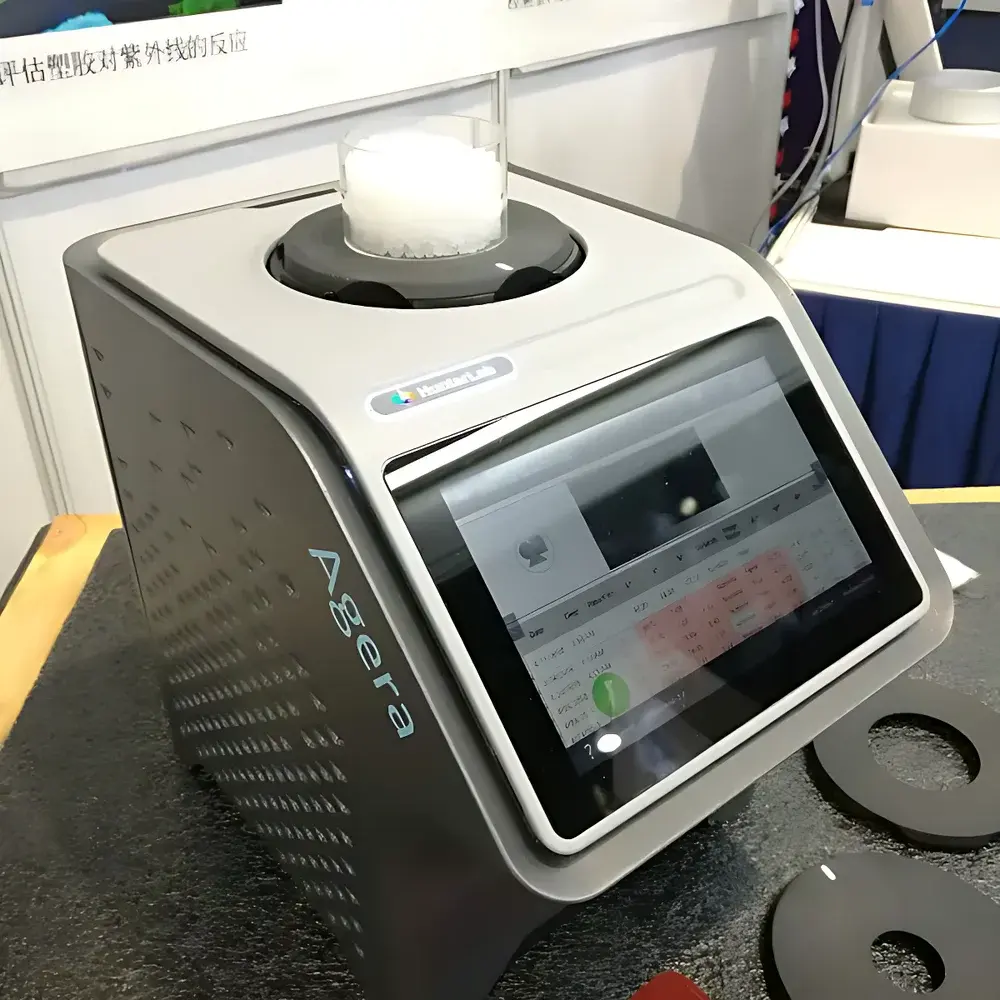
HunterLab Agera® Yellow Index Spectrophotometer
| Brand | HunterLab |
|---|---|
| Origin | USA |
| Model | AGR-Agera |
| Product Type | Benchtop Spectrophotometer |
| Optical Geometry | 0°/45° Annular Illumination (15-point fiber-optic averaging) |
| Light Source | Full-spectrum LED (360–700 nm) with UV control |
| Spectral Range | 360–700 nm |
| Repeatability | ΔE2000 < 0.03 (CIEL*a*b*, max) |
| Compliance | ASTM D1925, ASTM E313, ASTM D6290 (45–52 mm aperture), ASTM D2457, ASTM D523, ISO 2813, HG/T 3862-2006, ASTM E308 |
| Display | 7″ 1280×800 capacitive industrial touchscreen |
| Data Interfaces | USB, Ethernet, Wi-Fi, Bluetooth, Email export |
| Software | Embedded EasyMatch Essentials QC (FDA 21 CFR Part 11 electronic signature optional) |
| Aperture Options | XL (51 mm), L (25.4 mm), M (16.9 mm), Custom 30 mm |
| Calibration Standards | NIST-traceable white tile, certified green tile, ASTM/ISO-traceable black glass gloss standard |
| Optical Design | Sealed dual-beam spectrophotometer with 256-element diode array and holographic concave grating |
| UV Mode | Toggleable UV-included / UV-excluded reporting |
| Maintenance | Fanless, filterless, robust industrial enclosure |
Overview
The HunterLab Agera® Yellow Index Spectrophotometer is a benchtop, dual-function optical measurement instrument engineered for precise, repeatable quantification of yellowing—specifically the Yellow Index (YI) according to ASTM D1925 and ASTM E313—as well as full CIE L*a*b*, ΔE2000, and spectral reflectance across the visible range (360–700 nm). Its core optical architecture employs a rigorously validated 0°/45° annular illumination geometry with 15-point fiber-optic spatial averaging, replicating human visual perception under standardized viewing conditions. This geometry eliminates bias from surface texture, particle orientation, or micro-topography—critical for heterogeneous samples such as polymer granules, PTA crystals, titanium dioxide powders, or extruded film strips. Unlike integrating sphere instruments, Agera’s directional geometry ensures metrological traceability to ASTM D6290 (specifying 45–52 mm measurement aperture), enabling direct correlation between instrumental output and visual assessment in quality control laboratories operating under ISO/IEC 17025 or GMP frameworks.
Key Features
- Simultaneous color and 60° gloss measurement per single sample placement—fully compliant with ASTM D523 and ISO 2813, with traceable calibration standards included.
- Full-spectrum LED illumination (360–700 nm) with programmable UV component control, enabling accurate evaluation of fluorescent whitening agents (FWAs), optical brighteners, and UV-reactive additives in polymers and pigments.
- Embedded 5-megapixel camera positioned at 45°, capturing high-fidelity RGB images under identical illumination; images are time-stamped, stored with spectral data, and analyzable via on-device RGB histogram tools.
- Industrial-grade 7-inch capacitive touchscreen interface running embedded EasyMatch Essentials software—no external PC required for routine operation, data review, or pass/fail decision-making.
- Sealed, fanless optical path featuring a 256-element diode array and high-resolution holographic concave grating—ensuring long-term photometric stability and resistance to dust, vibration, and thermal drift.
- Multi-aperture support (XL: 51 mm, L: 25.4 mm, M: 16.9 mm, optional 30 mm) optimized for irregular, granular, or low-contrast samples; the 51 mm aperture delivers superior signal-to-noise ratio for particulate materials per ASTM D6290.
Sample Compatibility & Compliance
Agera accommodates solids, powders, pellets, films, and opaque sheets without auxiliary fixtures—its upward- and forward-facing port design allows direct placement of irregular geometries. It meets regulatory requirements for color-critical industries: ASTM D1925 and ASTM E313 for yellow index calculation; ASTM D6290 for aperture specification in polymer yellowness testing; and ASTM D2457/D523 for gloss. All factory calibration tiles carry NIST-traceable certificates (white tile), manufacturer-certified reference values (green tile), and ISO/ASTM-traceable black glass (gloss standard). The system supports GLP/GMP workflows through audit-trail-enabled electronic signatures (optional FDA 21 CFR Part 11 module), user access controls, and immutable data logging.
Software & Data Management
EasyMatch Essentials provides an embedded, intuitive QC environment with preconfigured indices—including YI D1925, YI E313, b* value, whiteness (Hunter), and custom tolerances. Users define pass/fail limits, generate reports in PDF/CSV, and export metadata with spectral curves and image thumbnails. Data transfer occurs via USB drive, Ethernet, Wi-Fi, Bluetooth, or SMTP email—no proprietary drivers required. For enterprise integration, optional EZMQC Windows-based software enables SPC charting, multi-instrument fleet management, and LIMS connectivity. All software modules undergo periodic validation per IQ/OQ protocols, and firmware updates are delivered remotely via HunterLab’s secure diagnostic portal.
Applications
Agera serves as the reference-grade instrument for yellow index monitoring in polyolefin (PP, PE), polyester (PET), engineering thermoplastics (ABS, POM), pigment manufacturing (titanium dioxide, carbon black), and purified terephthalic acid (PTA) production. Its ability to decouple color from surface effects makes it indispensable for R&D labs evaluating thermal degradation, UV exposure, or catalyst residue impact on polymer yellowness. In QC environments, it replaces subjective visual grading for incoming raw materials, in-process checks, and final release testing—supporting compliance with internal specifications, customer agreements, and industry standards such as ISO 9001 and IATF 16949.
FAQ
Does Agera comply with FDA 21 CFR Part 11 for electronic records and signatures?
Yes—when configured with the optional electronic signature module, Agera enforces role-based authentication, audit trails, and record integrity controls aligned with Part 11 requirements.
Can Agera measure yellow index on powdered samples with high repeatability?
Yes—the 51 mm aperture combined with 15-point spatial averaging minimizes sampling variance inherent in particulates, delivering ΔE2000 < 0.03 for homogeneous batches per ASTM D6290.
Is UV calibration traceable to national standards?
Yes—UV output is factory-calibrated using NIST-traceable standards, and users may perform secondary UV calibration against certified fluorescent reference materials.
How is gloss measurement integrated into the color workflow?
Gloss at 60° is acquired simultaneously with spectral reflectance in a single measurement cycle, using the same optical path and aperture—eliminating repositioning error and ensuring correlated color-gloss datasets.
What maintenance is required for long-term optical stability?
None beyond routine calibration with supplied standards; the sealed, fanless optical design prevents dust ingress and thermal gradient-induced drift, supporting >5 years of continuous operation without service intervention.




