
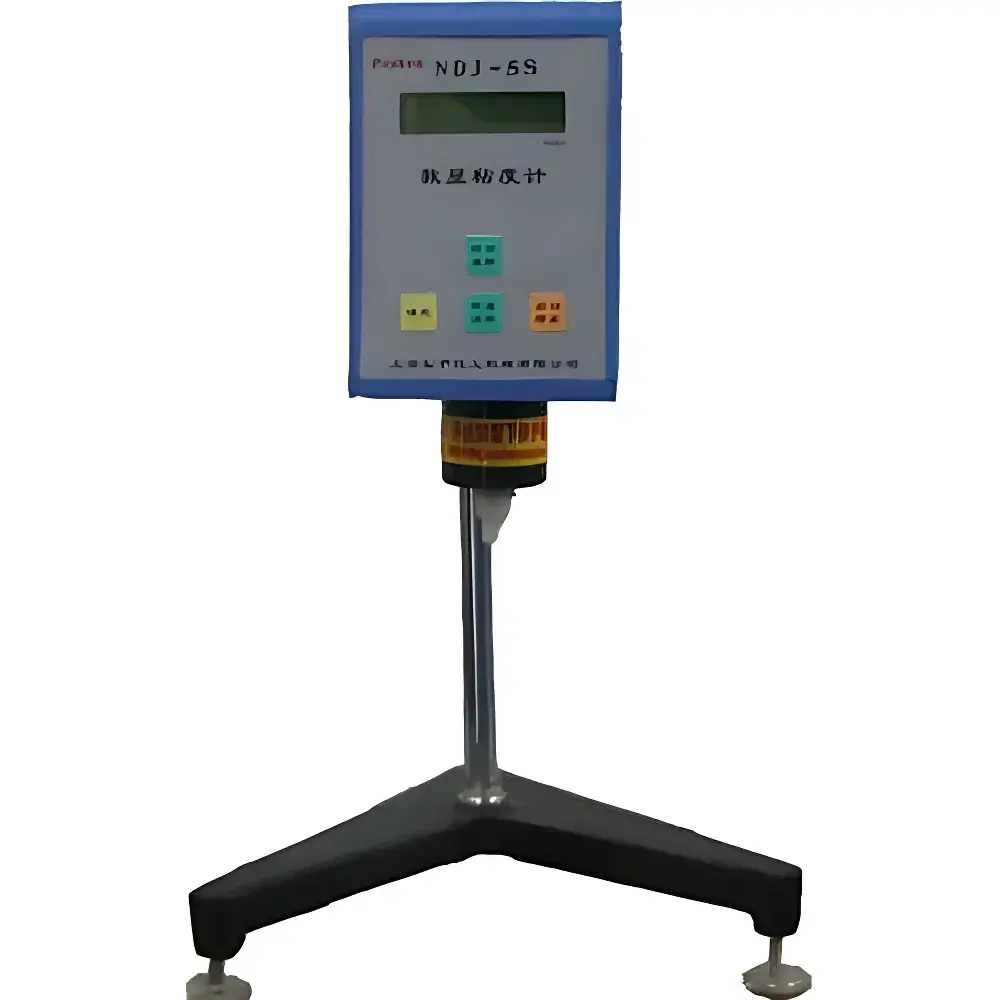
NDJ-5S Digital Viscometer by Shanghai Manufacturer
| Origin | Shanghai, China |
|---|---|
| Manufacturer Type | Authorized Distributor |
| Origin Category | Domestic (PRC) |
| Model | NDJ-5S |
| Pricing | Available Upon Request |
| Display | LCD with blue backlight |
| Drive System | High-resolution stepper motor |
| Power Supply | 220 V / 50 Hz AC |
| Measurement Range | 10–100,000 mPa·s (with spindles #1–#4) |
| Optional Low-Viscosity Range | 1–10 mPa·s (with #0 spindle) |
| Accuracy | ±3% of full scale (for Newtonian fluids) |
| Repeatability | ±0.5% of full scale (for Newtonian fluids) |
| Output Interface | RS232 (optional) |
| Compliance | Designed per GB/T 2794–2013 (Chinese national standard for viscometry), compatible with ISO 2555 and ASTM D2196 practices |
| Accessories | #0 spindle (optional), ultra-low-viscosity adapter, external thermostatic bath (not included) |
Overview
The NDJ-5S Digital Viscometer is a microprocessor-controlled rotational viscometer engineered for precision measurement of dynamic viscosity in Newtonian and mildly non-Newtonian liquids. It operates on the principle of rotational viscometry—applying controlled shear stress via a rotating spindle immersed in the test fluid and measuring the resulting torque to calculate absolute viscosity (in mPa·s). The instrument employs a high-subdivision stepper motor drive system, ensuring stable, jitter-free rotation across a defined speed range. Unlike analog or mechanical viscometers, the NDJ-5S integrates real-time digital signal processing to deliver continuous viscosity readouts, torque percentage, spindle identification, and rotational speed—all simultaneously displayed on an LCD screen with blue backlighting for enhanced readability under laboratory lighting conditions. Its compact benchtop architecture and robust electromagnetic interference (EMI) suppression make it suitable for QC labs, R&D facilities, and production environments where consistent power supply quality may vary.
Key Features
- Microcontroller-based closed-loop control system for precise spindle speed regulation, independent of AC line frequency fluctuations
- Four standard spindles (#1–#4) covering a broad dynamic viscosity range from 10 to 100,000 mPa·s; optional #0 spindle extends low-end capability to 1 mPa·s
- LCD display with real-time updates of viscosity value (mPa·s), rotational speed (rpm), torque (%), and maximum measurable viscosity at current settings
- Full-scale linear calibration using NIST-traceable silicone oil standards; accuracy certified to ±3% FS for Newtonian reference fluids
- RS232 serial interface (optional) enabling direct data export to PCs or thermal printers for GLP-compliant recordkeeping
- Switch-mode power supply supporting wide-input voltage tolerance (180–240 V AC), minimizing drift during brownout conditions
- No gear train or belt transmission—direct stepper motor coupling eliminates backlash, wear, and acoustic noise
Sample Compatibility & Compliance
The NDJ-5S is validated for use with homogeneous, low-to-medium viscosity liquids including edible oils, polymer solutions, aqueous suspensions, pharmaceutical syrups, cosmetic emulsions, and solvent-based coatings. It is not intended for highly thixotropic, yield-stress, or particulate-laden systems requiring controlled-shear-rate or oscillatory testing. While the base unit complies with GB/T 2794–2013 (Determination of apparent viscosity of adhesives), its operational methodology aligns with internationally recognized protocols: ISO 2555 (Plastics — Resins in solution — Determination of viscosity number), ASTM D2196 (Standard Test Methods for Rheological Properties of Non-Newtonian Materials), and USP (Rheology). When paired with a certified thermostatic bath (sold separately), measurements can be conducted under temperature-controlled conditions meeting ISO 3219 requirements. The device supports basic audit trail functionality via printed output when equipped with the RS232 module, facilitating documentation for internal QA procedures.
Software & Data Management
The NDJ-5S does not include proprietary PC software but functions as a serial ASCII data source. When connected via RS232, it transmits comma-delimited strings containing timestamp (if externally synchronized), spindle ID, rpm, torque %, and viscosity value. This enables integration into custom LIMS environments or third-party data acquisition platforms such as LabVIEW, MATLAB, or Excel-based logging tools. All displayed parameters are updated at ≥2 Hz, ensuring sufficient temporal resolution for stability assessment of time-dependent samples. Calibration coefficients are stored in non-volatile memory and survive power cycling. No firmware updates are supported in-field; recalibration requires traceable standard fluids and manual coefficient entry via front-panel interface.
Applications
- Quality control of edible oils and margarines (oxidative stability correlation)
- Batch release testing of topical pharmaceutical gels and ointments per USP monographs
- Formulation screening of water-based paints and architectural coatings
- Viscosity grading of industrial lubricants and hydraulic fluids
- Process consistency monitoring in adhesive manufacturing lines
- Academic rheology instruction for undergraduate materials science laboratories
FAQ
Is the NDJ-5S compliant with FDA 21 CFR Part 11?
No—the instrument lacks electronic signature capability, audit trail generation, and user access controls required for Part 11 compliance. It may be used in regulated environments only when paired with validated external data capture systems.
Can I measure non-Newtonian fluids with this viscometer?
Yes, but results represent apparent viscosity at a single shear rate. For full flow curve characterization (e.g., shear-thinning index), a programmable rheometer with variable shear rate control is recommended.
What temperature control options are available?
The NDJ-5S has no built-in temperature regulation. Users must integrate a separately purchased thermostatic bath with spindle immersion depth compatibility and ±0.1 °C stability.
Does the instrument support automatic viscosity unit conversion?
No—it displays exclusively in mPa·s (equivalent to cP). Unit conversion must be performed manually or in downstream software.
How often should calibration verification be performed?
Per ISO/IEC 17025 guidance, daily verification with a certified reference fluid is advised before critical measurements; full recalibration is recommended annually or after mechanical impact.



