
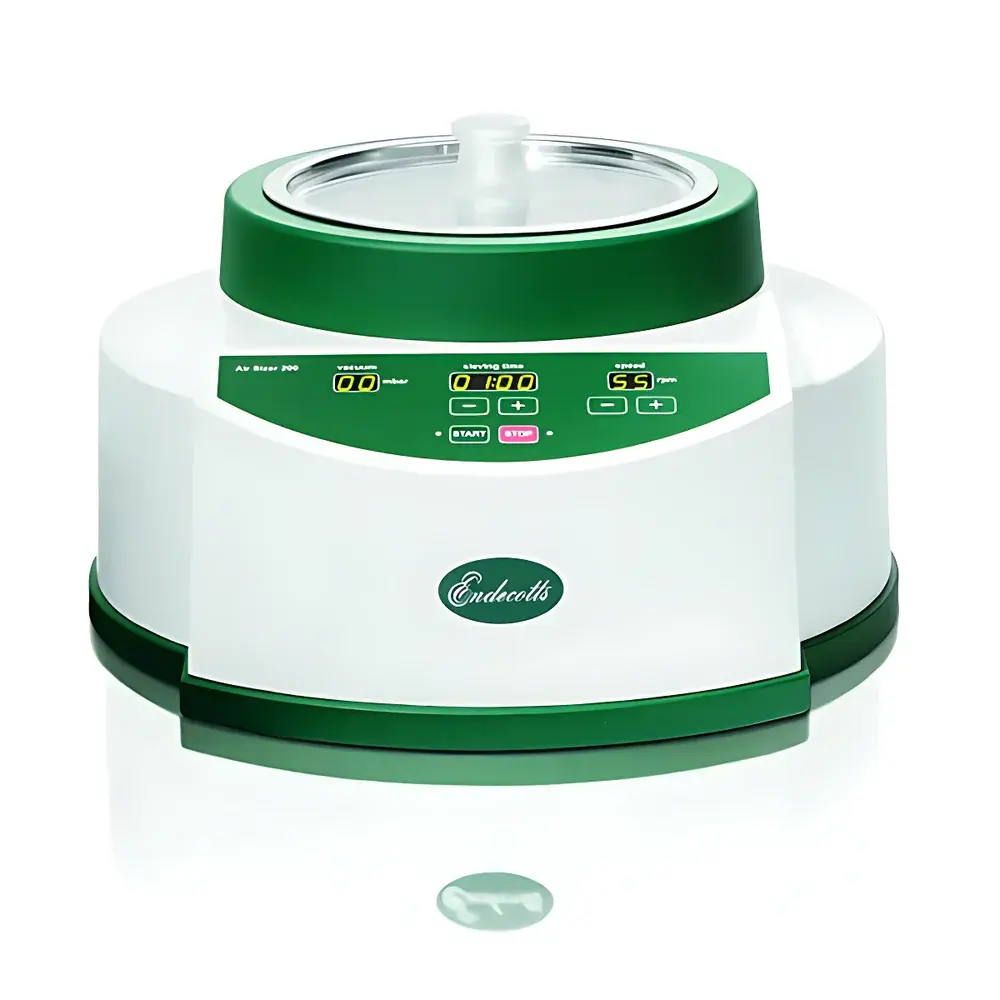
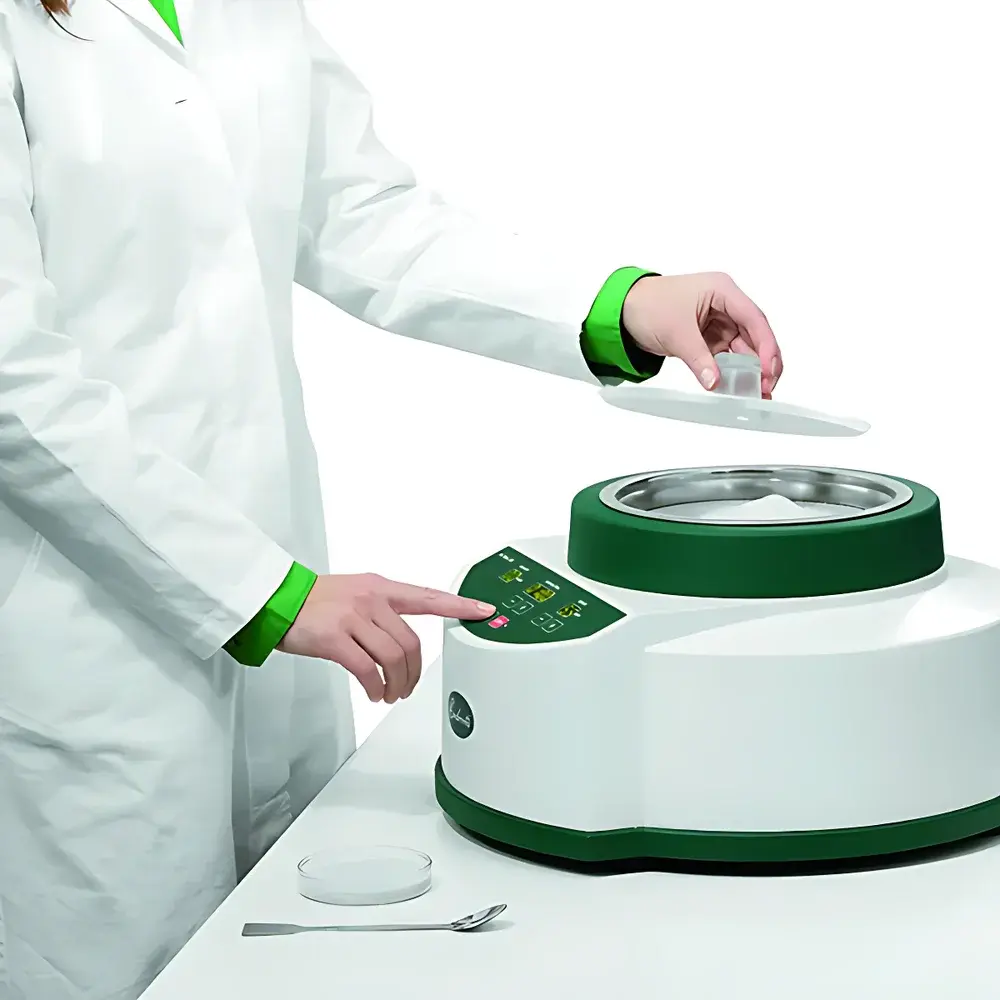
Endecotts Air Sizer 200 Air Jet Sieve Analyzer
| Brand | Endecotts |
|---|---|
| Origin | United Kingdom |
| Model | Air Sizer 200 |
| Sieve Diameter | 203 mm (8 in) |
| Sieving Range | 20 µm – 4 mm |
| Drive Mode | Air Jet Impingement |
| No. of Sieves | 1 |
| Rotational Speed (Nozzle) | 5–55 rpm |
| Sieving Time Display | Digital, 0:10–99:50 min:ss |
| Vacuum Pressure Range | 20–99 mbar |
| Power Supply | 100–240 V, 50–60 Hz, Single-Phase |
| Dimensions (W×H×D) | 450 × 235 × 435 mm |
| Net Weight | 16 kg |
| Ingress Protection | IP40 |
| Compliance | CE |
| Accessories Available | Pre-filter, Industrial Vacuum Unit |
Overview
The Endecotts Air Sizer 200 is a precision-engineered air jet sieve analyzer designed for the reliable, reproducible particle size distribution analysis of fine, cohesive, and electrostatically charged dry powders. Unlike conventional mechanical vibratory or tapping sieves—whose performance degrades significantly below 75 µm—the Air Sizer 200 employs controlled air jet impingement to fluidize and disperse particles dynamically against a single fixed sieve. This principle leverages turbulent airflow generated by a rotating nozzle to lift, accelerate, and project particles tangentially across the sieve surface, enabling efficient separation of agglomerates and overcoming interparticle adhesion forces. The instrument operates under regulated negative pressure (20–99 mbar), ensuring rapid passage of undersized fractions while maintaining consistent mass flow and minimizing operator-induced variability. It is particularly suited for materials prone to static charge buildup or moisture-induced cohesion—such as pharmaceutical excipients, pigment-grade titanium dioxide, nanoscale carbon black, ultrafine cement clinker, and high-purity metal powders used in additive manufacturing feedstocks.
Key Features
- Air jet impingement technology eliminates mechanical vibration, reducing wear, noise, and sample degradation.
- Adjustable nozzle rotation speed (5–55 rpm) enables method optimization for varying powder cohesivity and density.
- Single-sieve configuration with 203 mm (8-inch) diameter accommodates standard ISO 3310-1 and ASTM E11 compliant test sieves.
- Digital timer with resolution to the second (0:10–99:50) supports strict adherence to standardized sieving durations per ISO 2591-1 and USP <786>.
- Integrated vacuum interface compatible with external industrial vacuum units or optional pre-filters for extended operational duty cycles.
- Compact desktop footprint (450 × 235 × 435 mm) and IP40-rated enclosure ensure safe integration into QC laboratories, R&D cleanrooms, and GMP-compliant environments.
- CE-marked design complies with EU Machinery Directive 2006/42/EC and Low Voltage Directive 2014/35/EU.
Sample Compatibility & Compliance
The Air Sizer 200 is validated for dry, free-flowing to moderately cohesive powders with nominal particle sizes ranging from 20 µm to 4 mm. It delivers high repeatability (RSD < 2% for replicate runs on reference standards such as glass bead distributions) for materials including but not limited to: pharmaceutical APIs and excipients (e.g., microcrystalline cellulose, lactose monohydrate), ceramic precursors (alumina, zirconia), battery cathode materials (NMC, LFP), food-grade starches and flours, and construction additives (silica fume, metakaolin). The system supports compliance with ISO 9276-2 (representation of particle size distribution), ISO 2591-1 (sieving methods using test sieves), and ASTM C150/C595 specifications for cement fineness testing. While not intrinsically 21 CFR Part 11 compliant, audit trails and electronic records may be implemented via external LIMS integration when paired with validated data capture workflows.
Software & Data Management
The Air Sizer 200 operates as a stand-alone instrument with no embedded software or touchscreen interface. All operational parameters—including time, vacuum level, and rotational speed—are set manually via front-panel controls. Results are recorded externally using laboratory notebooks or spreadsheet-based templates aligned with internal SOPs. For laboratories requiring digital traceability, the device can be integrated into existing quality management systems via manual entry or semi-automated logging using barcode-scanned sample IDs and timestamped sieve change logs. Optional vacuum units with analog pressure gauges or digital vacuum controllers allow for post-run documentation of process conditions—supporting GLP and GMP audit readiness when combined with controlled document procedures.
Applications
- Quality control of inhalable drug powders per USP <1174> and Ph. Eur. 2.9.31.
- Fineness verification of Portland cement and supplementary cementitious materials (SCMs) per ASTM C204 and EN 196-6.
- Batch release testing of pigment dispersions and inkjet toner formulations.
- Characterization of conductive carbon blacks and graphene nanoplatelets prior to dispersion in polymer matrices.
- Validation of milling endpoints in API micronization processes.
- Raw material qualification for powder metallurgy and binder jetting AM feedstocks.
FAQ
Can the Air Sizer 200 perform wet sieving?
No. The Air Sizer 200 is strictly designed for dry sieving applications. Its air jet mechanism and vacuum architecture are incompatible with liquid-phase operation.
Is calibration required before each use?
Routine calibration is not required; however, periodic verification using certified reference powders (e.g., NIST-traceable glass microspheres) is recommended per ISO/IEC 17025 and internal QA protocols.
What sieve standards are supported?
Standard 203 mm (8-inch) woven wire mesh sieves conforming to ISO 3310-1, ASTM E11, or BS 410 are fully compatible.
Does the unit include a vacuum pump?
No. A vacuum source must be supplied externally. Endecotts offers optional pre-filters and industrial-grade vacuum units for continuous-duty operation.
How is sieve cleaning managed between analyses?
The air jet action inherently cleans the sieve surface during operation. Post-run cleaning is performed manually using compressed air or soft brushes—no ultrasonic or solvent cleaning is necessary for routine use.



