
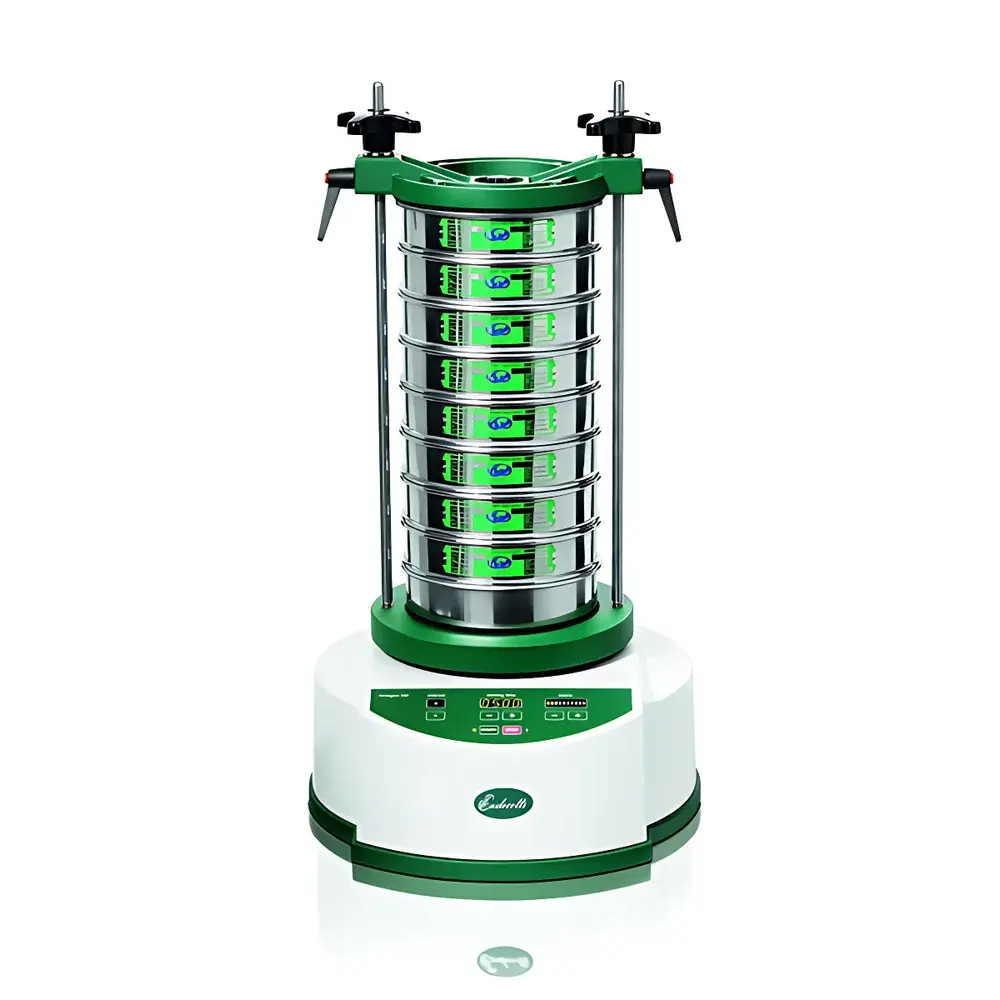
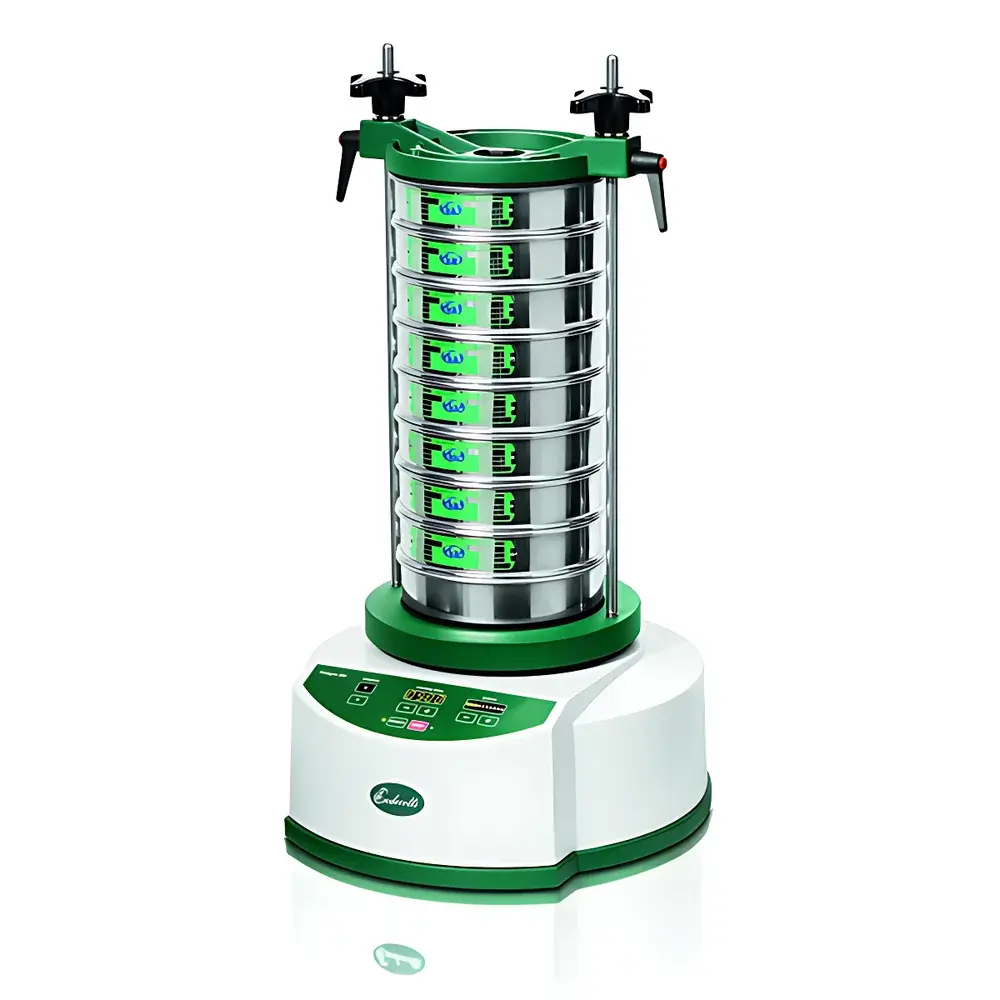
Endecotts OCTAGON 200 Digital Sieve Shaker
| Brand | Endecotts |
|---|---|
| Origin | United Kingdom |
| Model | OCTAGON 200 |
| Drive Type | Electromagnetic |
| Sieving Motion | 3D Oscillation |
| Max Sample Capacity | 3 kg |
| Sieve Capacity | 8 full-height (200 mm) or 18 half-height sieves |
| Amplitude Range | 0–3 mm (10-step digital adjustment) |
| Frequency | 3000 rpm @ 50 Hz |
| Timer Range | 0:10–99:59 min (digital display) |
| Intermittent Mode | Yes |
| Dry & Wet Sieving | Yes |
| Sieve Diameter Options | 100 mm, 200 mm (8 in) |
| Max Stack Height | 450 mm |
| Clamping System | Quick-action universal clamp |
| Vibration Isolation | Non-metallic springs + damping mounts |
| Enclosure Rating | IP54 |
| Power Supply | 230 V / 50 Hz or 115 V / 60 Hz, 300 VA |
| Dimensions (W×H×D) | 418 × 232 × 435 mm |
| Net Weight | 43 kg |
| Compliance | CE, EN 61000-6-2/6-4, EN 61000-3-2/3-3 |
Overview
The Endecotts OCTAGON 200 Digital Sieve Shaker is a precision-engineered laboratory instrument designed for standardized particle size distribution analysis via mechanical dry or wet sieving. It operates on electromagnetic actuation—eliminating rotating shafts, belts, or bearings—to deliver consistent, maintenance-free 3D oscillatory motion. This motion comprises simultaneous horizontal orbital displacement and rapid vertical acceleration, generating high-energy kinetic agitation that promotes efficient particle stratification and sieve penetration while minimizing blinding and agglomeration. The device complies with internationally recognized sieving standards including ISO 2591-1, ASTM E11, BS 410, and EN 933-1, making it suitable for quality control laboratories, R&D facilities, and contract testing organizations operating under GLP or GMP frameworks.
Key Features
- Electromagnetic drive system ensures zero mechanical wear, silent operation (<65 dB(A)), and long-term repeatability without lubrication or scheduled maintenance.
- Digitally controlled 3D oscillation with 10-step amplitude adjustment (0–3 mm) and precise timer resolution (10 seconds to 99 minutes 59 seconds), supporting both continuous and programmable intermittent modes.
- Universal quick-action clamp mechanism secures full-height (200 mm) or half-height (100 mm) sieves firmly yet without over-compression—preserving mesh integrity and enabling sub-30-second sieve stack assembly/disassembly.
- Integrated vibration isolation using non-metallic elastomeric springs and passive damping mounts reduces transmitted force to the work surface by >85%, meeting ISO 5349-1 hand-arm vibration exposure thresholds.
- Compact benchtop footprint (418 × 232 × 435 mm) and 43 kg net weight facilitate relocation between analytical labs, cleanrooms, or field deployment sites without requiring anchoring.
- IP54-rated enclosure protects internal electronics from dust ingress and incidental water splashes during wet-sieving protocols or humid environments.
Sample Compatibility & Compliance
The OCTAGON 200 accommodates diverse particulate matrices—including metal powders, pharmaceutical granules, mineral ores, soil aggregates, catalysts, and food-grade starches—across a validated sizing range of 20 µm to 125 mm. Its dual-mode capability supports both dry sieving per ISO 9276-2 Annex A and wet sieving per ISO 2591-2, with optional splash guards and stainless-steel承接 trays (200 mm diameter) certified for aqueous suspension handling. All operational parameters are traceable and auditable, satisfying documentation requirements under FDA 21 CFR Part 11 when paired with compliant LIMS or ELN systems. CE marking confirms conformity with EU Machinery Directive 2006/42/EC and Electromagnetic Compatibility Directive 2014/30/EU.
Software & Data Management
While the OCTAGON 200 operates as a standalone hardware platform with an integrated digital controller, its parameter settings—including amplitude level, total duration, on/off intervals in intermittent mode, and cycle count—are fully recordable via manual log or external data capture. For regulated environments, users may integrate the shaker into validated workflows using timestamped operator entries in electronic lab notebooks (ELNs) or laboratory information management systems (LIMS). Audit trails must include user ID, date/time stamp, parameter values, and any deviations—consistent with ALCOA+ principles (Attributable, Legible, Contemporaneous, Original, Accurate, Complete, Consistent, Enduring, Available).
Applications
- Quality assurance of raw materials in cement, ceramics, and metallurgical industries per ASTM C136/C780.
- Particle size release testing of inhalable drug powders (e.g., DPI formulations) aligned with USP <786> and Ph. Eur. 2.9.32.
- Aggregate gradation analysis in civil engineering labs according to AASHTO T 27 and EN 933-1.
- Process validation of spray-dried excipients and micronized APIs where sieve cut-points define critical quality attributes (CQAs).
- Environmental monitoring of sediment fractions in soil and wastewater treatment sludge characterization studies.
FAQ
Does the OCTAGON 200 require calibration certification prior to use?
Yes—initial verification of amplitude accuracy, timer deviation, and frequency stability should be performed using NIST-traceable vibration analyzers and documented per ISO/IEC 17025. Annual recalibration is recommended.
Can the shaker be used with non-standard sieve diameters or custom mesh configurations?
Only ISO- and ASTM-compliant 100 mm and 200 mm (8-inch) sieves with standard frame heights are mechanically supported. Custom diameters or non-circular frames are incompatible with the clamp geometry.
Is remote start/stop or network connectivity available?
No—this is a locally operated, non-networked instrument. All controls are front-panel based; no Ethernet, USB, or Bluetooth interfaces are provided.
What maintenance is required beyond routine cleaning?
None. The electromagnetic actuator contains no consumables. Users should inspect clamp jaws and silicone gaskets annually for deformation or cracking, replacing only if compromised.
How does the 3D motion improve separation efficiency compared to rotary or tapping shakers?
The triaxial acceleration profile achieves higher particle lift-off velocity and lateral dispersion, reducing residence time per sieve layer by up to 40% versus conventional 2D shakers—particularly beneficial for cohesive or near-size particles prone to agglomeration.



