
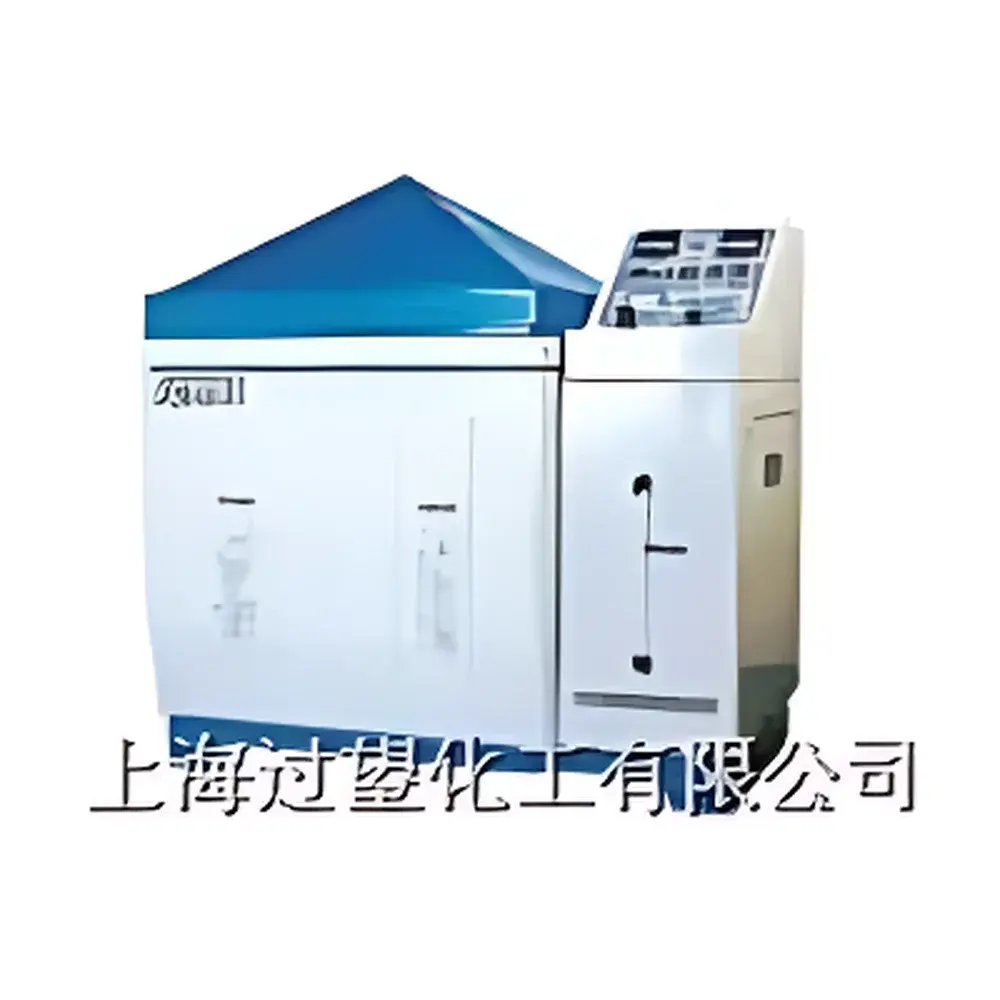
FQY010A Salt Spray Test Chamber
| Origin | Shanghai, China |
|---|---|
| Manufacturer Type | Authorized Distributor |
| Origin Category | Domestic (China) |
| Model | FQY010A |
| Quotation | Available upon Request |
| Temperature Range | Ambient to 50 °C |
| Temperature Fluctuation | ≤ ±0.5 °C |
| Temperature Uniformity | ≤ 2 °C |
| Temperature Deviation | ≤ ±2 °C |
| Salt Spray Deposition Rate | 1–2 mL per 80 cm² per hour |
| Internal Chamber Volume | 0.1 m³ |
| Internal Dimensions (D×W×H) | 500 × 500 × 400 mm |
| External Dimensions (D×W×H) | 720 × 1010 × 1080 mm |
| Total Power Consumption (excl. compressor) | 1.2 kW |
| Net Weight | Approx. 175 kg |
| Compliance | GB/T 2423.17, ISO 9227 |
Overview
The FQY010A Salt Spray Test Chamber is an engineered environmental test system designed to evaluate the corrosion resistance of metallic substrates, electroplated coatings, organic finishes (e.g., paints and lacquers), electronic assemblies, and electrical components under accelerated saline exposure conditions. Based on the standardized salt fog (or salt spray) corrosion test methodology, this chamber generates a controlled, continuous mist of 5% NaCl solution at elevated temperature (typically 35 °C) to simulate aggressive coastal or industrial marine environments. The test principle follows ASTM B117 and ISO 9227 protocols—both widely adopted for comparative evaluation of protective coating integrity, galvanic layer durability, and base material susceptibility to chloride-induced pitting and crevice corrosion. Unlike cyclic corrosion testers, the FQY010A operates in a steady-state mode optimized for reproducible, long-duration exposure testing in accordance with IEC 60068-2-11 and GB/T 2423.17.
Key Features
- Stable thermal control system with PID-regulated heating and high-precision platinum resistance thermometer (PT100) feedback, ensuring temperature fluctuation ≤ ±0.5 °C and uniformity ≤ 2 °C across the working volume.
- Calibrated salt solution delivery subsystem featuring adjustable nozzle pressure and pre-heated saturated air chamber to maintain consistent fog generation at 1–2 mL/80 cm²·h—within the tolerance limits specified by ISO 9227.
- Corrosion-resistant internal chamber constructed from high-grade PVC-coated stainless steel (SUS304), with sealed door gasketing and double-layer insulated walls to minimize thermal loss and condensation interference.
- Dedicated salt solution reservoir with level sensor and overflow protection, coupled with a corrosion-proof pump and glass nozzle assembly for long-term operational reliability.
- Integrated digital controller with real-time display of chamber temperature, elapsed test time, and system status; supports manual start/stop and timer-based automatic shutdown.
- Compliance-ready design: meets structural, procedural, and reporting requirements aligned with ISO/IEC 17025 laboratory accreditation frameworks when operated under documented SOPs.
Sample Compatibility & Compliance
The FQY010A accommodates flat-panel specimens up to 400 mm in height and 500 mm in width, with flexible rack mounting for multi-tier sample orientation (e.g., 15°–30° tilt per ISO 9227). It supports standard test coupons (e.g., ASTM G151 reference panels), PCB assemblies, connector housings, automotive fasteners, and coated sheet metal samples. All operational parameters—including temperature setpoint, spray duration, and solution concentration—are traceable and recordable for audit purposes. The chamber satisfies mandatory requirements of GB/T 2423.17 (Chinese national standard equivalent to IEC 60068-2-11) and ISO 9227 (neutral salt spray testing). While not inherently 21 CFR Part 11 compliant, its data logging capability can be integrated with validated third-party software for GLP/GMP environments requiring electronic signature and audit trail functionality.
Software & Data Management
The FQY010A operates via embedded microcontroller firmware without proprietary PC software dependency. However, optional RS-485 or analog 4–20 mA outputs enable connection to external SCADA systems or programmable logic controllers (PLCs) for centralized monitoring. Temperature readings and runtime data may be logged externally using calibrated chart recorders or industrial data acquisition units (DAQs). For laboratories implementing digital quality management systems (QMS), the device’s stable analog output permits integration into platforms supporting FDA 21 CFR Part 11 compliance—provided appropriate validation documentation (IQ/OQ/PQ) and user access controls are established per organizational SOPs.
Applications
- Quality assurance of zinc, nickel, chromium, and tin electroplated parts in automotive and aerospace supply chains.
- Performance benchmarking of primer/topcoat systems used in architectural steel and marine infrastructure projects.
- Failure analysis of solder joints, conformal coatings, and encapsulated sensors exposed to humid, chloride-laden atmospheres.
- Supplier qualification testing per OEM specifications (e.g., Ford CETP, GM W3177, VW TL 226).
- Research-level studies on corrosion inhibition mechanisms and coating adhesion degradation kinetics under static saline fog exposure.
FAQ
What standards does the FQY010A comply with?
It conforms to ISO 9227 (Neutral Salt Spray Test), GB/T 2423.17, and IEC 60068-2-11 for standardized corrosion assessment.
Can the chamber operate continuously for 96+ hours?
Yes—the system is rated for unattended operation over extended cycles, provided the salt solution reservoir is adequately filled and ambient ventilation meets minimum airflow requirements.
Is compressed air required for雾 generation?
Yes; clean, oil-free, dry compressed air (typically 0.2–0.3 MPa) is necessary to atomize the salt solution through the spray nozzle assembly.
Does the unit include a salt solution preparation kit?
No—the FQY010A requires externally prepared 5% (w/w) NaCl solution using analytical-grade reagents and deionized water; users must verify pH (6.5–7.2) prior to introduction.
How is temperature calibration verified?
Calibration is performed using NIST-traceable PT100 probes placed at three defined locations within the working zone, following procedures outlined in ISO/IEC 17025 Clause 6.5.



