
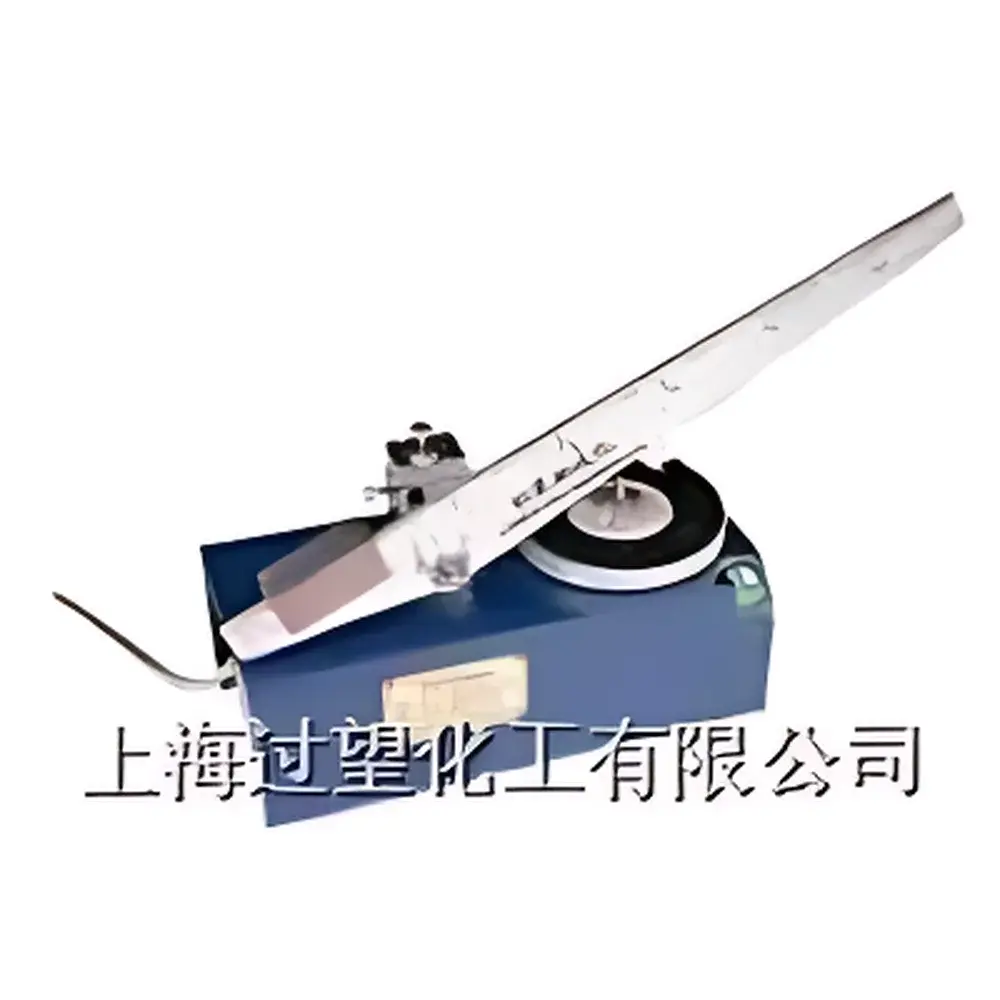
GW Scratch Tester for Engineered Wood Panels
| Key | Origin: Shanghai, China |
|---|---|
| Manufacturer Type | Distributor |
| Product Origin | Domestic (China) |
| Model | GW |
| Pricing | Upon Request |
| Motor | 6 W, 220 V, 50 Hz |
| Test Load Range | 0–5 N |
| Specimen Turntable Speed | 5 rpm |
| Specimen Dimensions | 100 mm × 100 mm, thickness < 10 mm, flat and dimensionally stable |
Overview
The GW Scratch Tester for Engineered Wood Panels is a precision mechanical testing instrument engineered to evaluate the surface resistance of decorative and structural wood-based panels against controlled linear abrasion and scratch deformation. It operates on the principle of applying a calibrated normal force via a hardened steel stylus (typically Rockwell C-scale indenter geometry) while rotating the specimen at a constant angular velocity beneath it. This configuration simulates real-world mechanical contact events—such as furniture movement, foot traffic, or tool impact—that induce surface plastic deformation, coating delamination, or substrate exposure. Designed in strict alignment with Chinese national standards GB/T 15102–1994 (for melamine-faced particleboard), GB/T 17657–1999 (wood-based panel testing methods), and GB/T 18102–2000 (laminate flooring specifications), the tester delivers repeatable, operator-independent scratch performance data essential for quality control, product development, and regulatory conformance in wood composite manufacturing.
Key Features
- Stable, low-inertia turntable drive system powered by a 6 W, 220 V / 50 Hz AC motor, delivering precise 5 rpm rotational speed with ≤±0.2 rpm deviation over extended test cycles.
- Adjustable vertical loading mechanism enabling continuous application of normal forces from 0 to 5 N with mechanical vernier calibration traceable to SI units.
- Dedicated specimen holder accommodating square specimens measuring exactly 100 mm × 100 mm and up to 10 mm in thickness, designed with parallelism tolerance < 0.05 mm to ensure uniform stylus engagement across the entire test area.
- Modular stylus mount compatible with standardized Rockwell C diamond or tungsten carbide tips (tip radius 0.2 mm typical), facilitating interchangeability and routine verification per ISO 1518–1 and ASTM D7027–20 guidelines for scratch methodology.
- Robust cast-aluminum base frame with vibration-damping feet, minimizing environmental transmission and supporting long-term measurement stability in production lab environments.
Sample Compatibility & Compliance
The GW Scratch Tester is validated for use with all common engineered wood substrates, including particleboard, medium-density fiberboard (MDF), high-density fiberboard (HDF), plywood, and laminated veneer lumber (LVL), whether uncoated, melamine-impregnated, PVC-laminated, or UV-cured acrylic surfaced. Its mechanical architecture meets the dimensional, load, and kinematic requirements stipulated in GB/T 15102–1994 Clause 6.4.3 (scratch resistance test), GB/T 17657–1999 Annex B (surface hardness and scratch evaluation), and GB/T 18102–2000 Section 6.5.2 (surface integrity under static load). While not certified to ISO/IEC 17025, the instrument supports GLP-aligned test documentation when integrated into laboratory quality management systems compliant with CNAS-CL01:2018.
Software & Data Management
This mechanical scratch tester operates without embedded firmware or proprietary software. All test parameters—including applied load, rotation duration, and visual assessment criteria—are recorded manually or via external digital logbooks in accordance with internal SOPs. The absence of electronic controllers ensures full auditability of raw test conditions and eliminates validation complexity associated with FDA 21 CFR Part 11 or EU Annex 11 compliance. Users may integrate digital imaging (e.g., stereo microscope + USB camera) and image analysis tools (e.g., ImageJ with custom thresholding protocols) to quantify scratch width, depth, and coating fracture density post-test—enabling semi-quantitative grading aligned with GB/T 17657–1999 visual rating scales (Class 1–5).
Applications
- Quality assurance of decorative surface layers during laminate flooring and kitchen cabinet panel production.
- Comparative evaluation of adhesive bond strength between overlay films and MDF substrates under tangential stress.
- R&D screening of novel UV-curable topcoats and nano-reinforced melamine resins for improved mar resistance.
- Third-party certification testing for CE-marked wood products sold in export markets requiring GB-standard conformity evidence.
- Root cause analysis of field-reported surface failures (e.g., white scratches on dark finishes) through controlled replication of suspected loading scenarios.
FAQ
What standards does the GW Scratch Tester directly support?
It is mechanically configured and operationally validated for GB/T 15102–1994, GB/T 17657–1999, and GB/T 18102–2000.
Can the tester accommodate specimens thicker than 10 mm?
No—maximum specimen thickness is strictly limited to <10 mm to maintain planar stability and prevent eccentric loading during rotation.
Is load calibration performed in-house or by an accredited lab?
Calibration of the mechanical load train is performed using NIST-traceable deadweight standards; users are advised to verify annually per ISO/IEC 17025 clause 6.5.2 if used in accredited testing environments.
Does the instrument include a stylus or require separate procurement?
A standard Rockwell C-type diamond stylus is supplied with each unit; alternative tip geometries (e.g., spherical tungsten carbide) are available as optional accessories.
What maintenance is required for long-term repeatability?
Monthly inspection of turntable runout (<0.03 mm TIR), stylus tip wear (via SEM or optical profilometry every 500 tests), and load spring fatigue is recommended per manufacturer’s service bulletin GW-ST-MNT-2023.



