
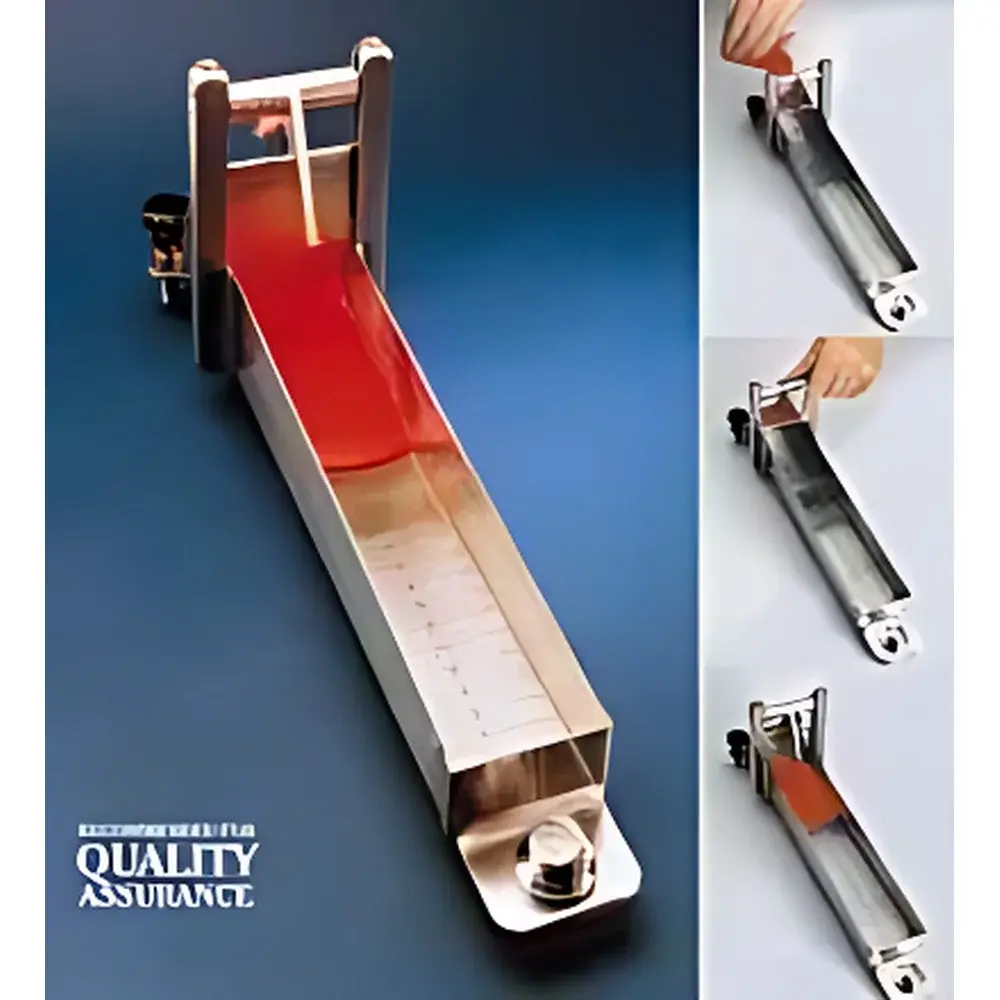
Endecotts Bostwick Consistometer for Jam and Ketchup Viscosity Testing
| Brand | Endecotts |
|---|---|
| Origin | United Kingdom |
| Model | Consistometer |
| Construction | Stainless steel body with electropolished 2 mm stainless steel channel |
| Sample volume | 75 mL |
| Dimensions (L × W × H) | 35.6 cm × 8.9 cm × 14.0 cm (14 in × 3.5 in × 5.5 in) |
| Base plate scale division | 0.5 cm |
| Leveling | Dual adjustable leveling screws + bubble level |
| Flow gate | Spring-loaded, instantaneous release mechanism |
| Compliance | Designed to meet ASTM D1200, ISO 2555, and AOAC Official Method 956.02 for consistency testing of semi-solid food products |
Overview
The Endecotts Bostwick Consistometer is a precision-engineered, gravity-driven flow consistency tester specifically designed for rapid, repeatable assessment of semi-solid food products such as tomato ketchup, fruit jams, jellies, yogurts, salad dressings, and other viscous, non-Newtonian food matrices. Operating on the principle of controlled gravitational flow under standardized geometry and time, the instrument measures the distance (in centimeters) a defined sample volume travels along a calibrated stainless steel channel within a fixed time interval—typically 30 seconds. This distance, known as the “Bostwick value,” serves as a direct, empirical indicator of product consistency, spreadability, and structural integrity. Unlike rotational or capillary viscometers, the Bostwick method does not require complex calibration fluids or shear-rate control; instead, it delivers robust, operator-independent results that correlate strongly with sensory perception and processing behavior in high-volume food manufacturing.
Key Features
- Stainless steel construction (electropolished 2 mm channel and base plate) ensures long-term corrosion resistance and compliance with food-grade hygiene standards (e.g., FDA 21 CFR Part 110, EC 1935/2004).
- Precision-machined 0.5 cm scale etched directly onto the base plate enables unambiguous visual reading without parallax error.
- Dual independent leveling screws paired with an integrated bubble level guarantee consistent 0° incline across all test runs—critical for measurement reproducibility (RSD < 2% intra-laboratory per ASTM D1200 interlaboratory data).
- Spring-loaded gate mechanism provides instantaneous, vibration-free release of the 75 mL sample—eliminating premature flow initiation and minimizing operator-induced variability.
- Compact footprint (35.6 × 8.9 × 14.0 cm) allows seamless integration into QC labs, pilot plants, or production-floor stations without dedicated infrastructure.
- No power supply, software, or consumables required—enabling immediate deployment and minimal maintenance overhead.
Sample Compatibility & Compliance
The Endecotts Bostwick Consistometer is validated for use with low-to-medium yield-stress fluids exhibiting thixotropic or pseudoplastic behavior. It is routinely applied to tomato-based sauces (ketchup, passata), fruit spreads (strawberry jam, apricot conserve), dairy products (sour cream, strained yogurt), condiments (mayonnaise, mustard), and plant-based alternatives (nut butters, hummus). The instrument conforms to internationally recognized standard methods including ASTM D1200 (Standard Test Method for Apparent Viscosity of Paints, Varnishes, and Related Products with the Ford Viscosimeter), ISO 2555 (Plastics — Resins in the liquid state or as emulsions or dispersions — Determination of apparent viscosity using the Brabender viscosimeter or the Bostwick consistometer), and AOAC Official Method 956.02 (Consistency of Tomato Ketchup). Its mechanical design supports GLP-compliant documentation when used in conjunction with controlled test protocols and traceable calibration verification records.
Software & Data Management
As a purely mechanical, analog measurement device, the Endecotts Bostwick Consistometer does not incorporate embedded electronics, firmware, or proprietary software. All measurements are recorded manually and entered into laboratory information management systems (LIMS) or electronic lab notebooks (ELN) via standardized templates. For regulated environments requiring audit trails, users may implement digital workflows using validated spreadsheet tools (e.g., Excel with password-protected change logs) or integrate readings into enterprise QMS platforms supporting 21 CFR Part 11–compliant electronic signatures and version-controlled SOPs. Calibration verification is performed using certified reference gels or traceable dimensional standards; no software-based calibration is applicable.
Applications
- QC release testing of tomato ketchup batches against internal specifications (e.g., 7–11 cm Bostwick at 30 s @ 20 °C).
- Formulation development for reduced-sugar jams, where consistency must compensate for lost pectin functionality.
- Monitoring thermal degradation during hot-fill processing by tracking consistency drift over time.
- Supplier qualification of fruit purees based on flow behavior under ambient storage conditions.
- Correlation studies linking Bostwick values to texture profile analysis (TPA) parameters (e.g., hardness, adhesiveness) and consumer acceptability scores.
- Root cause analysis of batch-to-batch variation in sauce viscosity linked to starch hydration, pH shifts, or enzyme activity.
FAQ
What is the recommended sample temperature for Bostwick testing?
Standardized testing is conducted at 20 ± 0.5 °C for tomato ketchup and most fruit-based products, per AOAC 956.02. Temperature control is critical—viscosity of these systems varies significantly with thermal history.
Can the Bostwick Consistometer measure yield stress quantitatively?
No. It provides an empirical consistency index, not absolute rheological parameters. Yield stress must be determined using controlled-stress rotational rheometry (e.g., vane or parallel-plate geometry).
Is cleaning between samples required?
Yes. Residue removal with warm water and food-grade detergent is mandatory before each test to prevent cross-contamination and channel surface fouling.
How often should leveling verification be performed?
Prior to each test series—and immediately after instrument relocation—to ensure gravitational vector alignment remains within ±0.1° tolerance.
Does Endecotts provide calibration certification?
Endecotts supplies factory-verified dimensional accuracy documentation for the scale and channel geometry. Users are responsible for periodic verification using NIST-traceable length standards.
Related Products






