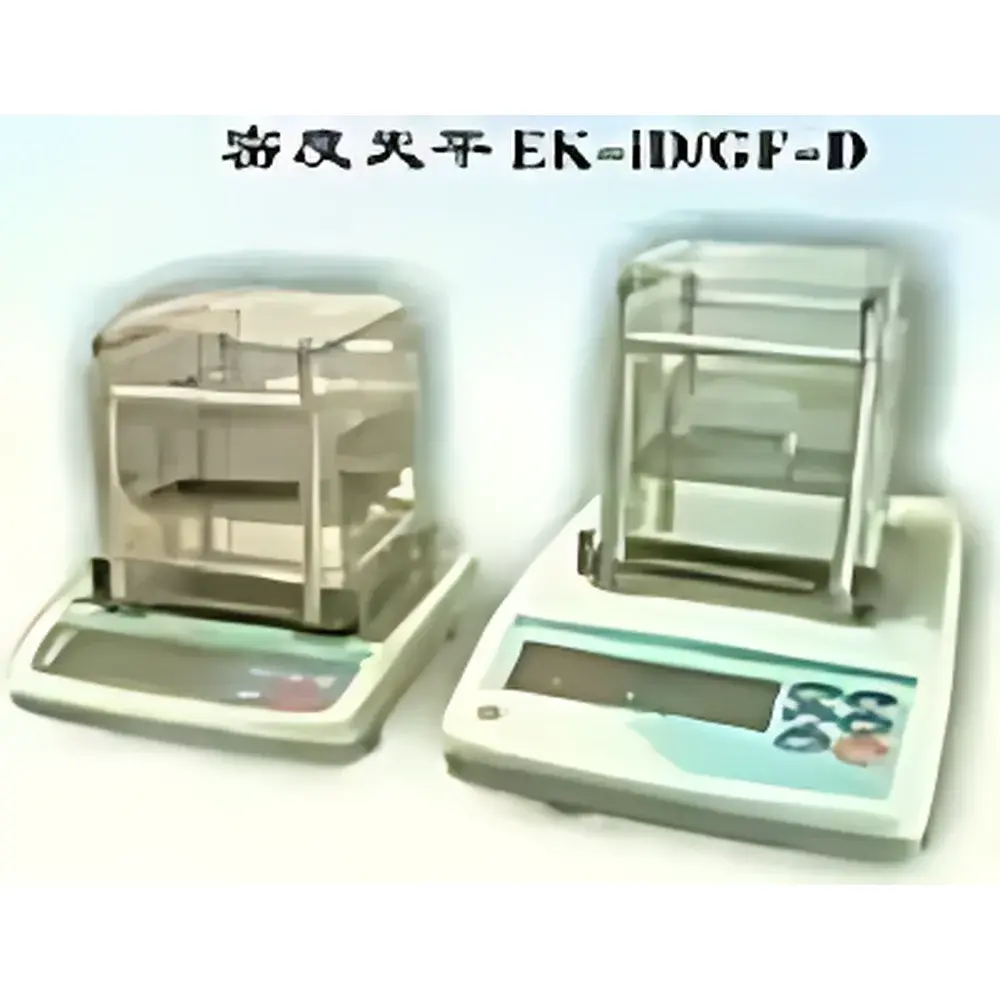
A&D EK-iD/GF-D Density Balance
| Brand | A&D |
|---|---|
| Origin | Japan |
| Model | EK-iD/GF-D |
| Measurement Principle | Archimedes’ Principle |
| Weighing Range | 300 g to 3100 g (model-dependent) |
| Readability | 0.001 g to 0.1 g |
| Density Resolution | 0.001 g/cm³ |
| Repeatability | ±0.002 g/cm³ |
| Display | High-contrast LCD (EK-iD) / Fluorescent display (GF-D), 16 mm digit height |
| Stabilization Time | 1 s (GF-D series) |
| Internal Resolution | 1/10,000,000 |
| Weighing Pan Size | 108 × 80 mm |
| Interface | RS-232 standard port |
| Software | WinCT for Windows (data logging, statistical analysis, Excel export) |
| Compliance | Built-in GLP/GMP/ISO audit trail support |
| Environmental Adaptation | Adjustable response speed (FAST/MID/SLOW) |
| Power Options | AC adapter or rechargeable battery (EK-iD only, up to 10 h operation) |
Overview
The A&D EK-iD/GF-D Density Balance is a precision laboratory instrument engineered for direct, rapid, and traceable density determination of solids, liquids, powders, porous materials, and suspensions. Based on Archimedes’ principle—measuring buoyant force in air and a reference fluid—the system integrates high-stability electromagnetic force compensation weighing technology with automated dual-mode measurement logic. Unlike conventional densitometers requiring manual calculation or external software interpolation, the EK-iD/GF-D performs real-time arithmetic correction for temperature-dependent fluid density (e.g., distilled water at user-input temperature), air buoyancy, and immersion geometry, delivering final density values (g/cm³ or g/mL) directly on the display without operator intervention. Its architecture meets the functional requirements of ISO 1183-1 (plastics), ASTM D792 (density and specific gravity of plastics), ASTM D1505 (density of solid electrical insulating materials), and USP (density of liquids). Designed for both R&D laboratories and production QC environments, it eliminates transcription errors, reduces measurement cycle time by >60% versus manual methods, and supports full metrological traceability.
Key Features
- Direct digital density readout—no manual conversion or lookup tables required.
- Dual-mode operation: solid mode (air + liquid immersion) and liquid mode (air + pycnometer immersion), each with auto-zero stabilization and temperature-compensated fluid density input.
- High-resolution electromagnetic sensor (SHS technology in GF-D series) achieves 1-second stabilization and internal resolution up to 1/10,000,000, enabling sub-milligram repeatability under controlled lab conditions.
- Adjustable weighing response (FAST/MID/SLOW) mitigates environmental vibration and airflow effects—critical for open-bench deployment near HVAC vents or fume hoods.
- GLP/GMP-compliant firmware with timestamped audit trail: stores calibration history, operator ID, sample ID, date/time stamps, and raw weight data per measurement event.
- Configurable density comparison function with Hi/OK/Lo status output via optional relay module (AD-8951 alarm lamp compatible) for inline pass/fail screening in manufacturing lines.
- Auto-power-off (10 min inactivity timeout) and optional rechargeable battery pack (EK-iD only) for field or mobile lab use.
Sample Compatibility & Compliance
The EK-iD/GF-D accommodates heterogeneous samples across industrial and academic domains: solid geometries (irregular, porous, or fragile), granular media (metal powders, polymer pellets), viscous liquids (resins, emulsions), low-density foams (EVA, PU), and suspended particulates. Sample handling accessories—including stainless-steel hooks, pycnometers, wire baskets, and anti-static trays—are available as certified OEM components. All models comply with IEC 61010-1 (safety), EN 55011 (EMC), and RoHS directives. Firmware supports 21 CFR Part 11–ready configurations when paired with WinCT v4.2+ and AD-8121B thermal printer, enabling electronic signatures, user access control, and immutable report generation for regulated industries (pharma, medical device, aerospace).
Software & Data Management
WinCT software (included) provides bidirectional RS-232 communication for remote command execution, real-time data streaming, and automated report generation. It enables batch measurement logging with customizable fields (sample ID, operator, temperature, fluid type), statistical summary (mean, SD, CV%, min/max), trend charting for time-series density monitoring (e.g., hydration kinetics, solvent absorption), and direct export to CSV, Excel, or PDF. Raw datasets retain full metadata—calibration coefficients, environmental parameters, and intermediate weights—ensuring reproducibility and audit readiness. Optional AD-8121B printer outputs GLP reports including calibration certificate number, balance serial ID, measurement uncertainty statement, and digital signature block.
Applications
This balance serves as a primary density verification tool in quality control labs for incoming raw material inspection (e.g., polymer pellet lot consistency), finished product release testing (tire tread compound density, PCB substrate uniformity), and R&D process development (porosity optimization in sintered metal parts, density profiling of multi-layer composites). In academia, it supports materials science studies on phase transitions, degradation kinetics, and nanocomposite dispersion homogeneity. Regulatory applications include USP monograph compliance for excipient density validation, ASTM D2766 density verification of calibration standards, and ISO 1628-1 molecular weight estimation via solution density gradients.
FAQ
What density units does the EK-iD/GF-D display?
It displays results in g/cm³ (equivalent to g/mL) by default; no unit conversion is required.
Can the balance measure the density of volatile or corrosive liquids?
Yes—when used with chemically resistant pycnometers (e.g., borosilicate glass or PTFE-lined) and proper ventilation; avoid direct contact between sample and load cell housing.
Is temperature compensation mandatory for accurate results?
Yes—user input of reference fluid temperature (e.g., water at 23.0 °C) is required to apply the IAPWS-95 water density model; omission introduces systematic error ≥0.005 g/cm³.
How is calibration performed?
Two-point calibration using certified weights: zero-point (tare) and full-scale span; internal calibration routines verify linearity and eccentric load response per ISO 9001 clause 7.6.
Does the system support network connectivity?
No native Ethernet or Wi-Fi; RS-232 remains the sole hardware interface, though third-party USB-to-serial adapters enable PC integration on modern systems.