
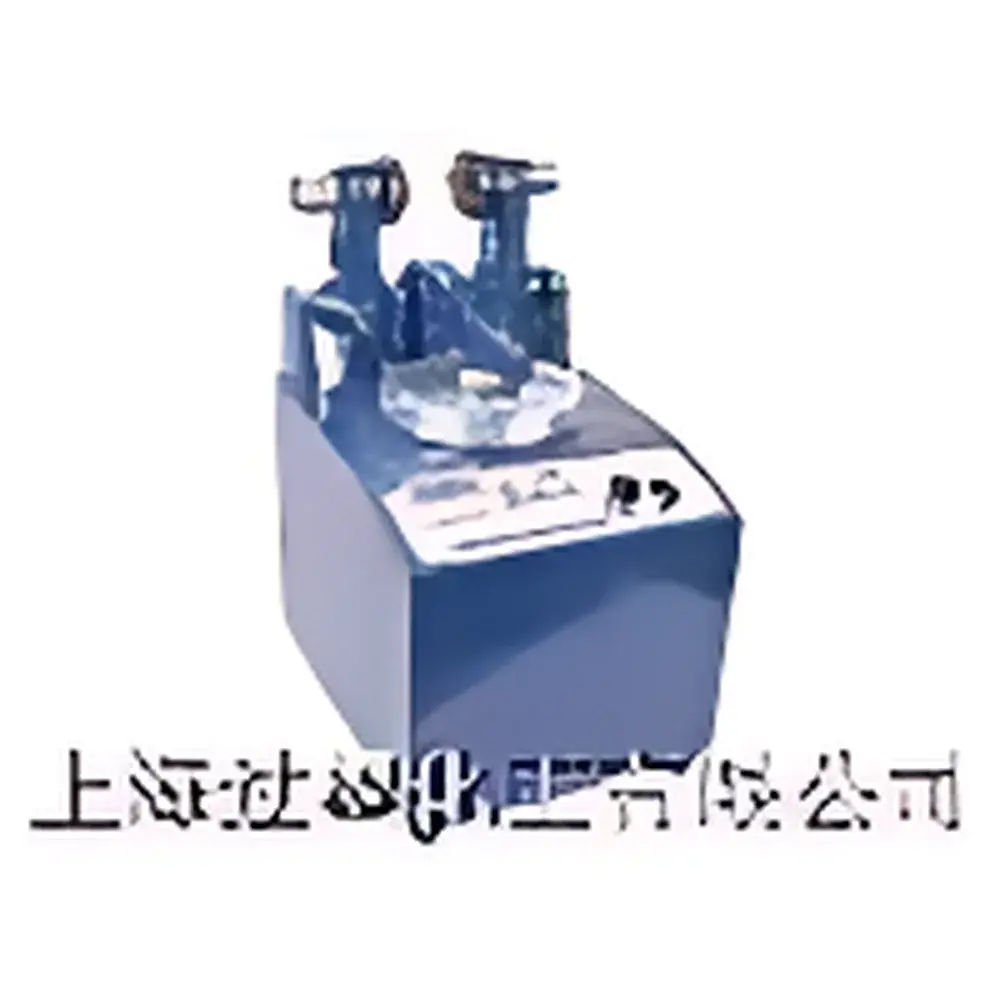
JM-4 Paint Film Abrasion Tester
| Origin | Shanghai, China |
|---|---|
| Manufacturer Type | Distributor |
| Origin Category | Domestic (China) |
| Model | JM-4 |
| Pricing | Upon Request |
| Motor | 40 W, 220 V, 50 Hz |
| Rotational Speed Range | 0–90 rpm |
| Sample Holder Diameter | Φ100 mm × 3 mm thick with Φ6.2 mm center hole |
| Abrasive Wheel Dimensions | Φ50 mm × 13 mm thick with Φ16 mm center hole |
| Standard Weights | 500 g, 750 g, 1000 g |
| Overall Dimensions (L×W×H) | 220 × 280 × 300 mm |
| Net Weight | 16 kg |
Overview
The JM-4 Paint Film Abrasion Tester is a precision-engineered tribological testing instrument designed to quantify the resistance of coated surfaces and thin-sheet materials to abrasive wear under controlled, standardized conditions. Based on the principle of rotary abrasion—where a rotating abrasive wheel applies defined normal force and tangential motion against a stationary or rotating specimen—the JM-4 enables reproducible evaluation of surface durability in accordance with widely adopted test methods including ASTM D4060 (Standard Test Method for Abrasion Resistance of Organic Coatings by the Taber Abraser), ISO 5470-1, and GB/T 1768–2006 (Chinese national standard for paint film abrasion resistance). The device employs a direct-drive motor coupled with a continuously variable speed control system, allowing precise adjustment of rotational velocity from 0 to 90 rpm—critical for simulating diverse service environments ranging from pedestrian foot traffic on floor coatings to vehicular abrasion on road markings.
Key Features
- Continuous variable speed regulation (0–90 rpm) ensures compatibility with multiple test protocols requiring specific rotational frequencies.
- Modular abrasive wheel mounting system accommodates interchangeable wheels with standardized dimensions (Φ50 mm × 13 mm, Φ16 mm center bore), supporting common abrasive media such as S-10, S-11, CS-10F, and H-18 wheels per ASTM D4060 specifications.
- Dual-purpose sample stage: accepts flat specimens up to Φ100 mm in diameter and 3 mm thickness, with a precisely machined Φ6.2 mm center locating hole for repeatable positioning and concentric loading.
- Calibrated dead-weight loading system includes three certified stainless-steel masses (500 g, 750 g, and 1000 g), enabling application of nominal normal forces of 4.9 N, 7.4 N, and 9.8 N—fully traceable to SI units and compliant with force reporting requirements in GLP environments.
- Compact benchtop architecture (220 × 280 × 300 mm) and low-mass design (16 kg net weight) facilitate integration into QC laboratories, R&D facilities, and accredited testing centers without dedicated floor space or reinforced flooring.
- Brushless 40 W AC motor (220 V, 50 Hz) delivers stable torque output across the full speed range, minimizing speed drift during extended test cycles and ensuring high inter-test reproducibility.
Sample Compatibility & Compliance
The JM-4 supports a broad spectrum of planar, rigid, or semi-rigid substrates—including solvent- and water-based architectural paints, marine deck coatings, automotive topcoats, industrial epoxy floors, PVC flooring sheets, laminated decorative panels, coated paperboard, and woven/nonwoven textiles. Specimen preparation follows standardized conditioning per ISO 291 (standard atmosphere: 23 °C ± 2 °C, 50 % RH ± 5 % RH) prior to testing. All mechanical components—including load-bearing shafts, bearing housings, and wheel clamping mechanisms—are manufactured to ISO 2768-mK general tolerances, ensuring long-term dimensional stability and minimal runout (< 0.05 mm TIR). The instrument conforms to electromagnetic compatibility (EMC) requirements per EN 61326-1 and electrical safety standards per EN 61010-1, making it suitable for use in ISO/IEC 17025-accredited laboratories.
Software & Data Management
While the JM-4 operates as a manual, analog-controlled instrument, its mechanical design incorporates features essential for digital traceability and audit readiness. Each test cycle is initiated and terminated via front-panel controls with tactile feedback; rotation count is tracked using a calibrated mechanical counter (optional digital tachometer interface available upon request). For laboratories implementing electronic recordkeeping, the JM-4 integrates seamlessly with LIMS or ELN platforms through external pulse-output modules (e.g., TTL-compatible encoder signals). All applied loads, rotational speeds, wheel types, and cycle counts are manually logged in accordance with 21 CFR Part 11-compliant documentation practices when paired with validated SOPs and analyst training records. Raw data—including mass loss (measured gravimetrically pre- and post-test using analytical balances meeting USP accuracy criteria)—is retained in secure, version-controlled test reports.
Applications
- Quality assurance of protective coatings for marine, aerospace, and infrastructure applications where abrasion resistance directly correlates with service life.
- Formulation development of high-durability floor finishes, including UV-curable acrylates and polyaspartic systems.
- Comparative ranking of pigment dispersion stability and binder toughness in latex-based wall paints.
- Evaluation of scratch-and-scuff resistance in thermoplastic decorative laminates used in furniture and cabinetry.
- Validation of coating adhesion retention after cyclic abrasion, per ASTM D3359 cross-hatch + abrasion sequences.
- Pre-screening of textile surface treatments (e.g., fluorocarbon finishes) for resistance to mechanical wear in upholstery and technical fabrics.
FAQ
What standards does the JM-4 comply with for abrasion testing?
The JM-4 is engineered to support test execution aligned with ASTM D4060, ISO 5470-1, and GB/T 1768–2006. Its mechanical specifications—including wheel geometry, load application method, and rotational stability—meet the physical prerequisites of these standards.
Can the JM-4 be used for wet abrasion testing?
No—the JM-4 is configured for dry-abrasion testing only. Wet abrasion protocols (e.g., ASTM D1044) require fluid delivery systems, corrosion-resistant components, and sealed drive mechanisms not present in this model.
Is calibration certification included with shipment?
A factory-issued mechanical verification report is provided, confirming compliance with dimensional, rotational, and load-application tolerances. Third-party ISO/IEC 17025 calibration services are available upon request.
What maintenance is required to ensure long-term accuracy?
Monthly inspection of wheel mounting threads, annual lubrication of motor bearings with NLGI #2 lithium grease, and quarterly verification of weight mass values using NIST-traceable calibrations are recommended.
Does the JM-4 support automatic test termination?
Not natively. Termination is operator-initiated. However, optional add-ons—including programmable timers and encoder-based cycle counters—can be integrated to enable preset endpoint control.



