
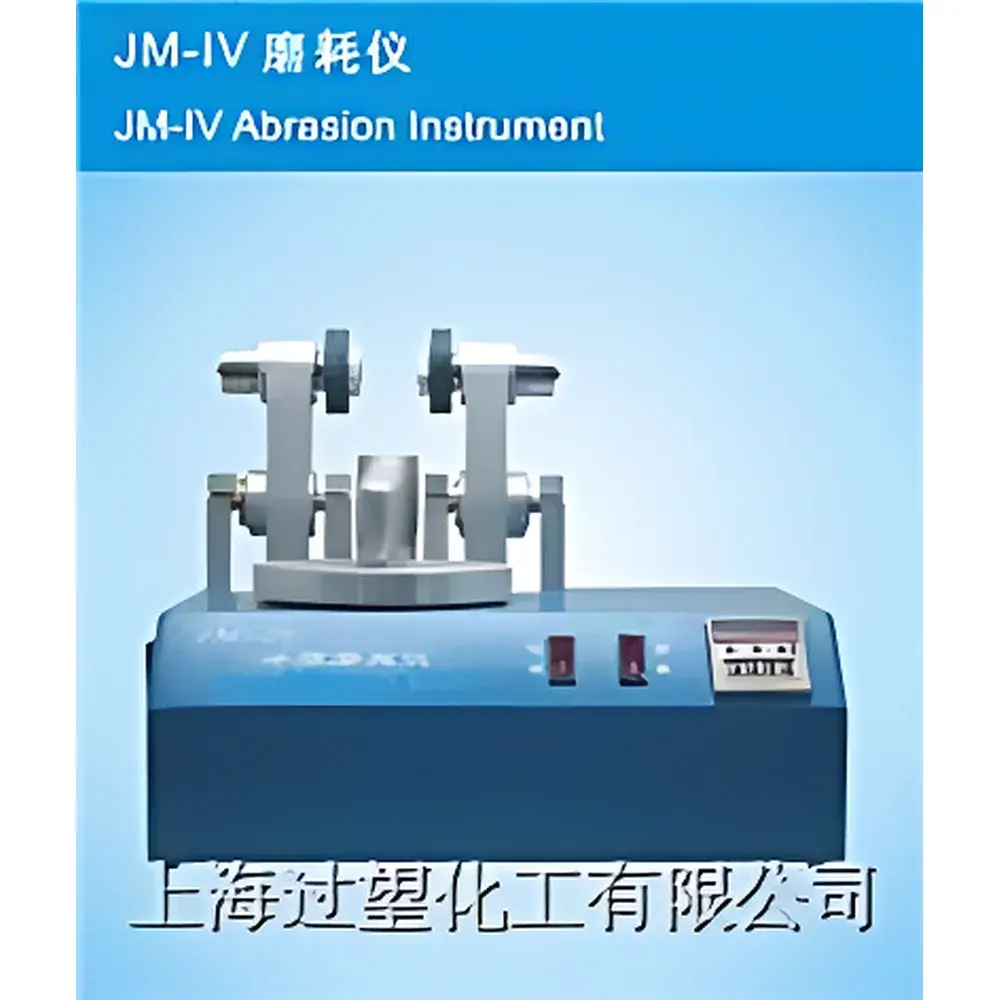
Jiangsu JM-IV Abrasion Tester
| Origin | Shanghai, China |
|---|---|
| Manufacturer Type | Authorized Distributor |
| Origin Category | Domestic (PRC) |
| Model | JM-IV |
| Pricing | Available Upon Request |
| Main Motor | 40 W, 220 V, 50 Hz |
| Turntable Speed Range | 0–70 rpm (infinitely variable) |
| Specimen Holder Diameter | φ100 mm × φ6.2 mm (center hole) × 3 mm |
| Abrasive Wheel Dimensions | φ50 mm × φ16 mm (center hole) × 13 mm |
| Standard Load Masses | 500 g, 750 g, 1000 g |
| Net Weight | 15 kg |
| Overall Dimensions (L×W×H) | 340 × 240 × 200 mm |
Overview
The Jiangsu JM-IV Abrasion Tester is a precision-engineered tribological testing instrument designed for quantitative evaluation of surface wear resistance under controlled rotary abrasion conditions. Based on the principle of rotating abrasive wheel contact against a stationary or rotating flat specimen—commonly aligned with ASTM D4060 (Standard Test Method for Abrasion Resistance of Organic Coatings by the Taber Abraser), ISO 5470-1, and GB/T 1768—this tester delivers repeatable, traceable results for quality control and R&D laboratories in coatings, polymers, paper, textiles, and laminated composites industries. Its modular design centers on a vertically aligned abrasive wheel driven by a low-noise, brushless DC motor, applying calibrated normal force via standardized dead-weight masses onto a horizontally mounted test specimen. The instrument operates within a defined kinematic regime where material removal rate is directly correlated to applied load, rotational speed, abrasive media hardness/geometry, and exposure duration—enabling comparative ranking of wear performance across diverse substrate classes.
Key Features
- Infinitely variable turntable speed control (0–70 rpm) via precision potentiometer, enabling precise replication of industry-standard test protocols requiring specific angular velocities.
- Dual-load configuration support: interchangeable 500 g, 750 g, and 1000 g calibrated stainless-steel weights conforming to ISO/IEC 17025 traceability requirements for force application.
- Modular abrasive wheel mounting system accommodating standard φ50 mm × 13 mm wheels with φ16 mm center bore—compatible with alumina, silicon carbide, and custom-specified abrasive media per ASTM D4060 Annex A1.
- Robust aluminum alloy frame with vibration-dampening base plate ensures mechanical stability during extended test cycles (up to 1000 cycles), minimizing measurement drift.
- Specimen holder engineered to ISO 5470-1 dimensional tolerances: φ100 mm diameter platform with φ6.2 mm center locating pin and 3 mm thickness—optimized for uniform clamping pressure distribution and minimal edge lift.
- Integrated safety interlock prevents operation when access cover is open; all electrical components comply with IEC 61000-6-3 EMC emission standards.
Sample Compatibility & Compliance
The JM-IV supports flat, rigid specimens up to 3 mm thickness and 100 mm diameter—including solvent- and water-based architectural coatings (e.g., marine deck paints, industrial floor epoxies, road marking thermoplastics), coated papers (e.g., glossy magazine stock), synthetic textiles (e.g., polyester upholstery fabrics), PVC and ABS plastic sheets, melamine-faced decorative panels, and anodized aluminum substrates. All test configurations adhere to the geometric and procedural constraints outlined in ASTM D4060 Sections 6–8 and ISO 5470-1 Clause 5. While not certified to GLP or GMP out-of-the-box, the instrument’s mechanical repeatability (±1.2% CV over 10 replicate runs per ASTM D4060 Section 11.2) supports qualification under internal laboratory validation protocols compliant with ISO/IEC 17025:2017 Clause 7.7.
Software & Data Management
The JM-IV operates as a standalone electromechanical tester without embedded firmware or digital interface. Data acquisition is manual: users record cycle count, elapsed time, and post-test mass loss (via analytical balance) or haze/gloss change (via separate spectrophotometer). This architecture eliminates software validation overhead—making it suitable for regulated environments where FDA 21 CFR Part 11 compliance is not required, but mechanical audit trails must remain unambiguous. Laboratories integrating the JM-IV into validated workflows commonly document test parameters using controlled paper forms or LIMS-integrated Excel templates with revision-controlled SOPs referencing ASTM D4060 and internal calibration records for weights and turntable tachometer verification.
Applications
- Coating Formulation Development: Screening binder-resin systems for improved mar and scuff resistance in high-traffic floor coatings.
- Quality Assurance of Roll-to-Roll Laminates: Verifying abrasion endurance of printed PET films prior to packaging line integration.
- Textile Durability Benchmarking: Assessing pilling resistance of woven nylon fabrics used in automotive seating.
- Construction Material Certification: Supporting third-party testing reports for CE-marked decorative wall panels per EN 438-2 Annex E.
- Academic Tribology Studies: Serving as a low-cost, mechanically transparent platform for undergraduate friction-wear correlation experiments.
FAQ
What standards does the JM-IV comply with?
It is configured to execute test methods aligned with ASTM D4060, ISO 5470-1, and GB/T 1768—though formal certification requires user-performed verification per each standard’s apparatus validation clauses.
Can the JM-IV accommodate non-circular specimens?
No—it requires flat, circular specimens of φ100 mm diameter with a centered φ6.2 mm locating hole for consistent rotational alignment and load distribution.
Is calibration service available for the turntable speed and load masses?
Yes—traceable calibration certificates for speed (±0.5 rpm accuracy) and weights (Class M2 tolerance per OIML R111) are provided upon request through accredited metrology partners.
Does the instrument include abrasive wheels?
No—wheels are selected and procured separately based on test specification (e.g., CS-10, CS-17 per ASTM D4060); compatibility is confirmed via dimensional verification against φ50 mm × φ16 mm × 13 mm geometry.
What maintenance is required?
Monthly inspection of wheel mounting threads, quarterly lubrication of turntable bearing with ISO VG 32 mineral oil, and annual verification of motor torque consistency using a calibrated dynamometer.



