
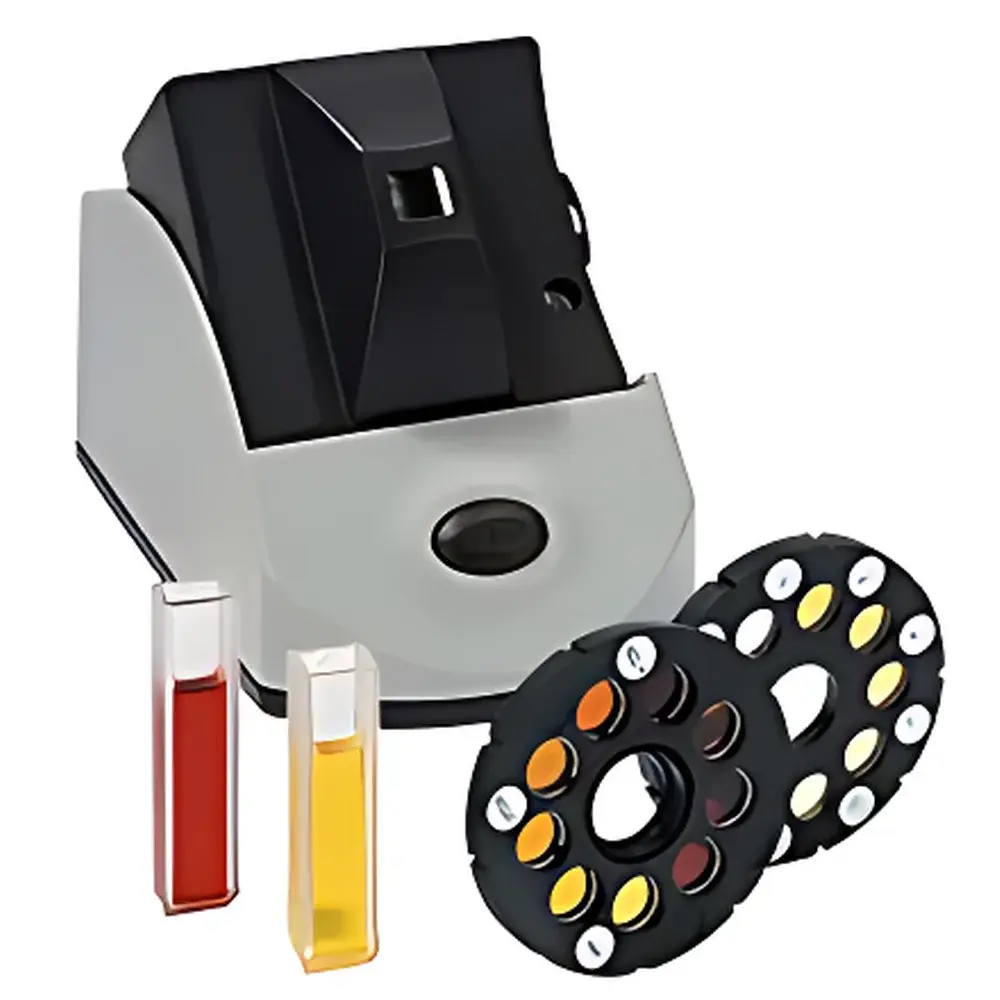
Orbeco-Hellige Gardner-Hellige 705-VA2 Transparent Liquid Colorimeter
| Brand | Orbeco-Hellige |
|---|---|
| Origin | USA |
| Model | 705-VA2 |
| Compliance | ASTM D-1544, AOCS Td 1a |
| Color Scale Range | Gardner No. 1–18 (via dual calibrated discs No.602C-43 and No.602C-44) |
| Sample Vessels | Two cylindrical quartz tubes (Part No. 605-VT) |
| Illumination | Daylight-simulating light source (Part No. 600-DA) |
| Optical System | Precision-aligned prismatic magnifier for side-by-side visual comparison |
Overview
The Orbeco-Hellige Gardner-Hellige 705-VA2 Transparent Liquid Colorimeter is a precision optical comparator engineered for standardized visual assessment of color in transparent, low-viscosity organic liquids. It operates on the principle of subjective but rigorously controlled color matching—comparing the hue and depth of a liquid sample against a series of stable, factory-calibrated glass color standards under controlled illumination. This method aligns with the fundamental requirements of ASTM D-1544 (“Standard Test Method for Color of Transparent Liquids (Gardner Color Scale)”) and AOCS Official Method Td 1a, making it an essential tool for quality control laboratories in coatings, resins, edible oils, fatty acids, nitrocellulose lacquers, and related chemical manufacturing sectors. Unlike spectrophotometric instruments, the 705-VA2 delivers results traceable to the original Gardner scale definition—ensuring consistency across decades of historical data and inter-laboratory comparisons where regulatory or contractual specifications reference Gardner units explicitly.
Key Features
- Dual-disc calibration system comprising two thermally stable, interference-filtered glass color wheels: No.602C-43 (Gardner 1–9) and No.602C-44 (Gardner 9–18), enabling seamless coverage across the full 18-step Gardner scale without interpolation or extrapolation.
- Integrated daylight-simulating illumination unit (Part No. 600-DA) with CIE Standard Illuminant C spectral power distribution, minimizing metamerism and ensuring reproducible viewing conditions independent of ambient lighting.
- High-fidelity prismatic magnifier providing 2× angular magnification and precise collimation, facilitating accurate side-by-side visual alignment between sample and reference disc segments.
- Two matched cylindrical quartz sample tubes (Part No. 605-VT), each with 10 mm path length and optically polished ends, designed to minimize internal reflection artifacts and ensure consistent cell geometry across measurements.
- Robust aluminum alloy housing with anti-vibration base and adjustable leveling feet, optimized for benchtop stability during extended visual assessments.
- No electronics or software dependency—fully mechanical operation ensures long-term calibration integrity, zero drift, and compliance with GLP environments requiring instrument simplicity and auditability.
Sample Compatibility & Compliance
The 705-VA2 is validated for use with transparent, non-turbid liquids having optical clarity sufficient to permit unobstructed transmission through a 10 mm path length. Typical applications include alkyd resins, linseed oil, rosin esters, shellac solutions, nitrocellulose lacquers, tall oil fatty acids, and refined vegetable oils. It excludes opaque, hazy, or highly fluorescent samples, which require alternative methods such as ASTM D1209 (Platinum-Cobalt scale) or spectrophotometric analysis. The instrument meets the physical design and operational criteria specified in ASTM D-1544 Section 6 (Apparatus) and AOCS Td 1a Annex A. Its mechanical construction supports routine verification using NIST-traceable Gardner standard reference liquids (SRMs), and documentation of disc calibration history satisfies FDA 21 CFR Part 11 requirements when integrated into validated laboratory workflows.
Software & Data Management
The 705-VA2 is a purely analog, operator-dependent measurement device and does not incorporate digital electronics, firmware, or onboard data storage. All readings are recorded manually by trained personnel following documented SOPs. Laboratories implementing this instrument within regulated environments (e.g., GMP or ISO/IEC 17025-accredited facilities) typically integrate it into electronic lab notebooks (ELNs) or LIMS platforms via structured manual entry templates that capture observer ID, sample ID, date/time, observed Gardner number, disc used, and verification status. Audit trails are maintained externally; no software validation is required for the instrument itself, though procedural validation—including inter-operator repeatability studies and periodic recalibration verification—is mandatory per ISO/IEC 17025 Clause 7.7.
Applications
- Batch release testing of resin solutions in paint and ink manufacturing, where Gardner color deviation beyond ±1 unit triggers rework or rejection.
- Monitoring oxidative degradation in drying oils during storage or thermal processing, correlating Gardner number increase with peroxide value and acid number trends.
- Quality conformance of edible oil refining intermediates, particularly in deodorized soybean or sunflower oil production lines.
- Raw material acceptance testing for nitrocellulose grades used in aerospace coating formulations, where color stability directly correlates with nitrogen content homogeneity.
- Stability studies of UV-curable acrylate monomers, tracking yellowing kinetics under accelerated aging protocols.
FAQ
Is the 705-VA2 suitable for measuring colored solvents like xylene or toluene?
Yes—provided the solvent is optically clear and free of suspended particulates or phase separation. However, volatile solvents must be assessed promptly after filling to avoid evaporation-induced meniscus distortion.
Can Gardner values obtained with the 705-VA2 be converted to CIELAB or other spectrophotometric color spaces?
No direct mathematical conversion exists. Gardner is a perceptual ordinal scale tied to specific glass filters and viewing geometry; correlation studies require empirical mapping per material class and are not transferable across chemistries.
How often should the color discs be replaced or recertified?
Orbeco-Hellige recommends disc recalibration every 24 months or after 5,000 visual comparisons, whichever occurs first. Discs exposed to UV-rich environments or aggressive solvents may require more frequent verification.
Does the instrument require annual third-party calibration?
Not mandated by ASTM or AOCS, but accredited labs commonly include disc verification and illumination intensity checks in their annual equipment qualification protocol.
What is the minimum sample volume required per test?
Each 605-VT tube holds approximately 3.5 mL; full fill to the etched line is required for correct path length and meniscus positioning.




