
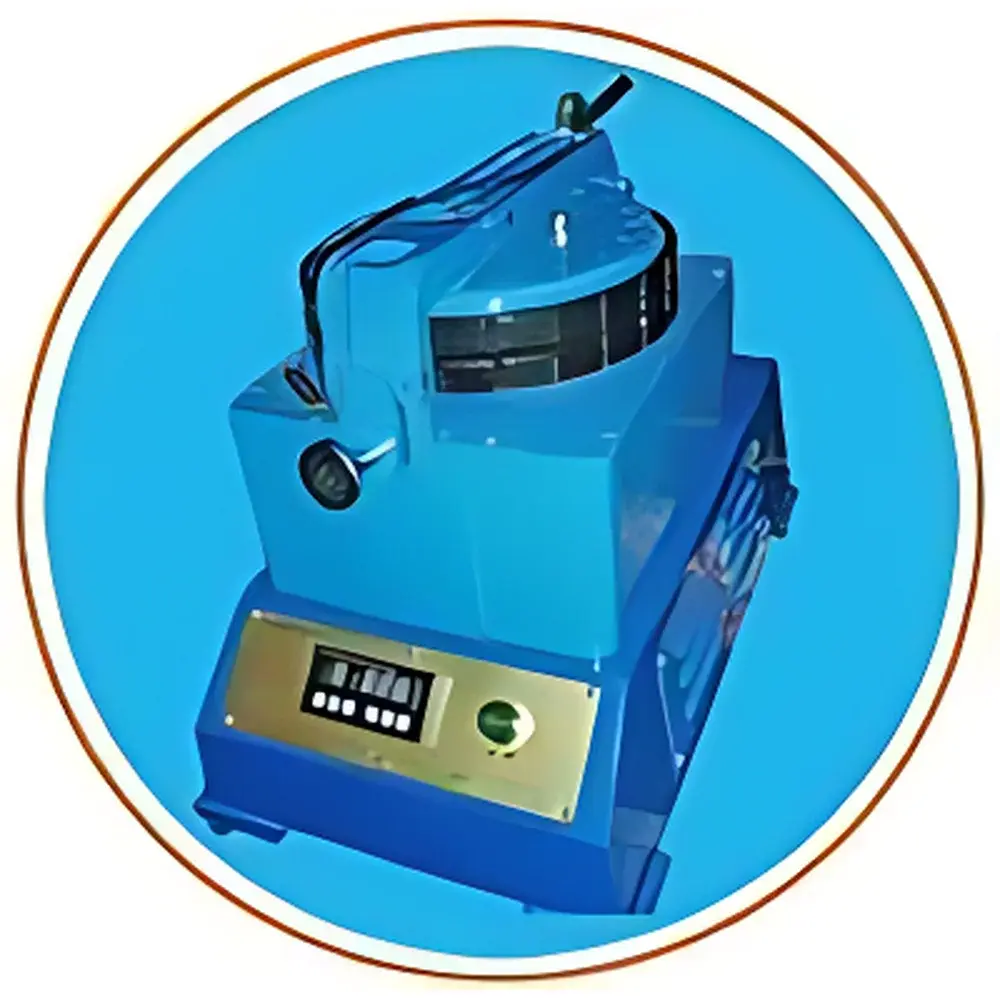
PM240-D Planetary Abrasion Tester
| Origin | Shanghai, China |
|---|---|
| Manufacturer Type | Authorized Distributor |
| Origin Category | Domestic (China) |
| Model | PM240-D |
| Motor Power | 0.75 kW |
| Supply Voltage | 380 V, 50 Hz (220 V optional) |
| Platen Speed | 75 ± 5 rpm |
| Load Options | 43 kg, 64 kg, 100 kg |
| Digital Counter Range | 0–9999 cycles |
| Dimensions (L×W×H) | 580 × 360 × 480 mm |
| Net Weight | 80 kg |
Overview
The PM240-D Planetary Abrasion Tester is a precision-engineered tribological testing instrument designed for standardized evaluation of abrasion resistance, dispersion stability, and pigment grinding efficiency in pigments, coatings, inks, and related dispersions. It operates on the principle of planetary motion—where a rotating glass or steel grinding disc applies controlled mechanical shear and compressive load to a sample under defined pressure and rotational frequency—enabling reproducible simulation of industrial milling and attrition processes. Compliant with GB/T 5211.19–1988 (“Determination of Relative Tinting Strength and Tinting Power of Color Pigments by Visual Comparison”), the PM240-D serves as a critical reference instrument for quality control laboratories in R&D and production environments where batch-to-batch consistency of colorant performance must be quantified objectively.
Key Features
- Microcontroller-based digital control system ensures stable platen speed (75 ± 5 rpm) and precise cycle counting (0–9999), with real-time display via high-contrast LED interface.
- Modular load configuration supports three standardized test masses (43 kg, 64 kg, and 100 kg), enabling method-specific calibration per ASTM D281, ISO 787-16, or internal QC protocols.
- Quick-release glass grinding disc mounting mechanism allows tool-free installation and removal—minimizing downtime between tests and facilitating cleaning or disc replacement.
- Robust cast-iron frame and vibration-damped base provide mechanical stability during extended operation, ensuring measurement repeatability across multiple test runs.
- Motor-driven planetary motion architecture delivers uniform radial force distribution across the grinding surface, reducing edge effects and improving inter-laboratory comparability.
- Optional 220 V / 50 Hz power configuration available for international deployment in regions with single-phase industrial supply infrastructure.
Sample Compatibility & Compliance
The PM240-D accommodates standard 100 mm diameter glass or tempered steel grinding discs and accepts sample volumes of 1–5 g (typical for pigment pastes, resin-bound colorants, and aqueous dispersions). Its mechanical design aligns with requirements for method validation under GLP-compliant environments. While primarily referenced in GB/T 5211.19–1988, its operational parameters are traceable to internationally recognized tribological test frameworks—including ISO 787-16 (pigment dispersion assessment), ASTM D281 (grind gauge verification), and ISO 15184 (pencil hardness correlation studies). The unit’s fixed-speed, constant-load architecture ensures compliance with regulatory audit expectations for instrument qualification (IQ/OQ/PQ) in GMP-aligned coating and ink manufacturing facilities.
Software & Data Management
The PM240-D operates via embedded firmware without external PC dependency; however, its digital counter output (TTL-compatible pulse signal) supports integration with third-party data acquisition systems (e.g., LabVIEW, MATLAB, or custom SCADA platforms) for automated logging, statistical process control (SPC), and long-term trend analysis. Cycle count data can be exported manually via RS-232 interface (optional add-on) for inclusion in electronic lab notebooks (ELN) compliant with FDA 21 CFR Part 11 requirements—provided user-configured audit trails and electronic signature controls are implemented at the host system level. No proprietary software is bundled; all calibration and operational records remain under full user control.
Applications
- Quantitative assessment of relative tinting strength and dilution behavior of organic and inorganic pigments per GB/T 5211.19.
- Dispersion stability screening of titanium dioxide, carbon black, and phthalocyanine pigments in solvent- and water-based systems.
- Grind fineness validation for automotive OEM coatings, architectural paints, and packaging inks prior to filtration and spray application.
- Accelerated wear simulation for functional fillers (e.g., conductive carbon, anti-corrosion zinc dust) in protective coating formulations.
- QC benchmarking of mill base consistency across multi-shift production lines, supporting Six Sigma process capability (Cpk) analysis.
FAQ
Is the PM240-D suitable for use outside China?
Yes—the unit supports voltage customization (220 V / 50 Hz) and meets CE-marking mechanical safety prerequisites when installed with appropriate local grounding and enclosure certification.
Can test results from the PM240-D be correlated to ISO or ASTM methods?
Direct equivalence requires method adaptation and cross-validation; however, its load/speed parameters fall within the operational envelope of ISO 787-16 Annex B and ASTM D281 Procedure A, making it suitable for comparative internal QC when documented in SOPs.
Does the instrument include calibration documentation?
Factory calibration certificates for speed and load verification are provided; users are responsible for periodic verification using NIST-traceable tachometers and calibrated deadweight sets per ISO/IEC 17025 guidelines.
What maintenance is required for long-term reliability?
Biannual inspection of drive belt tension, bearing lubrication (grease type: NLGI #2 lithium complex), and disc surface flatness (measured with optical flat and monochromatic light) is recommended.
Is remote diagnostics supported?
No native remote access is integrated; however, the digital counter’s TTL output enables integration into facility-wide predictive maintenance systems via PLC gateways.



