
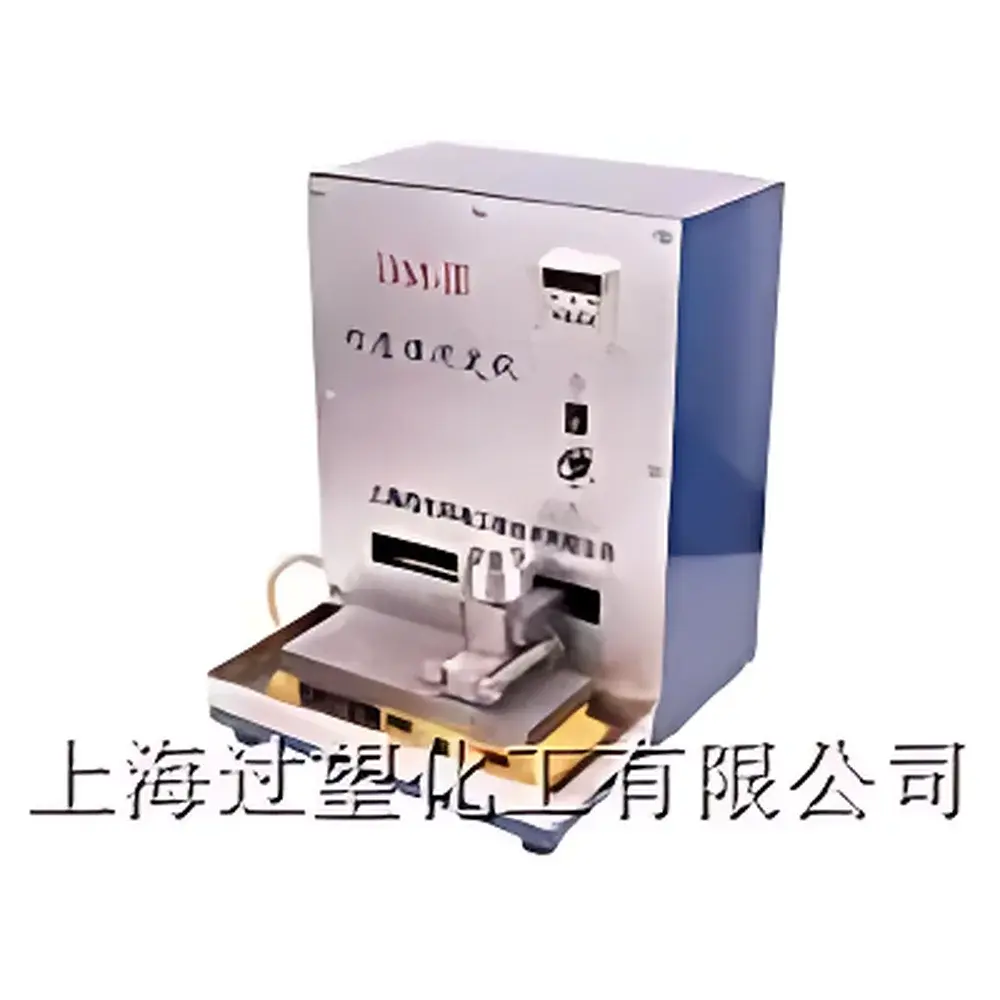
English Product Name
| Origin | Shanghai, China |
|---|---|
| Manufacturer Type | Authorized Distributor |
| Origin Category | Domestic (China) |
| Model | DM-III |
| Pricing | Available Upon Request |
| Stroke Frequency | 0–135 cycles/min (single-pass) |
| Counter Range | 0–9999 (dual-pass |
| Abrading Head Mass | 570 ± 20 g |
| Optional Weights | 50 g, 100 g, 200 g |
| Power Supply | 220 V, 50 Hz |
| Rated Power | 60 W |
| Dimensions (L×W×H) | 300 × 280 × 380 mm |
| Net Weight | ~25 kg |
Overview
The DM-III Abrasion Resistance Tester is a precision-engineered tribological testing instrument designed specifically for the quantitative evaluation of sanding resistance in architectural and industrial coating systems—particularly primers, fillers, and putties. It operates on a controlled reciprocating motion principle, simulating standardized manual sanding conditions under defined load, stroke frequency, and cycle count. The device applies a calibrated normal force via a magnetic chuck-mounted abrading head, enabling repeatable linear back-and-forth motion across the specimen surface. This mechanical configuration replicates real-world finishing operations where operator-dependent variables are minimized, allowing objective comparison of material response to abrasive wear. The tester complies with core principles referenced in ASTM D4060 (Standard Test Method for Abrasion Resistance of Organic Coatings by the Taber Abraser) and ISO 1518-1 (Paints and varnishes — Determination of resistance to sanding), adapted for flat-surface, hand-sanding–type evaluation rather than rotary abrasion. Its design emphasizes metrological stability, mechanical reproducibility, and operator safety during routine QC inspection.
Key Features
- Magnetic sample mounting system ensures rapid, alignment-free specimen loading and secure fixation without clamps or adhesives—critical for high-throughput laboratory environments.
- Digital dual-pass counter with 0–9999 range provides traceable, non-volatile cycle logging; total abrasion events are automatically calculated as displayed value × 2, eliminating manual conversion errors.
- Adjustable vertical load configuration: standard abrading head mass of 570 ± 20 g, supplemented by optional calibrated weights (50 g, 100 g, 200 g) to simulate varying hand pressure conditions per application requirements.
- Stepless stroke frequency control (0–135 cycles/min, single-pass) enables precise tuning of mechanical energy input—essential for method development and inter-laboratory correlation studies.
- Compact benchtop footprint (300 × 280 × 380 mm) and low power consumption (60 W, 220 V / 50 Hz) support integration into ISO/IEC 17025-accredited testing labs without dedicated utility infrastructure.
- Robust aluminum alloy frame with reinforced linear guide rails ensures long-term dimensional stability and minimal mechanical drift over extended operational cycles.
Sample Compatibility & Compliance
The DM-III accommodates flat, rigid substrates up to 150 mm × 150 mm (e.g., glass, cold-rolled steel, MDF panels) coated with waterborne or solventborne primers, body fillers, and surfacers. Specimen thickness must allow full magnetic coupling (typically ≤ 6 mm for steel-backed samples). The instrument supports test protocols aligned with internal OEM specifications and regional regulatory frameworks—including China’s HG/T 3828–2006 (Testing Method for Sanding Resistance of Architectural Coatings) and European EN 13523-13 (Coil Coated Metals — Test Methods — Part 13: Resistance to Sanding). While not certified to GLP or GMP out-of-the-box, its deterministic mechanical operation and digital counter output meet baseline data integrity requirements for audit-ready documentation when paired with lab-controlled SOPs.
Software & Data Management
The DM-III operates as a standalone electromechanical system with no embedded microprocessor or proprietary software. All operational parameters are set manually via front-panel controls; cycle counts are displayed on a high-contrast LED counter with battery backup memory. For digital data capture and traceability, users may integrate external USB-connected counters or log results directly into LIMS or Excel-based QC templates. The absence of firmware eliminates cybersecurity vulnerabilities and simplifies validation—making it suitable for regulated environments where software qualification (per FDA 21 CFR Part 11 or EU Annex 11) would otherwise introduce complexity. Audit trails rely on procedural documentation (e.g., signed test records, calibration logs, and weight certification reports).
Applications
- Quality control of automotive primer-surfacer systems prior to topcoat application.
- Formulation screening for water-based putties used in furniture manufacturing.
- Comparative assessment of sanding dust generation across different filler chemistries (e.g., calcium carbonate vs. talc-filled acrylics).
- Process validation of curing schedules—under-cured coatings exhibit premature wear onset, detectable via reduced cycle-to-failure thresholds.
- Supplier qualification testing against tier-1 OEM sanding performance specifications (e.g., GMW14872, Ford CETP 00.00-L-467).
- Academic research on polymer network crosslink density effects on surface plastic deformation under cyclic shear loading.
FAQ
What standard test methods does the DM-III support?
It is engineered to align with HG/T 3828–2006 and adaptable to principles in ASTM D4060 and ISO 1518-1, though method adaptation requires user-defined SOPs.
Can the abrading head be replaced with alternative media?
Yes—the magnetic interface accepts custom-machined heads with standardized M6 threading; users commonly substitute P120–P220 aluminum oxide sandpaper discs or silicon carbide pads.
Is calibration certification included?
A factory-issued calibration report covering counter linearity and weight verification is provided; annual recalibration against NIST-traceable masses is recommended.
Does the instrument require compressed air or vacuum?
No—it operates solely on electrical power; no auxiliary utilities are needed.
What maintenance intervals are recommended?
Lubrication of linear guides every 500 operating hours and inspection of magnetic chuck integrity every 6 months ensure optimal repeatability.



