
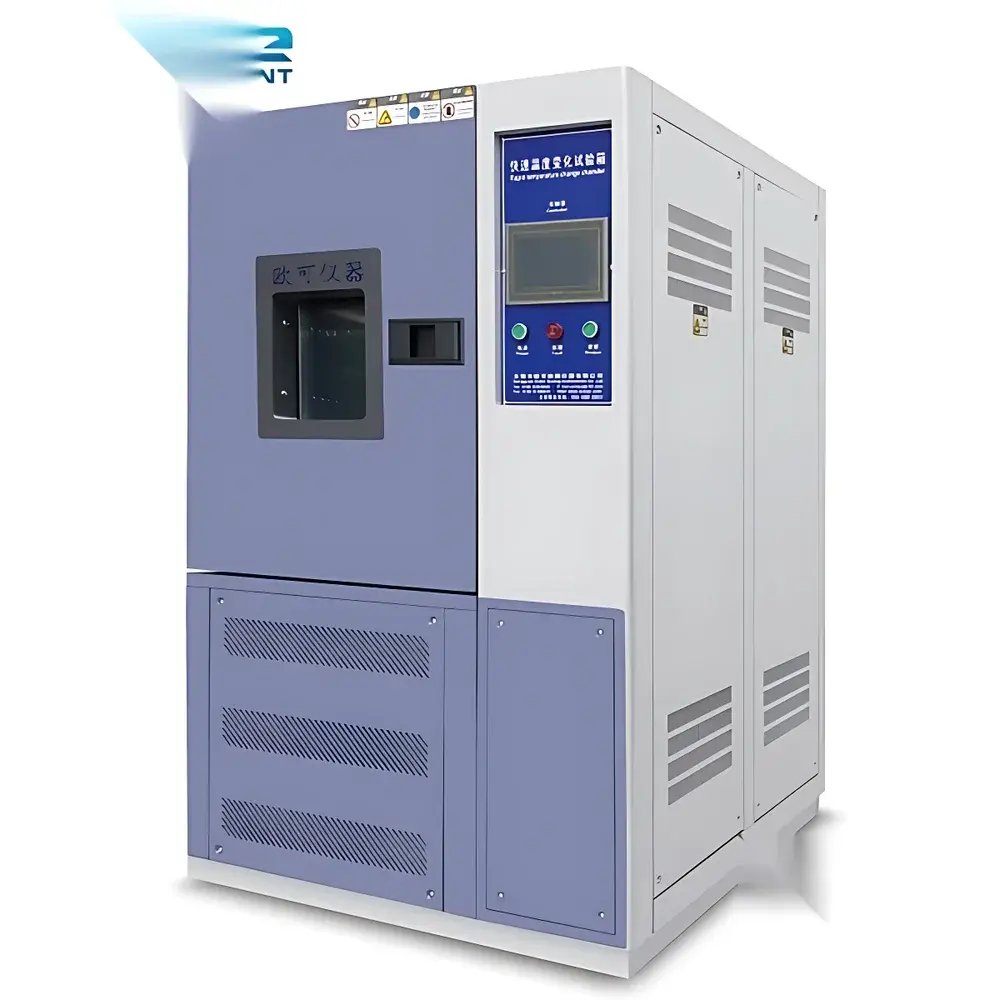
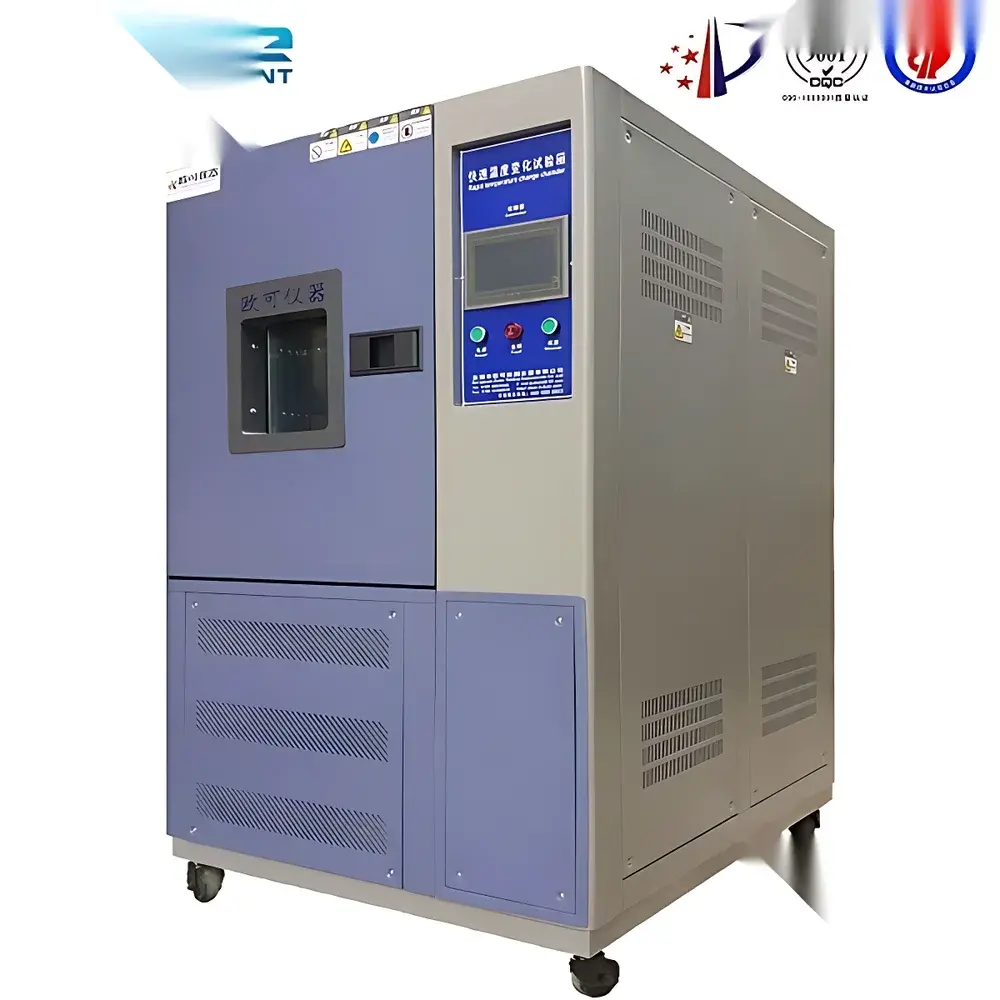
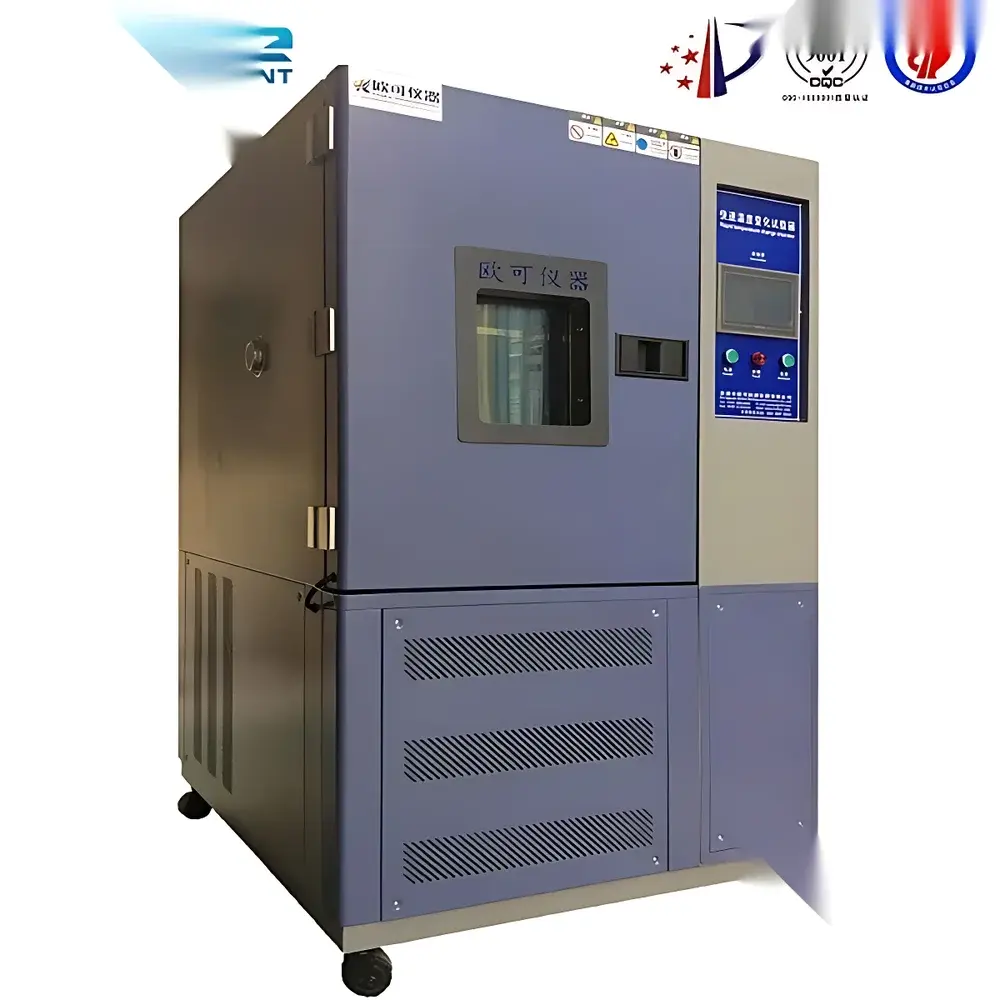
Quick Temperature Transition Environmental Chamber – Industrial-Grade Thermal Shock Test System
| Temperature Range | -70 to +150 °C |
|---|---|
| Humidity Range | 20–98% RH |
| Temperature Uniformity | ±1 °C |
| Humidity Uniformity | ±5% RH |
| Refrigerant | R404A/R23 (ODP = 0, GWP-optimized blend) |
| Controller | PLC-Based Touchscreen HMI with Embedded Test Sequencing Software |
| Optional | RS232/RS485 Interface, Paperless Data Logger, Remote Monitoring Suite (PC + Software + Cables) |
Overview
The Quick Temperature Transition Environmental Chamber is an industrial-grade thermal shock test system engineered for high-fidelity, repeatable evaluation of material and component reliability under rapid, controlled thermal transients. It operates on a two-zone (hot/cold) or single-chamber forced-air circulation architecture—configurable per application—to deliver precise, programmable temperature transitions at rates up to 15 °C/min (typical), with dwell stabilization times validated per IEC 60068-2-14 Clause 6. This chamber is not a general-purpose climatic cabinet; it is purpose-built for accelerated stress testing where thermal inertia, sensor placement fidelity, and test zone representativeness are critical to data integrity. Its design prioritizes metrological traceability: temperature and humidity sensors are embedded directly within the usable test volume—not in air ducts—ensuring measurements reflect actual specimen exposure conditions. The chamber’s structural integrity, refrigeration redundancy, and aluminum-based load validation protocol eliminate plastic-induced thermal lag artifacts common in lower-tier systems, making it suitable for qualification-level testing in regulated environments.
Key Features
- Test zone sensor placement compliant with ASTM E2293 and ISO 16750-4 requirements for thermal shock validity
- Dual-facing access doors (front and rear) enabling seamless integration into inline production or automated handling workflows
- Adjustable LCD-tilt mounting fixtures for ergonomic positioning and optical alignment of flat-panel displays during thermal cycling
- Aluminum thermal mass validation standard—no plastic dummy loads—ensuring realistic heat transfer dynamics during qualification runs
- Low-temperature 0 °C shock capability with energy-optimized compressor staging, reducing power demand without compromising transition repeatability
- Integrated support for lead-free process validation, including extended dwell protocols for tin whisker growth assessment per IPC-J-STD-002 and JEDEC JESD201
- Double-glazed, low-emissivity heated viewing window with anti-condensation coating—maintains optical clarity down to −70 °C
Sample Compatibility & Compliance
This chamber is specifically validated for photonic and microelectronic assemblies requiring stringent thermal shock profiling: TFT-LCD panels, OLED modules, LTPS backplanes, LED backlight units, and flexible display substrates. Its uniformity performance (±1 °C spatial deviation across 600 × 600 × 600 mm test volume) meets Class 3 requirements of IEC 60068-3-5. Humidity control accuracy (±5% RH) supports combined environmental stress screening (C-ESS) per MIL-STD-810H Method 503. All firmware and controller logs maintain audit-ready timestamped records compatible with GLP/GMP documentation frameworks. Calibration certificates (NIST-traceable) and IQ/OQ documentation packages are available upon request.
Software & Data Management
The embedded PLC-based controller features a 10.1-inch color touchscreen HMI running proprietary thermal sequencing software. It supports multi-step profiles with conditional branching, real-time deviation alarms, and automatic pass/fail flagging against user-defined limits. Data export is native to CSV and Excel-compatible formats. Optional RS485/RS232 interfaces enable integration with MES or SCADA platforms. The remote monitoring suite includes secure Windows-based client software with role-based access control, electronic signature support aligned with FDA 21 CFR Part 11 Annex 11, and full audit trail logging for all parameter changes and run initiations.
Applications
- Qualification testing of display modules for automotive infotainment and ADAS HUD systems
- Tin whisker acceleration studies for Pb-free solder joints in aerospace avionics
- Thermal fatigue analysis of thin-film transistor arrays under cyclic ΔT > 200 °C
- Reliability screening of encapsulated OLED subpixels exposed to rapid ambient shifts
- Process validation of low-temperature lamination steps in foldable display manufacturing
- Pre-compliance thermal shock verification prior to formal MIL-STD-810 or AEC-Q200 submission
FAQ
Does this chamber support humidity-controlled thermal shock?
Yes—combined temperature/humidity shock profiles are fully supported, with simultaneous control across the full 20–98% RH range while transitioning between −70 °C and +150 °C.
Can the system validate test chamber performance per ISO 17025?
Yes—the chamber is supplied with as-delivered calibration reports traceable to NIST standards; optional accredited calibration services and uncertainty budgets are available.
Is remote diagnostics and firmware update capability included?
Standard Ethernet connectivity enables remote diagnostic access via secure VPN; firmware updates are delivered as signed binary packages with version rollback support.
What safety interlocks are implemented?
Dual independent over-temperature cutoffs (mechanical and electronic), door-open interruption logic, refrigerant pressure monitoring, and emergency stop circuitry compliant with IEC 61000-6-2 and UL 61010-1.



