
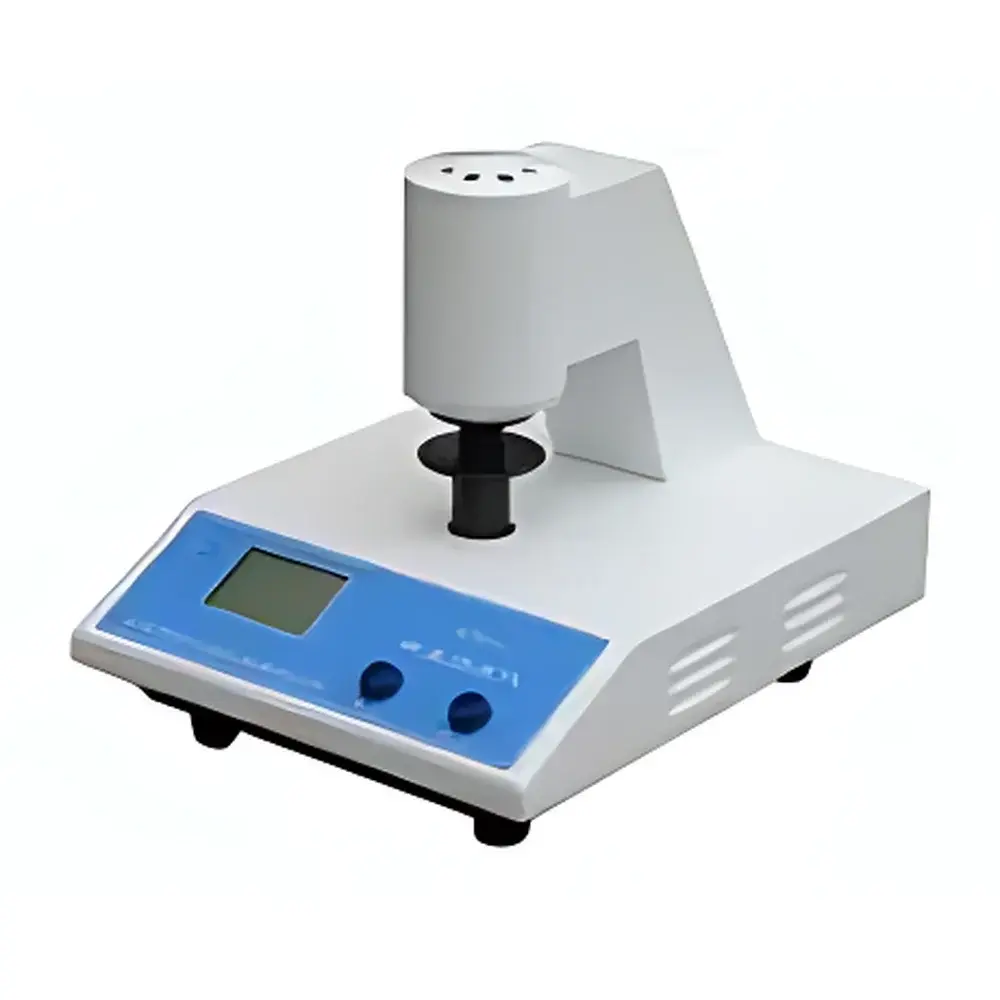
WSB Digital Whiteness Meter
| Origin | Shanghai, China |
|---|---|
| Manufacturer Type | Authorized Distributor |
| Origin Category | Domestic (China) |
| Model | WSB |
| Pricing | Available Upon Request |
| Measurement Range | 0–100 |
| Display Resolution | 0.1 |
| Illumination/Viewing Geometry | 45/0 |
| Light Source | 12 V / 30 W Tungsten-Halogen Lamp |
| Whiteness Formula | Blue-Reflectance Whiteness (WB = R₄₅₇) |
| Aperture Diameter | Φ30 mm |
| Measurement Accuracy | ±2.5 |
| Zero Drift | ≤0.3 per 10 min |
| Stability | ≤0.5 per 10 min |
| Repeatability | ≤0.5 |
| Operating Temperature | +5 °C to +35 °C |
| Relative Humidity | <85 % RH |
| Power Supply | 220 V ±10 %, 50 Hz ±1 Hz |
| Power Consumption | <30 W |
| Weight | 7 kg |
| Dimensions | 340 × 270 × 280 mm |
| Calibration Standard | NMI-traceable Certified White Tile (GB-compliant) |
Overview
The WSB Digital Whiteness Meter is a precision optical instrument engineered for quantitative assessment of whiteness in flat, opaque, and diffusely reflecting materials—primarily paper, textiles, plastics, ceramics, and coated surfaces. It operates on the CIE-recommended 45/0 illumination/viewing geometry and implements the standardized blue-reflectance whiteness index (WB = R457), defined as the diffuse reflectance at 457 nm under illuminant A. This metric is widely adopted in quality control laboratories for its direct correlation with visual perception of brightness and bluish tint under typical daylight conditions. The instrument conforms rigorously to national metrological standards including JJG 512–2002 (Verification Regulation for Whiteness Meters) and multiple GB specifications—namely GB/T 2913 (plastics), GB/T 5950 (paper and board), GB/T 8940.1 (pulp), GB/T 12097 (paperboard), and GB/T 13025.2 (industrial salt)—ensuring traceability, inter-laboratory comparability, and regulatory acceptability in manufacturing QA/QC environments.
Key Features
- Optimized 45/0 optical architecture with minimized stray light and controlled aperture (Φ30 mm), eliminating edge effects and ensuring consistent sample illumination.
- Stabilized 12 V / 30 W tungsten-halogen lamp calibrated to CIE Illuminant A spectral power distribution, providing long-term photometric repeatability.
- Corrected interference filter system enabling accurate quantification of fluorescent whitening agent (FWA)-enhanced whiteness without spectral distortion.
- High-stability analog-to-digital conversion circuitry with 0.1-unit resolution and verified repeatability ≤0.5 units (standard deviation over ten consecutive measurements on homogeneous reference tile).
- Robust mechanical design featuring precision-machined sample stage and light-tight sample holder to prevent peripheral light leakage—a common source of measurement bias in low-reflectance samples.
- Integrated low-noise switch-mode power supply (<30 W consumption) with wide-input tolerance (220 V ±10 %, 50 Hz ±1 Hz), optimized for continuous operation in industrial lab settings.
- Factory-calibrated using nationally certified white reference tiles traceable to the National Institute of Metrology (NIM), China, supporting compliance with ISO/IEC 17025 internal calibration requirements.
Sample Compatibility & Compliance
The WSB meter accommodates rigid and semi-rigid planar specimens up to 5 mm thick, including uncoated and coated papers, bleached pulp sheets, synthetic films, ceramic tiles, and powdered samples pressed into uniform discs. Its 45/0 geometry inherently excludes specular reflection, making it suitable for matte and semi-gloss surfaces where surface texture may influence perceived whiteness. The instrument satisfies mandatory verification criteria outlined in JJG 512–2002 and supports conformance with international frameworks including ISO 2470-1 (Paper and board — Optical properties — Part 1: Diffuse reflectance factor (ISO brightness)), ISO 11475 (Graphic technology — Optical properties of paper and board — Determination of CIE whiteness), and ASTM E313 (Standard Practice for Calculating Yellowness and Whiteness Indices from Instrumentally Measured Color Coordinates). While not FDA 21 CFR Part 11–enabled by default, its stable analog output and manual calibration log support GLP/GMP-aligned documentation practices when integrated into validated SOPs.
Software & Data Management
The WSB Digital Whiteness Meter is a standalone benchtop instrument with no embedded microprocessor or digital connectivity. All operations—including zeroing, calibration, and measurement—are executed via front-panel controls with real-time LED display. Raw values are recorded manually or exported via optional RS-232 interface (add-on module, sold separately) for integration with LIMS or Excel-based QA databases. Calibration history, operator ID, environmental conditions (ambient temperature/humidity), and reference tile serial number must be documented externally per ISO/IEC 17025 Clause 7.7. The instrument’s passive architecture ensures immunity to firmware vulnerabilities, software obsolescence, or cybersecurity risks—advantageous in regulated environments requiring long-term validation stability.
Applications
- Quality assurance of paper brightness consistency across production batches (e.g., printing paper, tissue, packaging board).
- Monitoring FWA efficacy during pulp bleaching and coating formulation development.
- Comparative evaluation of pigment dispersion homogeneity in polymer films and architectural coatings.
- Raw material screening for ceramic glazes and dental composites where chromatic neutrality is critical.
- Regulatory testing per GB/T 13025.2 for sodium chloride whiteness in food-grade and pharmaceutical excipient applications.
- Academic research in color science, particularly studies correlating R457 with CIELAB ΔE*ab metrics under D65 illumination.
FAQ
What does R457 represent, and why is it used for whiteness evaluation?
R457 denotes the diffuse reflectance factor measured at 457 nm wavelength under CIE Illuminant A. It correlates strongly with human visual assessment of “bluish-white” appearance and remains the dominant metric in paper, textile, and plastic industries due to its simplicity, reproducibility, and standardization across GB, ISO, and ASTM methods.
Can the WSB meter measure opacity or translucency?
Yes—the instrument includes a dedicated opaque backing plate and procedure for single-sheet opacity determination per GB/T 1543, leveraging the same optical path and detector linearity.
Is regular recalibration required, and what reference standard is used?
Annual verification against a NIM-certified white tile (with valid calibration certificate) is recommended. Daily zeroing with the black trap and periodic verification using the supplied working white tile fulfill routine QC requirements per JJG 512–2002.
Does the instrument comply with ISO 2470-1 for ISO brightness?
No—ISO brightness requires d/0 geometry and UV-adjusted illumination; the WSB implements 45/0 geometry and R457, aligning with ISO 11475 (CIE whiteness), not ISO 2470-1.
What maintenance is necessary to ensure long-term accuracy?
Periodic cleaning of the aperture lens and sample port with lint-free optical tissue, annual lamp replacement (halogen lamp lifetime ≈ 1,000 h), and verification of mechanical alignment per manufacturer’s service manual.



