
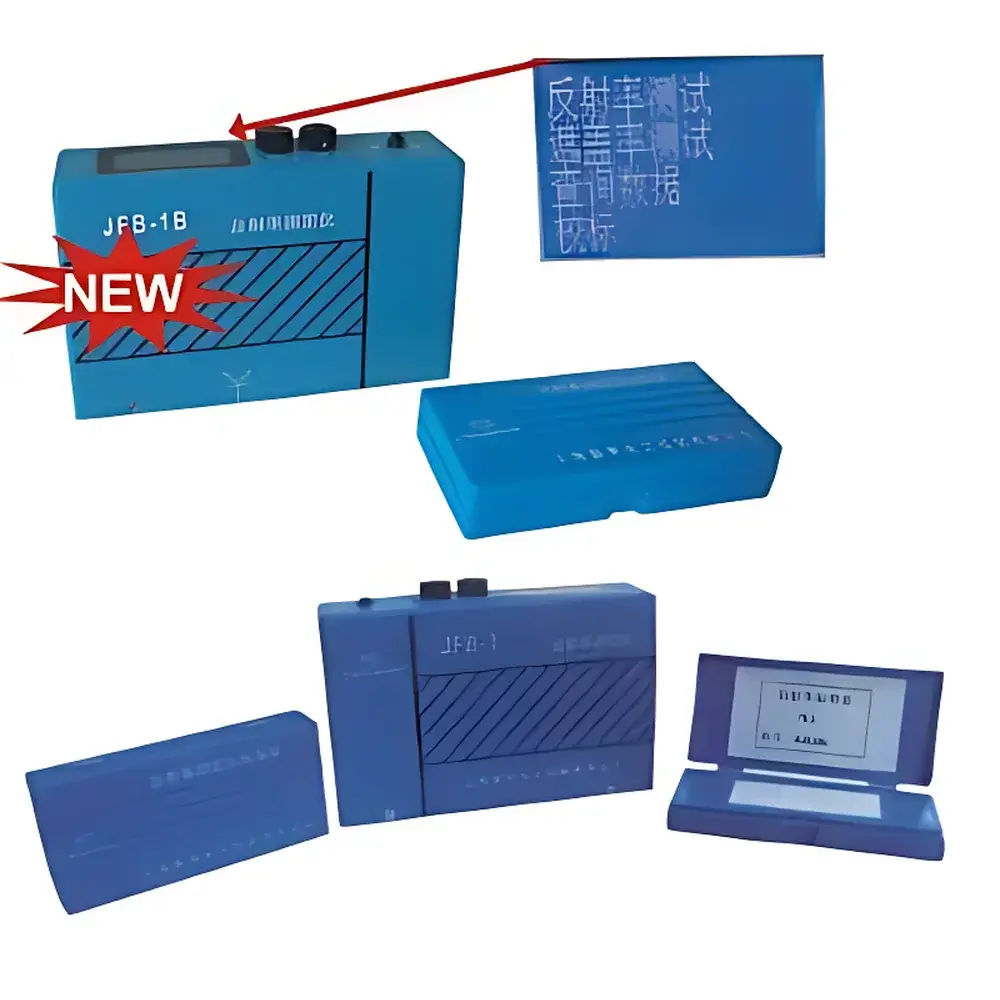
JFB-IB Portable Reflectance Meter
| Origin | Shanghai |
|---|---|
| Manufacturer Type | Distributor |
| Origin Category | Domestic (China) |
| Model | JFB-IB |
| Pricing | Upon Request |
Overview
The JFB-IB Portable Reflectance Meter is a precision optical instrument engineered for quantitative measurement of diffuse reflectance in accordance with internationally recognized standards for coating, pigment, and ink quality control. It operates on the principle of 0° illumination and diffuse reflectance detection — a geometry standardized in ISO 3906:1980(E) for opacity and contrast ratio evaluation. The device delivers direct digital readouts of reflectance values (RB on black substrate and RW on white substrate), enabling rapid calculation of contrast ratio (RB/RW × 100%) — a critical parameter defined in ISO 3906, ASTM D2805, and GB/T 13452.3–1992 for assessing film hiding power. Its compact, handheld architecture integrates a calibrated silicon photodiode sensor, low-drift DC amplifier circuitry, and dual-standard calibration capability (black/white reference tiles), ensuring traceable, repeatable measurements under ambient laboratory or production-floor conditions.
Key Features
- Compliant optical geometry: 0° incident angle with integrated diffuse reflectance collection, aligned with ISO 3906:1980(E) and GB/T 13452.3–1992 requirements
- Dual-point calibration system using certified black and white standard tiles for zero and gain adjustment
- High-stability analog signal path with low-noise DC amplifier and digital display (0.1-unit resolution)
- Battery-powered operation (7.2 V DC rechargeable Li-ion), supporting up to 10 hours of continuous use per charge
- Integrated low-battery indicator (“LOBAT” warning) and auto-sleep mode to conserve power during idle intervals
- Robust mechanical design optimized for field deployment: lightweight housing, ergonomic probe head, and anti-fatigue sensor management protocol (black tile resting during inter-measurement pauses)
Sample Compatibility & Compliance
The JFB-IB is validated for use with uniformly applied, non-fluorescent, opaque coatings on standardized ceramic substrates (black and white tiles per GB 9271–1988). Sample preparation must follow ISO 1514 and GB/T 9271–1988 protocols, including controlled film thickness (e.g., via drawdown bar), drying/curing conditions, and surface flatness verification. Instrument compliance extends to multiple regulatory frameworks: ISO 3906:1980(E) for contrast ratio; GB/T 13452.3–1992 (equivalent to ISO 3906); GB 9270–1988 (method for determining hiding power); and GB 5211.17–1988 (pigment reflectance testing). While not inherently 21 CFR Part 11–compliant due to lack of audit trail or electronic signature functionality, its measurement output supports GLP/GMP documentation when paired with manual logbooks and SOP-controlled calibration records.
Software & Data Management
The JFB-IB operates as a standalone analog-digital hybrid instrument with no embedded firmware or connectivity interface. All data acquisition is manual: RB and RW values are recorded directly from the LCD display, and contrast ratio is calculated externally (e.g., in Excel or LIMS). Calibration parameters (zero offset, gain factor) are adjusted mechanically via front-panel potentiometers and require no software configuration. For laboratories requiring digital traceability, integration with external data capture systems is achievable via optional RS-232 or USB-to-serial adapters (sold separately), though native driver support is not provided. Calibration logs, measurement records, and environmental conditions (5–40 °C, RH <85%) must be maintained per ISO/IEC 17025 Clause 7.7 and internal QA procedures.
Applications
- Contrast ratio determination for architectural, industrial, and automotive coatings per ISO 3906 and ASTM D2805
- Hiding power evaluation of titanium dioxide, zinc oxide, and organic pigments in dispersion form
- Batch-to-batch consistency monitoring in paint manufacturing QC workflows
- R&D screening of novel opacifiers, extenders, and tinting strength modifiers
- Field verification of coating application performance on construction sites or OEM assembly lines
- Supporting technical documentation for ISO 9001:2015 clause 8.5.1 (control of production and service provision)
FAQ
What standards does the JFB-IB comply with?
ISO 3906:1980(E), GB/T 13452.3–1992, GB 9270–1988, and GB 5211.17–1988.
How often should calibration be performed?
Before each measurement session and after every 10–15 readings; recalibration is mandatory if repeatability exceeds ±0.3 units.
Can the instrument measure fluorescent or metallic coatings?
No — it is designed exclusively for non-fluorescent, diffusely reflecting surfaces; metallic or pearlescent finishes require gonio-spectrophotometric instrumentation.
What is the recommended substrate for sample testing?
Standardized black and white ceramic tiles conforming to GB 9271–1988, with film thickness controlled per ISO 2808.
Is battery life affected by ambient temperature?
Yes — optimal operation occurs between 5 °C and 40 °C; prolonged exposure below 5 °C may reduce Li-ion capacity and increase drift.



