
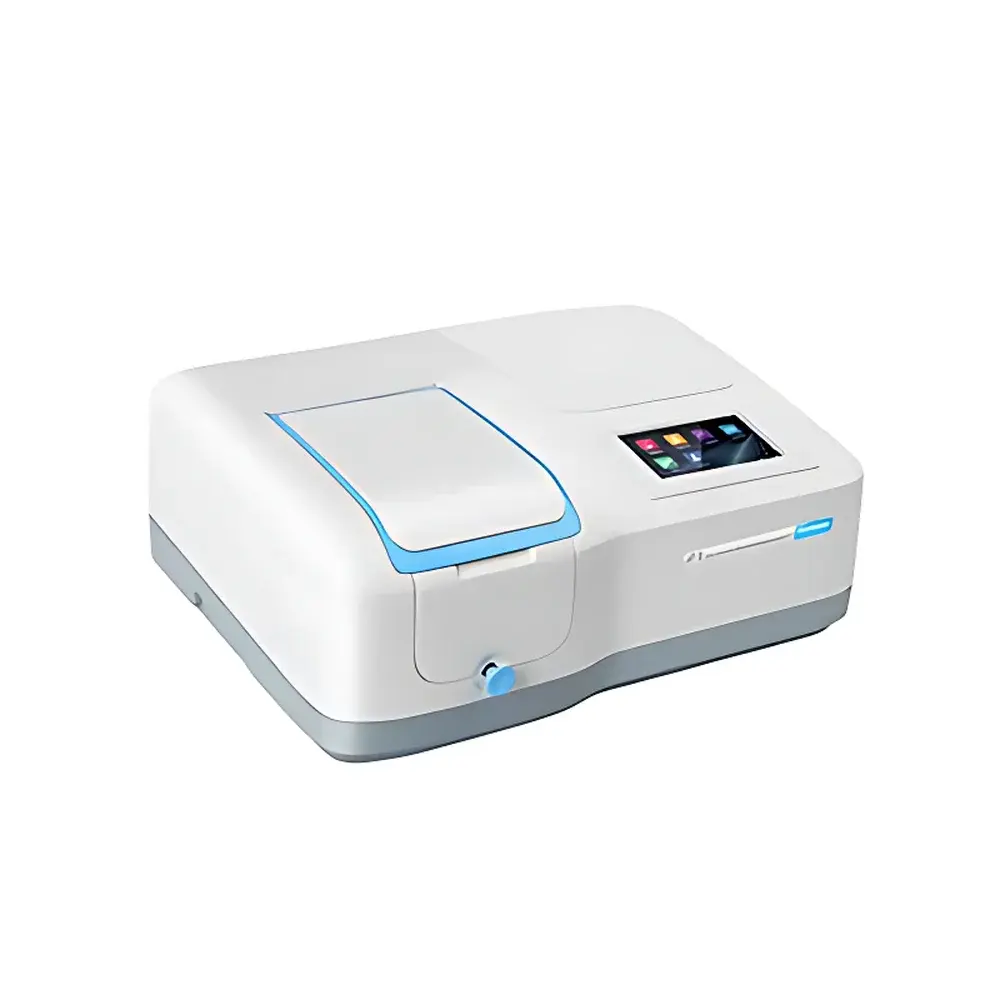
Mapada P1 Single-Beam Ultraviolet-Visible Spectrophotometer
| Brand | Mapada |
|---|---|
| Origin | Shanghai, China |
| Manufacturer Type | Original Equipment Manufacturer (OEM) |
| Product Origin | Domestic (China) |
| Model | P1 |
| Price Range | USD 1,400 – 2,800 |
| Optical Configuration | Single-Beam |
| Detector Type | Silicon Photocell |
| Wavelength Range | 195 – 1050 nm |
| Wavelength Scanning Mode | Motorized Auto-Scanning |
| Spectral Bandwidth | 4 nm |
| Wavelength Accuracy | ±0.8 nm |
Overview
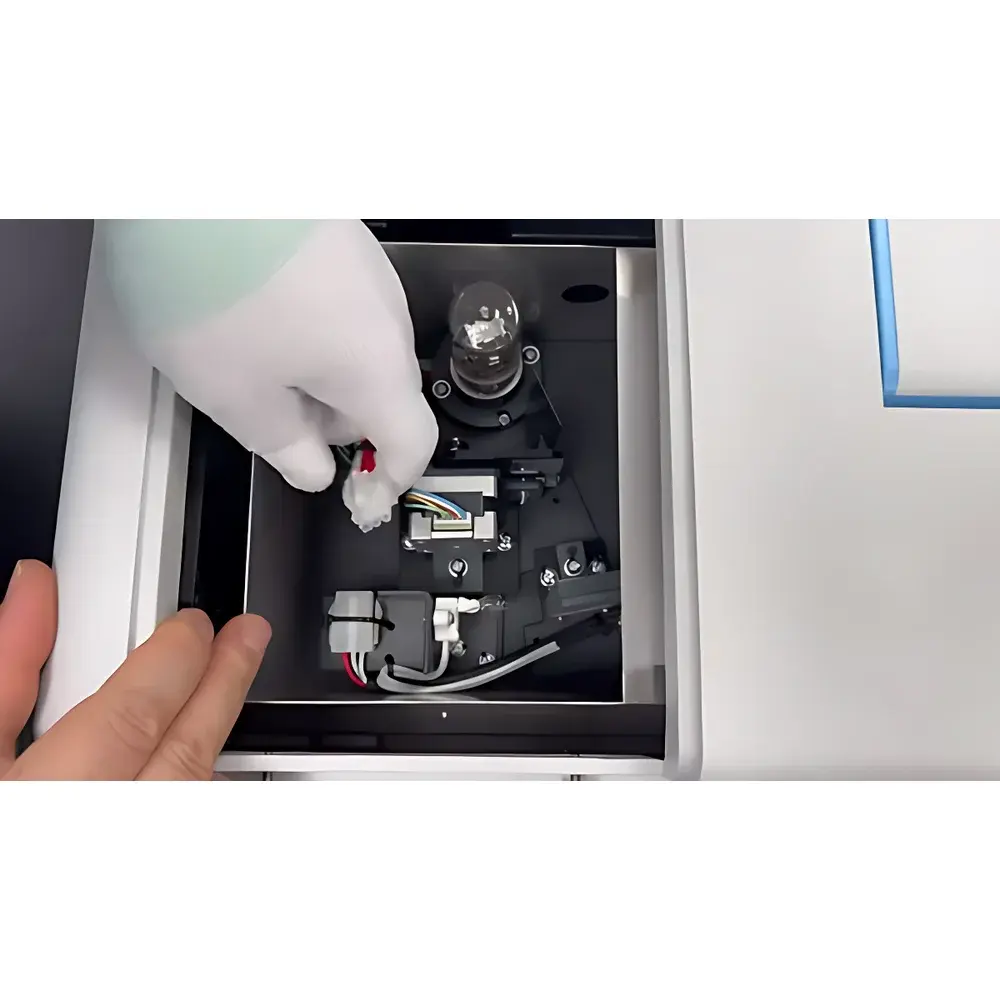
The Mapada P1 Single-Beam Ultraviolet-Visible Spectrophotometer is a compact, entry-level analytical instrument engineered for routine quantitative and qualitative analysis in academic teaching laboratories, quality control environments, and small-scale R&D settings. It operates on the fundamental principle of Beer–Lambert law-based absorbance measurement, utilizing a single-beam optical architecture where light from a deuterium lamp (UV) and tungsten-halogen lamp (visible/NIR) passes sequentially through the sample and is detected by a silicon photocell. The instrument delivers reliable photometric performance across a broad spectral range—from deep ultraviolet (195 nm) to near-infrared (1050 nm)—enabling applications such as concentration determination, purity assessment, kinetic studies, and basic spectral profiling of organic and inorganic compounds.
Key Features
- Motorized wavelength scanning system ensures repeatable, hands-free spectral acquisition without manual adjustment.
- Fixed 4 nm spectral bandwidth provides balanced resolution and signal-to-noise ratio for general-purpose UV-Vis analysis.
- Dual-lamp source configuration (deuterium + tungsten-halogen) enables seamless coverage across the full 195–1050 nm range with automatic lamp switching at ~350 nm.
- Wavelength accuracy of ±0.8 nm—verified against NIST-traceable holmium oxide and didymium filters—meets ISO 9001 calibration requirements for routine laboratory use.
- Robust mechanical design with thermally stabilized optical bench minimizes drift during extended measurements.
- Integrated digital display and membrane keypad allow direct operation without external PC dependency, supporting immediate absorbance, transmittance, and concentration readouts.
Sample Compatibility & Compliance
The P1 accommodates standard 10 mm pathlength quartz or glass cuvettes (including matched pairs for baseline correction), as well as micro-volume adapters (optional). It supports liquid, solution-phase samples in transparent containers; solid or turbid samples require appropriate dilution or filtration prior to analysis. While not designed for regulated GMP/GLP environments requiring full audit trails, the instrument complies with core optical performance criteria outlined in ASTM E275 (Standard Practices for Describing and Measuring Performance of UV-Vis Spectrophotometers) and ISO/IEC 17025–aligned verification protocols. Its wavelength accuracy and photometric linearity are suitable for educational accreditation, internal QC checks, and method development under non-regulated workflows.
Software & Data Management
The P1 operates in standalone mode but is compatible with optional Windows-based data acquisition software (Mapada UVWin v3.0) via RS-232 interface. This software enables spectral scanning, kinetic time-course plotting, multi-wavelength quantitation, and basic curve-fitting (e.g., linear regression for calibration curves). All data exports in CSV format for integration into LIMS or statistical packages such as Excel, Origin, or JMP. Though the base hardware does not support 21 CFR Part 11-compliant electronic signatures or user-level access control, the software can be deployed in validated environments with supplementary procedural controls (e.g., documented SOPs, manual logbooks, periodic instrument verification).
Applications
- Quantitative analysis of nucleic acids (A260/A280 ratio), proteins (Bradford/Lowry assays), and pharmaceutical actives (e.g., paracetamol, aspirin).
- Verification of reagent purity and solvent transparency in synthetic chemistry labs.
- Teaching core spectroscopic concepts—including absorption maxima, molar absorptivity, and spectral interference—in undergraduate chemistry curricula.
- Monitoring dye degradation kinetics, enzyme reaction rates (e.g., NADH oxidation), and pH-dependent spectral shifts.
- Supporting raw material screening in food, cosmetics, and water treatment industries where regulatory compliance is governed by national standards rather than FDA/EMA mandates.
FAQ
Is the P1 compliant with FDA 21 CFR Part 11?
No—the P1 lacks built-in electronic signature capability, audit trail generation, and role-based user authentication required for Part 11 compliance. It may be used in non-GxP contexts or within validated workflows supplemented by procedural controls.
What cuvette types are supported?
Standard 10 mm square quartz cuvettes (for UV measurements below 350 nm) and optical glass cuvettes (for visible/NIR only) are recommended. Plastic cuvettes are not advised due to UV absorption and scattering effects.
Can the P1 perform kinetic measurements?
Yes—when paired with Mapada UVWin software, it supports time-scan mode with user-defined intervals (1–999 seconds), enabling monitoring of reaction progress under constant wavelength conditions.
How often should wavelength calibration be performed?
Annual verification using holmium oxide reference filter is recommended per ISO/IEC 17025 guidance; more frequent checks (e.g., quarterly) are advised in high-throughput or critical QC applications.
Does the instrument include GLP/GMP documentation support?
The P1 does not generate automated calibration logs or electronic records. Users must maintain manual calibration logs, maintenance records, and performance verification reports to meet GLP/GMP documentation expectations.



