
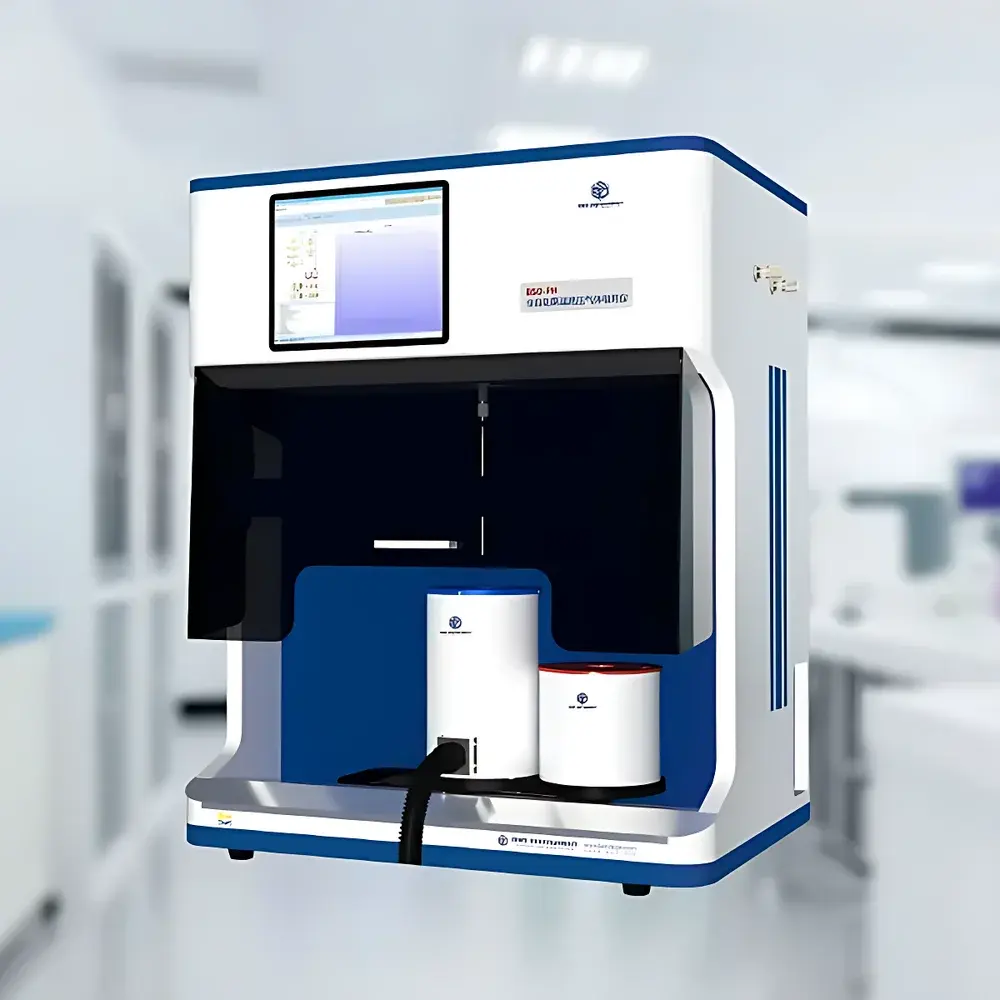
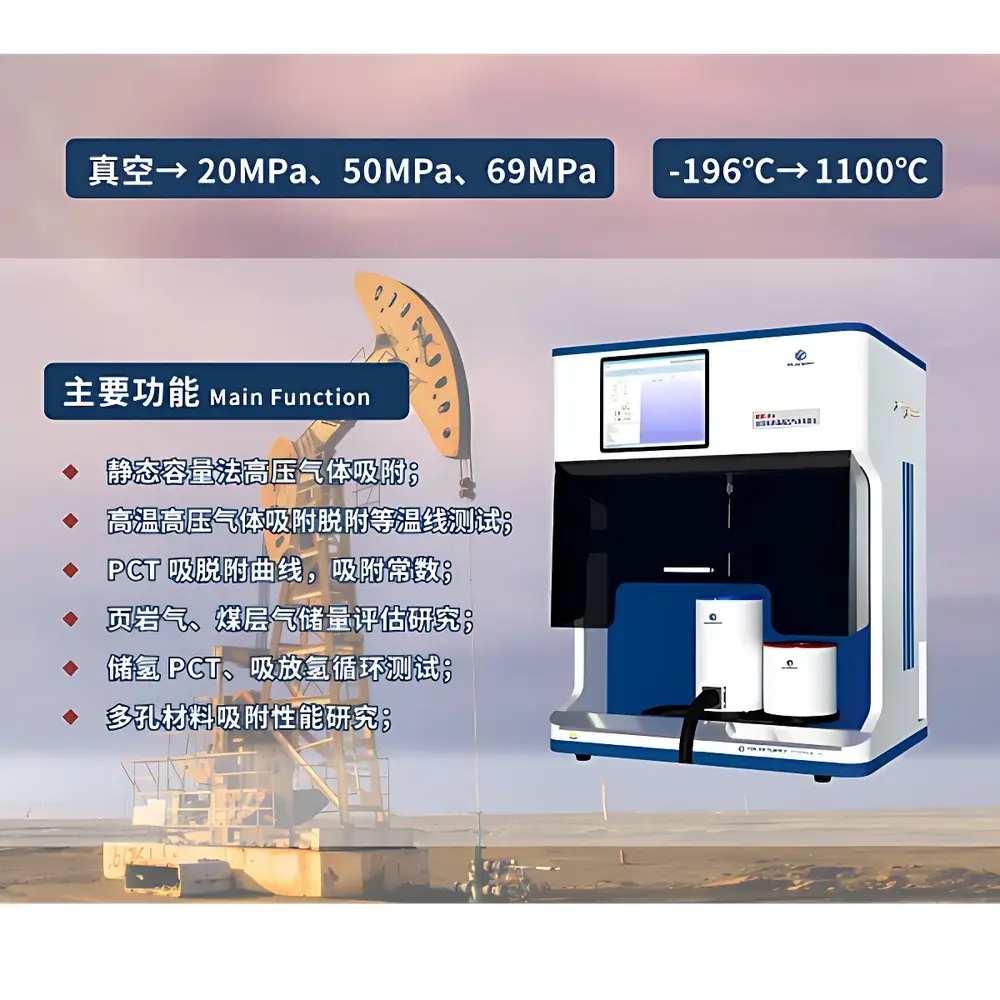
Beishide BSD-PH High-Pressure Hydrogen Sorption Analyzer
| Brand | Beishide Instrument |
|---|---|
| Origin | Beijing, China |
| Manufacturer Type | Manufacturer |
| Country of Origin | Domestic (China) |
| Model | BSD-PH |
| Testing Method | Static Volumetric Method |
| Temperature Range | -196 °C to 300 °C (extendable to 1100 °C with optional furnace) |
| Pressure Range | High vacuum to 690 bar (69 MPa) |
| Ultimate Vacuum | 1 × 10⁻⁷ mbar |
| Repeatability | ±2% |
| Pressure Sensor Accuracy | ±0.01% FS |
| Air-Bath Temperature Control | 40.0 °C ±0.1 °C |
Overview
The Beishide BSD-PH High-Pressure Hydrogen Sorption Analyzer is an engineered static volumetric system designed for quantitative characterization of gas adsorption and desorption behavior under rigorously controlled high-pressure and elevated-temperature conditions. It operates on the principle of pressure-decay volumetric measurement: after helium pycnometry to determine skeletal volume and dead volume, precise incremental doses of adsorptive gas (e.g., H₂, CH₄, CO₂, N₂) are introduced into a thermostatted sample cell; equilibrium pressures are recorded following each dose, enabling construction of adsorption isotherms across defined pressure–temperature domains. The instrument integrates dual thermal control architectures—air-bath (40.0 °C ±0.1 °C) and programmable high-temperature furnace (up to 300 °C standard, extendable to 1100 °C)—and supports cryogenic operation via liquid nitrogen (77 K) or liquid argon (87 K) baths with optional LNL level-stabilization systems. Its core application domain includes hydrogen storage material evaluation (e.g., Mg-based alloys, TiFe, AB₅-type intermetallics, MOFs, COFs), shale gas and coalbed methane reservoir assessment, and thermodynamic/kinetic modeling of gas–solid interactions in energy and environmental materials science.
Key Features
- Static volumetric methodology compliant with ISO 15901-2 and ASTM D4641 standards for high-pressure gas sorption analysis
- Full automation of degassing, dosing, equilibration, data acquisition, and model fitting—enabling unattended overnight operation
- Pressure range spanning high vacuum (1 × 10⁻⁷ mbar) to 690 bar (69 MPa), with optional configurations up to 80 MPa
- Temperature capability from cryogenic (77 K) to 300 °C standard; extended options include 1100 °C high-temperature furnace and sub-ambient solid–liquid baths (ice, dry ice, salt–ice)
- Integrated safety architecture: ASME-certified pressure vessels, internal combustible gas detection (H₂-specific sensor), optional alarm interlock with emergency venting
- High-fidelity pressure transduction using imported piezoresistive sensors (0.01% FS accuracy, 0.025% FS long-term stability)
- Modular design supporting multiple analytical positions (1, 2, or 4 stations) and configurable sample cell volumes (gram-scale to kilogram-scale with MFC-enhanced PHEM variant)
Sample Compatibility & Compliance
The BSD-PH accommodates powdered or granular samples typical of metal hydrides, porous coordination frameworks, activated carbons, coals, shales, and geological cores. Sample mass ranges from 0.1 g to >100 g depending on cell configuration. For intact rock or coal cores, the BSD-PHC variant adds axial and radial stress application (up to 30 MPa confining pressure) to replicate in-situ geomechanical conditions—critical for accurate resource estimation per API RP 14C and ISO 13703 guidelines. All hardware and software workflows adhere to GLP principles; audit trails, electronic signatures, and data integrity controls align with FDA 21 CFR Part 11 requirements when configured with validated software modules. Calibration traceability follows NIST standards for pressure and temperature metrology.
Software & Data Management
The proprietary Beishide SorptionStudio™ platform provides real-time monitoring, automated isotherm generation, and integrated thermodynamic modeling—including Langmuir, Freundlich, Sips, and Toth isotherm fittings; Clausius–Clapeyron analysis for isosteric heat of adsorption; IAST (Ideal Adsorbed Solution Theory) for multicomponent selectivity prediction; and TPD/TPA curve deconvolution. Raw pressure–time and pressure–volume datasets are stored in HDF5 format with metadata embedding (sample ID, operator, timestamp, calibration history). Export options include CSV, Excel, and PDF reports conforming to ISO/IEC 17025 documentation templates. Version-controlled software updates and remote diagnostic support ensure long-term compliance readiness.
Applications
- Hydrogen storage capacity evaluation (PCT curves, absorption/desorption hysteresis, cycle stability)
- Shale gas and coalbed methane adsorption isotherms for reserve quantification (per USGS methodologies)
- Thermodynamic parameter derivation: isosteric heat (Qst), entropy of adsorption, enthalpy–entropy compensation
- Adsorption kinetics under constant-pressure conditions (BSD-PHE variant), including initial desorption rate and TPD plateau identification
- Multicomponent competitive adsorption (BSD-PHM) for CO₂/CH₄ separation screening in carbon capture applications
- Stress-dependent adsorption measurements on reservoir rocks (BSD-PHC) for enhanced recovery modeling
FAQ
What gases can be used with the BSD-PH system?
Standard configurations support H₂, CH₄, CO₂, N₂, and Ar. Optional gas-specific booster systems enable safe pressurization up to 80 MPa for reactive or low-critical-point gases.
Is helium pycnometry included in the standard workflow?
Yes—automated He intrusion and expansion cycles are embedded in every analysis sequence to determine skeletal density and dead volume prior to adsorption dosing.
Can the system perform dynamic kinetic measurements?
The base BSD-PH executes equilibrium isotherm acquisition. For constant-pressure adsorption/desorption kinetics, the BSD-PHE or BSD-PHD variants are required.
How is temperature uniformity ensured across the gas manifold?
The air-bath design maintains all valves, sensors, and connecting lines at a stable 40.0 °C ±0.1 °C. For higher-temperature precision, optional full-oil-bath immersion (BSD-PHUO) eliminates thermal gradients across the entire high-pressure flow path.
Does the system support regulatory-compliant data archiving?
When deployed with SorptionStudio™ Validation Pack, it delivers 21 CFR Part 11–compliant audit trails, role-based access control, and immutable raw-data storage with SHA-256 hashing.



