
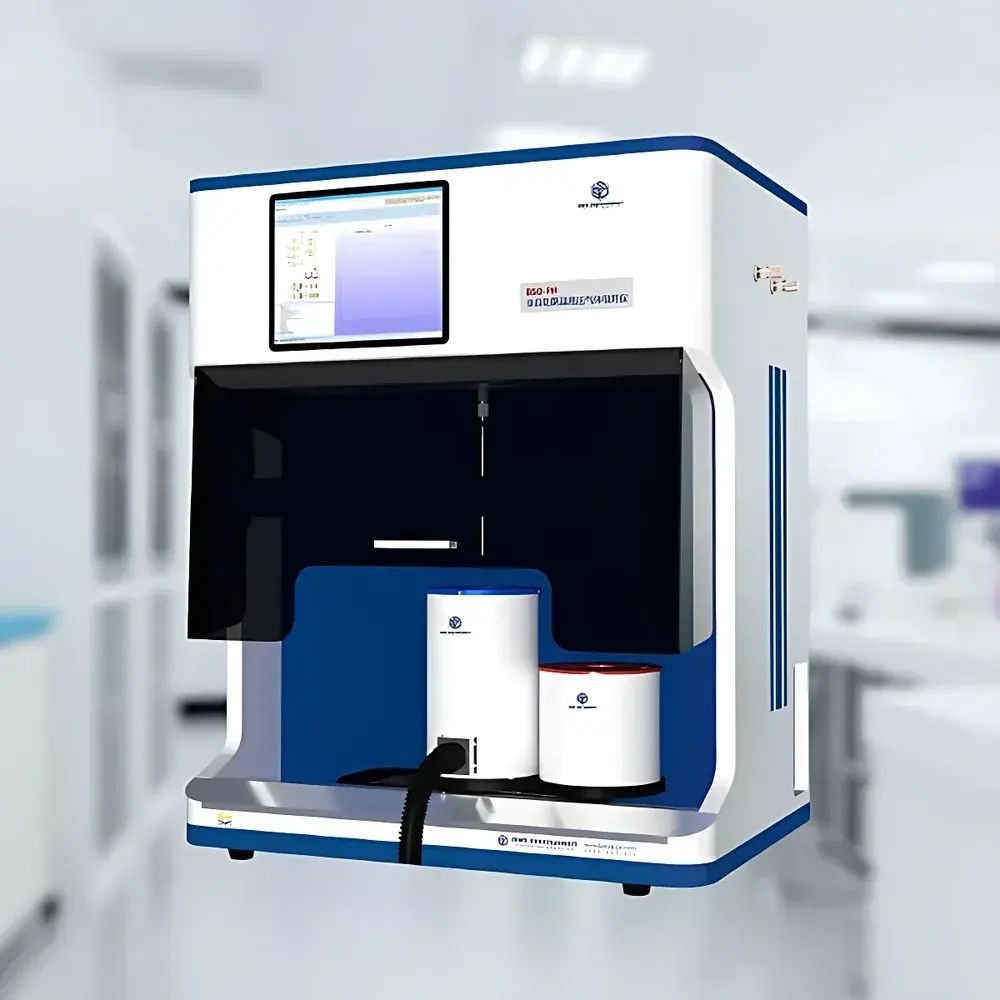
Beishide BSD-PHUO Full Oil Bath Ultra-High Pressure Gas Sorption Analyzer
| Brand | Beishide Instrument |
|---|---|
| Origin | Beijing, China |
| Manufacturer Type | Manufacturer |
| Country of Origin | Domestic (China) |
| Model | BSD-PHUO |
| Testing Method | Static Volumetric Method |
| Temperature Range | -196 °C to 300 °C (extendable to 900 °C with optional high-temp furnace) |
| Pressure Range | High vacuum up to 700 bar (70 MPa) |
| Ultimate Vacuum | 1×10⁻² to 1×10⁻⁶ Pa |
Overview
The Beishide BSD-PHUO Full Oil Bath Ultra-High Pressure Gas Sorption Analyzer is an engineered solution for quantitative characterization of gas adsorption behavior under extreme thermodynamic conditions—specifically designed for research and industrial evaluation of low-adsorption-capacity materials at ultra-high pressures (up to 700 bar) and cryogenic to elevated temperatures (−196 °C to 300 °C, extendable to 900 °C). It operates on the static volumetric principle: inert gas (e.g., He) pycnometry determines sample skeletal volume and system dead volume; incremental dosing of adsorptive gas (H₂, CH₄, CO₂, N₂, etc.) followed by equilibrium pressure measurement enables precise calculation of absolute adsorbed amount via ideal or real-gas equations of state. Unlike air-bath or partial-oil-bath systems, the BSD-PHUO immerses the entire gas path—including valves, pressure transducers, sample cell, and connecting capillaries—within a thermostatically controlled oil bath. This eliminates thermal gradients across critical components, achieving temperature uniformity ≤ ±0.05 °C and reducing pressure drift by >90% compared to conventional air-bath designs—essential for reliable quantification of sub-micromole adsorption increments at 50–700 bar.
Key Features
- Full immersion oil-bath thermal management: All pressure-critical components operate within a single, homogeneous thermal environment, minimizing thermal expansion-induced volume artifacts and ensuring <0.1% relative pressure stability during multi-hour equilibration.
- Ultra-high pressure capability: Configurable up to 700 bar (70 MPa) with dual-range pressure sensors (0–10 bar / 0–700 bar), each calibrated to ISO 17025-accredited standards; long-term sensor stability rated at ±0.025% FS.
- Cryogenic-to-high-temperature flexibility: Standard configuration supports −196 °C (liquid nitrogen) to 300 °C; optional upgrades include 3 L Dewar with BSD-LNL liquid level stabilization (for reproducible 77 K/87 K operation), solid–liquid constant-temperature baths (ice–salt, dry ice–acetone), and high-temperature furnaces (up to 900 °C).
- Automated volumetric protocol execution: Fully programmable sequence for He pycnometry, degassing (under vacuum or inert purge), multi-step gas dosing, equilibrium validation (dP/dt < 1 Pa/min), and desorption cycling—all without operator intervention.
- Integrated safety architecture: ASME-certified pressure vessels; redundant overpressure relief; internal combustible gas detector (H₂/CH₄); optional interlocked ventilation and emergency shutdown per IEC 61511 SIL2 requirements.
Sample Compatibility & Compliance
The BSD-PHUO accommodates powdered, granular, or monolithic samples—including metal hydrides (Mg-based, TiFe, LaNi₅), MOFs/COFs/HOFs, activated carbons, coals, shale cores, and soil matrices—in standard 6–12 mm OD quartz or stainless-steel sample tubes (customizable for gram- to kilogram-scale loading). Its full-oil-bath design is particularly suited for geological samples exhibiting low adsorption density (<0.5 mmol/g at 60 MPa), where minute thermal drift would otherwise dominate signal noise. The instrument complies with ASTM D3663 (standard test method for surface area of catalysts), ISO 9277 (surface area by gas adsorption), and supports data traceability in accordance with FDA 21 CFR Part 11 and GLP/GMP audit requirements through electronic signature-enabled software logs, immutable audit trails, and version-controlled calibration records.
Software & Data Management
The proprietary SorptionMaster™ software provides end-to-end workflow control—from method definition (isotherm type, P/T ramp rate, equilibrium criteria) to automated model fitting (Langmuir, Freundlich, Sips, Toth, IAST for multicomponent systems) and thermodynamic derivation (Clausius–Clapeyron adsorption enthalpy, isosteric heat). Raw pressure–time–temperature datasets are stored in HDF5 format with embedded metadata (gas purity, calibration date, operator ID, environmental conditions). Export options include CSV, Excel, and PDF reports compliant with journal submission standards (e.g., ACS, RSC, Elsevier templates). Remote monitoring, scheduled runs, and integration with LIMS via RESTful API are supported.
Applications
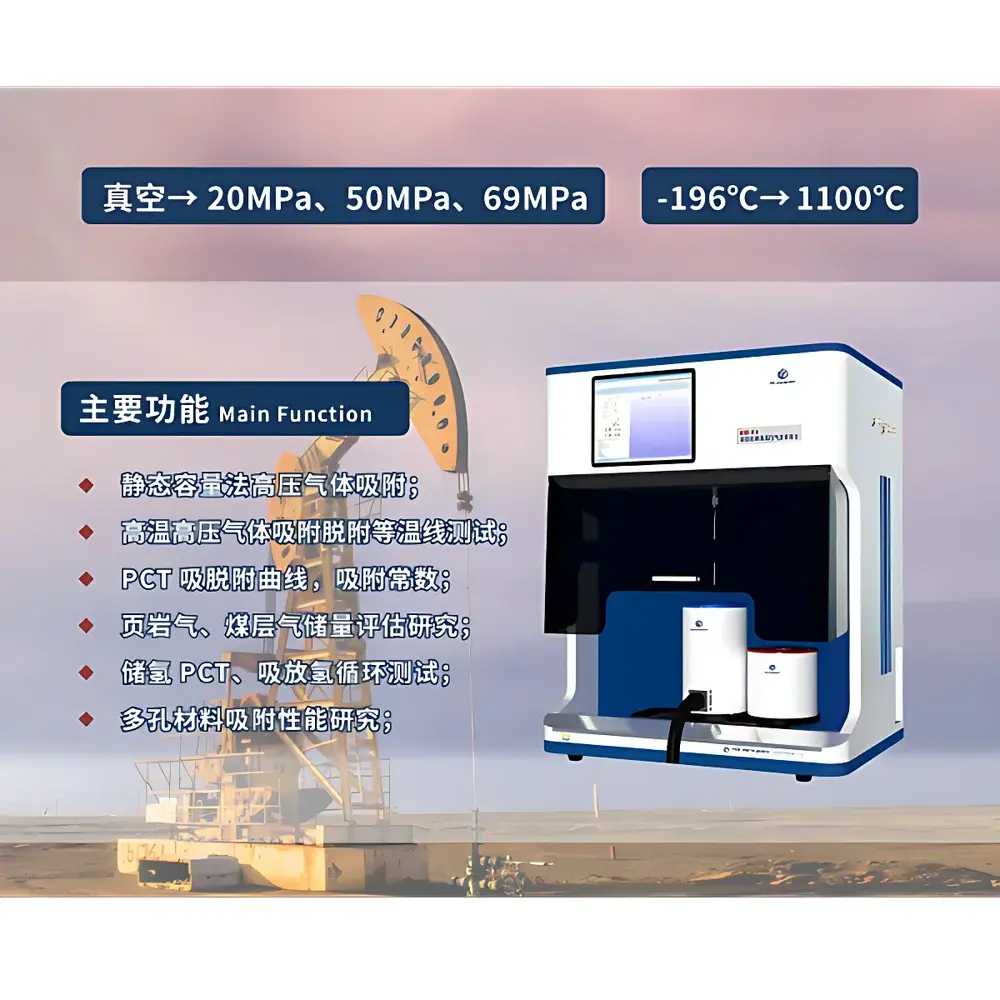
- Quantitative PCT (Pressure–Composition–Temperature) analysis of hydrogen storage materials under realistic refueling conditions (up to 700 bar, −40 °C to 85 °C).
- Shale gas and coalbed methane reserve assessment using CH₄/CO₂ binary competitive adsorption isotherms at reservoir-relevant pressures (20–70 MPa) and temperatures (40–120 °C).
- Thermodynamic characterization of adsorption enthalpy and entropy via van’t Hoff analysis across ≥5 isotherms.
- Long-term cyclic adsorption–desorption stability testing (≥100 cycles) for MOF regeneration studies.
- Validation of molecular simulation outputs (GCMC, DFT) requiring experimental benchmarks at >50 MPa.
FAQ
What distinguishes “full oil bath” from conventional air-bath or partial-oil-bath systems?
Full oil bath submerges the entire gas manifold—including pressure transducers, solenoid valves, and sample cell—to eliminate thermal lag and ensure isothermal conditions across all volumetric elements. This reduces systematic error in adsorbed amount calculation by up to one order of magnitude at pressures >50 MPa.
Can the BSD-PHUO perform kinetic measurements such as constant-pressure adsorption rate?
No—the BSD-PHUO is optimized for equilibrium isotherm acquisition. For dynamic rate analysis, the BSD-PHE or BSD-PHD models are recommended, which integrate mass flow controllers and real-time volumetric tracking.
Is helium pycnometry performed automatically before each adsorption run?
Yes—He intrusion and expansion cycles are executed automatically prior to gas dosing, with user-definable number of pycnometry repetitions and pressure stabilization thresholds.
How is data integrity ensured for regulatory submissions?
SorptionMaster™ enforces ALCOA+ principles: Attributable, Legible, Contemporaneous, Original, Accurate, Complete, Consistent, Enduring, and Available. Audit trails record every parameter change, calibration event, and manual override with timestamp and user ID.
What gases are supported, and are custom gas handling modules available?
Standard support includes H₂, CH₄, CO₂, N₂, and Ar. Optional gas-specific booster systems (30/60/80 MPa) with catalytic purifiers and moisture traps are available for reactive or impurity-sensitive applications.



