
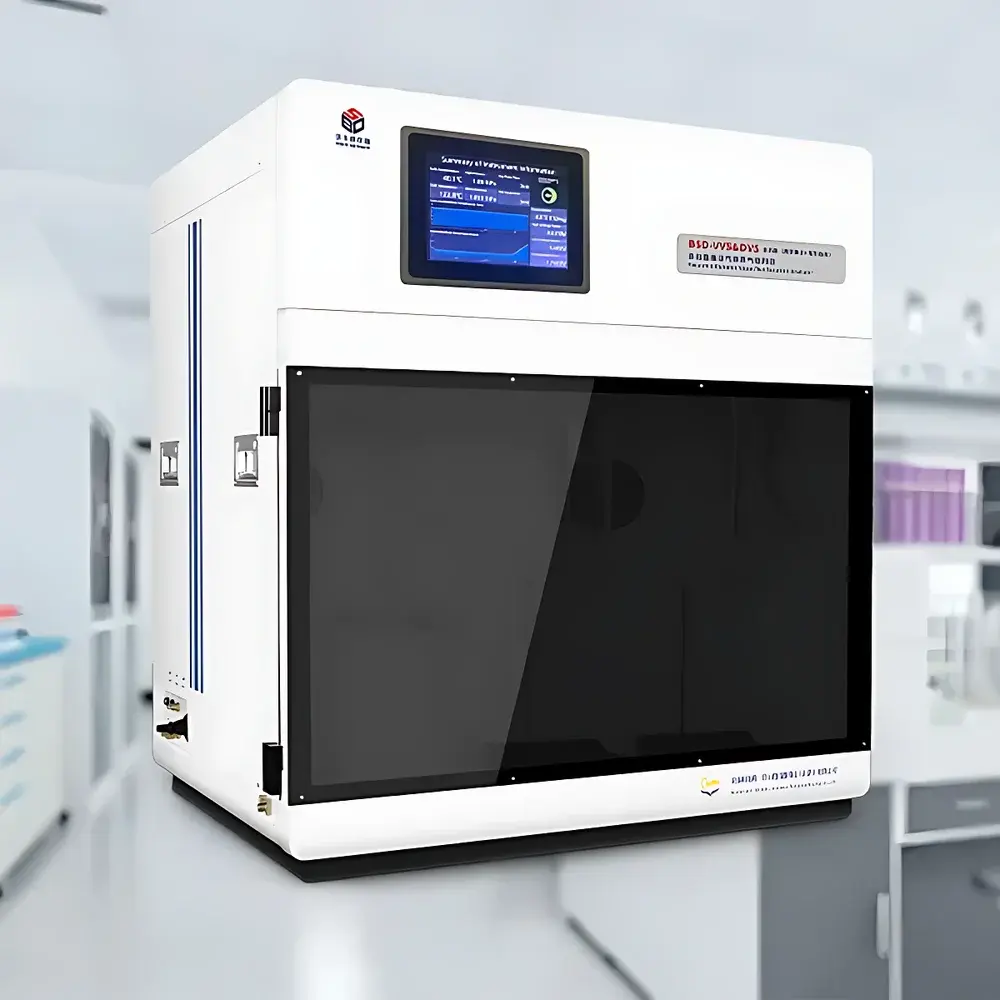
Beishide BSD-VVS&DVS8 Multi-Station Gravimetric Vapor Sorption Analyzer
| Brand | Beishide Instrument |
|---|---|
| Origin | Beijing, China |
| Manufacturer Type | Manufacturer |
| Regional Category | Domestic (China) |
| Model | BSD-VVS&DVS8 |
| Instrument Type | Static & Dynamic Vapor Adsorption Analyzer |
| Analytical Stations | 4 or 8 (configurable) |
| Microbalance Resolution/Range | 1 µg / 5000 mg (optional 0.1 µg / 500 mg) |
| Temperature Control | Degassing Furnace: RT–400 °C (±0.1 °C) |
| Thermostatic Bath | −5–150 °C (±0.1 °C) |
| Vapor Line Heating | RT–60 °C (±0.1 °C) |
| Vapor Pressure Control Range | 0.1–98% P/P₀ (2–98% P/P₀ standard |
| Vapor Generation Methods | Static Evaporation & Carrier-Gas Mixing Flow Method |
| Compatible Vapors | H₂O, organic solvents (e.g., ethanol, toluene), CO₂, alkanes/alkenes |
| Vacuum System | Dual-pump architecture — high-vacuum mechanical pump + dedicated vapor pump |
| Pressure Sensing | Dual capacitive diaphragm gauges (segmented range) |
| Gas Control | Imported mass flow controller (MFC) for precise vapor/gas mixing |
| Software Compliance | Audit trail, user access control, electronic signature support per FDA 21 CFR Part 11 requirements |
| Standards Support | ASTM D3663, ISO 15901-2, ISO 9277, USP <1251>, IUPAC recommendations for physisorption analysis |
Overview
The Beishide BSD-VVS&DVS8 is a multi-station gravimetric vapor sorption analyzer engineered for high-precision, reproducible measurement of vapor uptake and release kinetics across solid and porous materials. It operates on the fundamental principle of microgravimetric detection: changes in sample mass are continuously monitored under precisely controlled temperature, pressure, and vapor partial pressure conditions using ultra-stable industrial-grade microbalances. The system supports both static (equilibrium-based) and dynamic (kinetic-driven) vapor adsorption methodologies—enabling comprehensive characterization of water vapor, organic solvent vapors, CO₂, light hydrocarbons, and other non-corrosive analytes. Optional corrosion-resistant configurations extend capability to reactive species such as NH₃ and SO₂. Designed for rigorous R&D and QC environments, the BSD-VVS&DVS8 delivers trace-level mass resolution (1 µg standard; 0.1 µg optional) over extended mass ranges (up to 5000 mg), eliminating trade-offs between sensitivity and sample representativeness.
Key Features
- Configurable 4- or 8-position analytical manifold—enabling parallel, identical-condition testing for statistical evaluation of batch-to-batch variability and accelerated screening.
- Dual-mode vapor generation: “static evaporation” for ultra-low drift equilibrium studies and “carrier-gas mixing flow” for rapid, programmable humidity/vapor concentration ramping.
- Fully automated degassing–sorption switching: integrated furnace and thermostatic bath allow seamless transition between high-vacuum thermal activation (RT–400 °C, ±0.1 °C) and isothermal sorption protocols.
- Patented saturated vapor recovery system: recirculates condensed liquid reagent, reducing consumption by >40% and improving long-term stability during multi-cycle lifetime testing.
- Triple-mode buoyancy correction: (1) theoretical Archimedes calculation, (2) blank-position background subtraction, and (3) full-time reference curve compensation—minimizing systematic drift from thermal expansion and gas density fluctuations.
- High-fidelity vacuum architecture: dual-pump design (mechanical + dedicated vapor pump) with optional turbomolecular pumping (<1×10⁻⁶ torr base pressure) ensures ultra-low residual vapor background—critical for low-P/P₀ (<0.1%) micropore analysis.
Sample Compatibility & Compliance
The BSD-VVS&DVS8 accommodates powders, granules, monoliths, fibers, thin films, and catalyst pellets—up to 5000 mg per station without compromising resolution. Its all-stainless-steel, electropolished vapor path and heated (RT–60 °C, ±0.1 °C), condensation-free gas delivery system prevent adsorbate condensation and wall deposition. The instrument complies with ASTM D3663 (water vapor sorption on activated carbon), ISO 15901-2 (pore size distribution by physisorption), ISO 9277 (BET surface area), and USP (moisture sorption profiling). Full audit trail, role-based user permissions, electronic signatures, and data integrity safeguards meet FDA 21 CFR Part 11 and EU Annex 11 requirements for regulated pharmaceutical and materials development labs.
Software & Data Management
The proprietary SorptionWare™ platform provides real-time visualization of mass change, vapor pressure, temperature, and flow dynamics across all stations. Automated report generation includes BET surface area (single-point & multi-point), Langmuir parameters, t-plot, D-R, HK, and BJH pore size distributions, isosteric heat of adsorption (via virial analysis), and kinetic rate constants derived from first- or second-order models. Raw data export is supported in CSV, TXT, and ASTM E1382-compliant formats. All method files, calibration logs, and raw datasets are timestamped, version-controlled, and stored with immutable metadata—facilitating GLP/GMP-compliant review and regulatory submission.
Applications
- Pharmaceutical solid-state stability: moisture-induced phase transitions, hydrate formation kinetics, excipient compatibility mapping.
- Porous material development: MOF/COF water stability screening, zeolite hydrophobicity ranking, silica gel regeneration efficiency quantification.
- Battery electrode materials: electrolyte vapor uptake in cathode/anode composites, SEI layer formation under humid aging.
- Food packaging barrier performance: water vapor transmission rate (WVTR) correlation with polymer crystallinity and plasticizer content.
- Catalyst deactivation studies: competitive adsorption of H₂O vs. reactants on Pt/Al₂O₃, sulfur poisoning kinetics under SO₂ co-adsorption.
- Carbon capture materials: CO₂ working capacity at flue-gas-relevant P/P₀ (0.01–0.15), cyclic stability over >100 adsorption–desorption cycles.
FAQ
What vapor pressure ranges does the BSD-VVS&DVS8 support?
The standard configuration covers 0.1–98% P/P₀ for water and organic vapors; extended low-P/P₀ operation down to 0.001% is achievable with optional saturator modules and molecular pump integration.
Can the system perform simultaneous degassing and sorption on different stations?
Yes—each station operates independently with dedicated temperature, pressure, and vapor control, enabling concurrent degassing, equilibration, and kinetic measurement across heterogeneous sample sets.
Is ISO/IEC 17025 calibration documentation available?
Yes—NIST-traceable microbalance calibration certificates, temperature sensor validation reports, and pressure transducer calibration records are provided upon request and updated annually per quality assurance protocol.
How is data integrity ensured during long-duration tests (e.g., 72+ hours)?
Continuous internal diagnostics monitor balance stability, vacuum integrity, and thermal uniformity; automatic zero-checks and background drift compensation algorithms are applied in real time, with all corrections logged transparently in the audit trail.
Does the software support custom kinetic modeling beyond built-in options?
Yes—SorptionWare™ includes an open scripting interface (Python API) allowing users to implement user-defined diffusion models, multi-site Langmuir variants, or machine-learning–assisted parameter estimation directly within the analysis workflow.
Related Products



