
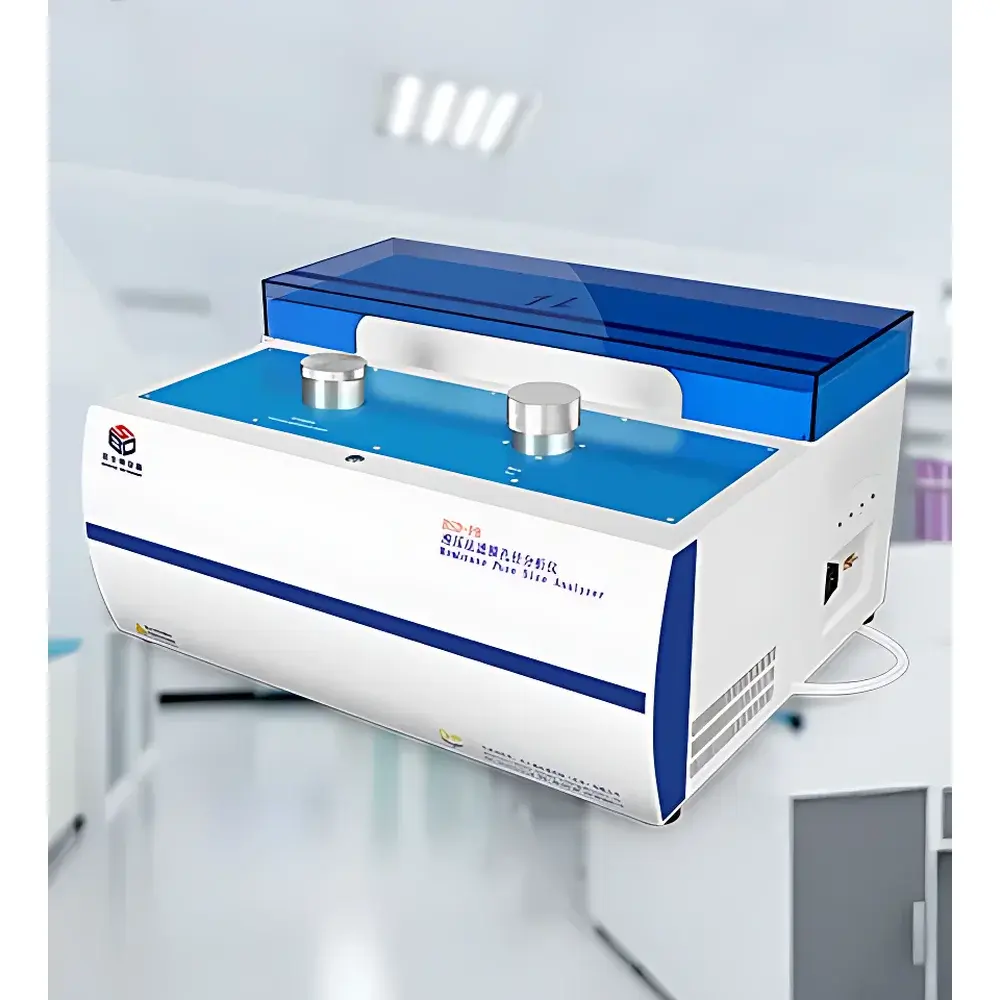
Beishide BSD-PB Bubble Point Pore Size Analyzer
| Brand | Beishide Instrument |
|---|---|
| Origin | Beijing, China |
| Manufacturer Type | Direct Manufacturer |
| Product Category | Domestic |
| Model | BSD-PBx |
| Price Range | USD 14,000 – 42,000 (FOB) |
| Instrument Type | Specific Surface Area and Pore Size Analyzer |
| Operating Principle | Static Gas Pressure Method (Bubble Point & Gas Flow) |
| Number of Analysis Stations | 1 |
| Pore Size Range | 0.02 – 500 µm |
| Pressure Range | 0–1 bar & 0–40 bar (dual-range, auto-switching) |
| Test Theory | Gas Bubble Point Method |
| Repeatability | ±0.01 µm (on certified reference membranes) |
Overview
The Beishide BSD-PB Bubble Point Pore Size Analyzer is an engineered solution for the quantitative characterization of through-pore structure in microporous and mesoporous thin-film materials. Based on the fundamental thermodynamic principle of capillary pressure equilibrium—governed by the Young–Laplace equation—the instrument determines pore size distribution by measuring the critical gas pressure required to displace a wetting liquid from pores of varying diameters. As gas pressure increases incrementally across a fully liquid-saturated membrane, the largest pores open first (bubble point), followed sequentially by smaller pores as pressure rises. Real-time concurrent measurement of differential gas flow and applied pressure yields a complete pressure–flow curve, which—when compared with the dry-membrane baseline—is mathematically transformed into pore size distribution, maximum pore size (bubble point pore), minimum pore size (critical flow onset), mean flow pore size, and gas permeability. Designed for rigorous R&D and QC environments, the BSD-PB delivers traceable, reproducible data aligned with ASTM F316-22 (Standard Test Methods for Pore Size Characteristics of Membrane Filters by Bubble Point and Forward Flow), ISO 4003:1977, and USP guidelines for membrane integrity testing.
Key Features
- High-precision dual-pressure sensor system with automatic range switching between 0–1 bar (for sub-micron resolution) and 0–40 bar (for coarse ceramic or sintered metal substrates)
- Dual high-stability mass flow sensors with segmented calibration and auto-ranging capability—ensuring accurate flow quantification across 6 orders of magnitude (10−3–103 mL/min)
- Integrated vacuum-assisted wetting station with programmable dwell time and pressure ramping—reducing full saturation time by >50% versus manual immersion
- Modular sample cell design accommodating flat-sheet membranes (up to Ø90 mm), tubular modules, fibers, nonwovens, and irregularly shaped ceramics; custom fixtures available upon request
- Full stainless-steel fluidic path with metal-to-metal sealing—rated for 40 bar service pressure and compatible with alcohols, water, silicone oils, and fluorinated wetting liquids (e.g., FC-40, HFE-7100)
- Fully automated operation with embedded voice-guided workflow, real-time status logging (timestamped to ±100 ms), and hardware-level fault diagnostics
- Patented pressure stabilization algorithm minimizing thermal drift and pulsation artifacts during low-flow measurements
Sample Compatibility & Compliance
The BSD-PB supports broad material classes including polymeric microfiltration/ultrafiltration membranes (PVDF, PTFE, PES, nylon), battery separators (PP/PE multilayer films), fuel cell gas diffusion layers (GDLs), ceramic membranes (Al2O3, ZrO2), sintered stainless steel/felt filters, geotextiles, and medical-grade woven/nonwoven fabrics. All test protocols comply with GLP documentation requirements: audit-trail-enabled software logs operator ID, method version, calibration history, raw pressure/flow timestamps, and post-processing parameters. Data export formats include CSV, XML, and PDF reports conforming to FDA 21 CFR Part 11 electronic record integrity standards when paired with optional secure user authentication and digital signature modules.
Software & Data Management
The proprietary BSD-PoreAnalysis™ v4.2 software provides ISO/IEC 17025-aligned data reduction workflows. It applies the normalized gas-permeation model (per ASTM F316 Annex A2) to derive pore size distribution histograms with bin widths adjustable from 0.005 µm to 1 µm. Built-in validation tools include bubble point repeatability assessment (per USP ), dry/wet curve overlay diagnostics, and automatic detection of incomplete wetting or channeling artifacts. Raw data files are stored in HDF5 format with embedded metadata (instrument ID, sensor serial numbers, environmental temperature/humidity). Export options support LIMS integration via RESTful API and direct linkage to enterprise QA systems using OPC UA protocol.
Applications
- Quality control of membrane manufacturing: verification of pore size specification compliance per batch release protocols
- Development of next-generation battery separators: correlation of pore architecture with ionic conductivity and dendrite suppression performance
- Evaluation of filtration media for pharmaceutical sterile filtration: bubble point validation prior to sterilizing grade certification
- Characterization of catalytic membrane reactors: mapping pore tortuosity and effective diffusivity for reaction engineering models
- Research on biomimetic porous scaffolds: quantifying interconnectivity and hydraulic permeability for tissue engineering applications
- Failure analysis of fouled membranes: comparative pore narrowing assessment before/after cleaning cycles
FAQ
What wetting liquids are supported, and how is liquid selection determined?
Selection depends on surface energy compatibility: water (γ = 72.8 mN/m) for hydrophilic membranes; isopropanol (γ = 21.7 mN/m) or ethanol (γ = 22.4 mN/m) for moderately hydrophobic surfaces; perfluorinated ethers (γ ≈ 12–15 mN/m) for highly hydrophobic PTFE or PVDF. The software includes a built-in surface tension database and recommends optimal liquids based on contact angle literature values.
Can the BSD-PB measure non-through pores or blind pores?
No—the bubble point method inherently characterizes only interconnected through-pores. Blind or closed pores do not contribute to gas flow and remain undetected. For total porosity including closed voids, complementary techniques such as mercury intrusion porosimetry (MIP) or image-based 3D tomography are recommended.
Is calibration traceable to NIST or other national standards?
Yes—pressure transducers are calibrated against Fluke 754 Documenting Process Calibrators (NIST-traceable to 0.025% FS), and flow sensors are validated using Brooks 5850E thermal mass flow meters (NIST-traceable to 0.5% reading). Full calibration certificates with uncertainty budgets are provided with each instrument shipment.
How does the instrument handle temperature-induced viscosity and density drift during long tests?
An integrated Pt100 sensor monitors bath or ambient temperature (±0.1 °C) and dynamically corrects gas viscosity and compressibility factors in real time using the Chung et al. (1988) generalized correlation—ensuring pore size calculations remain valid across 15–35 °C operating ranges.



