
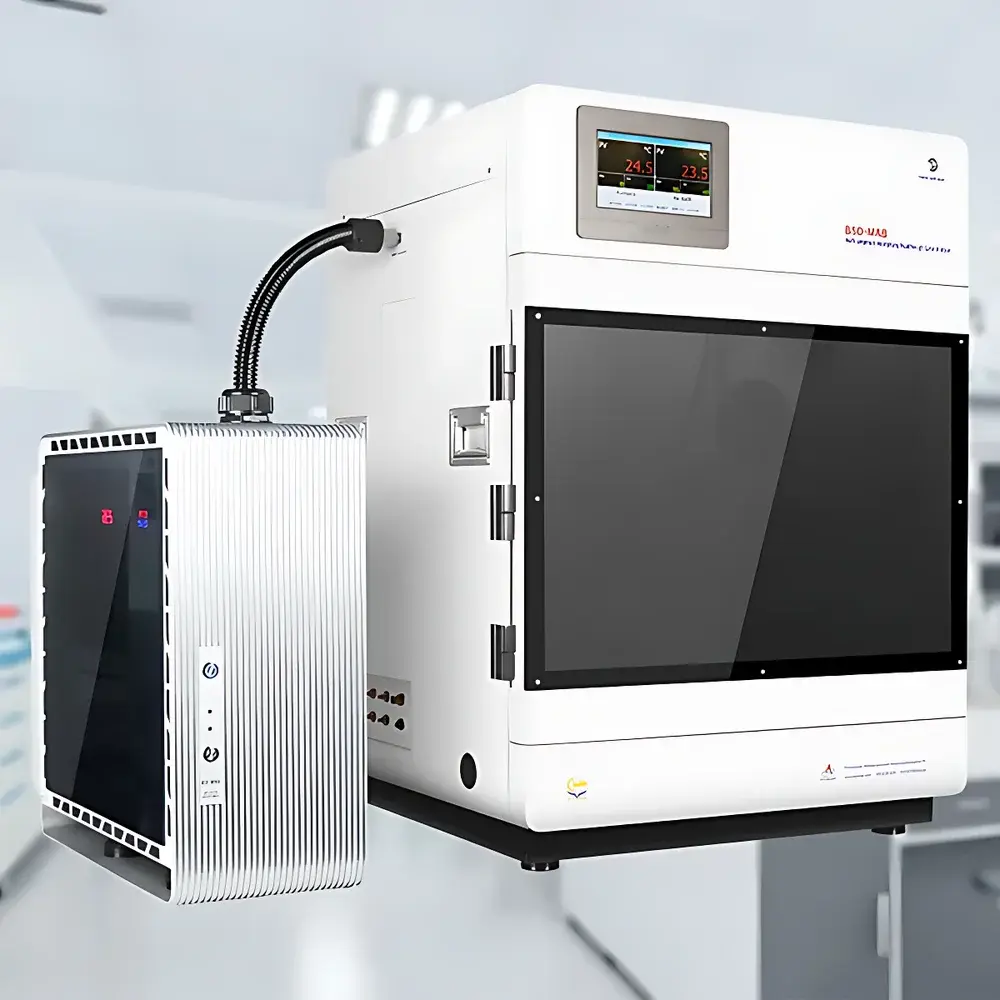
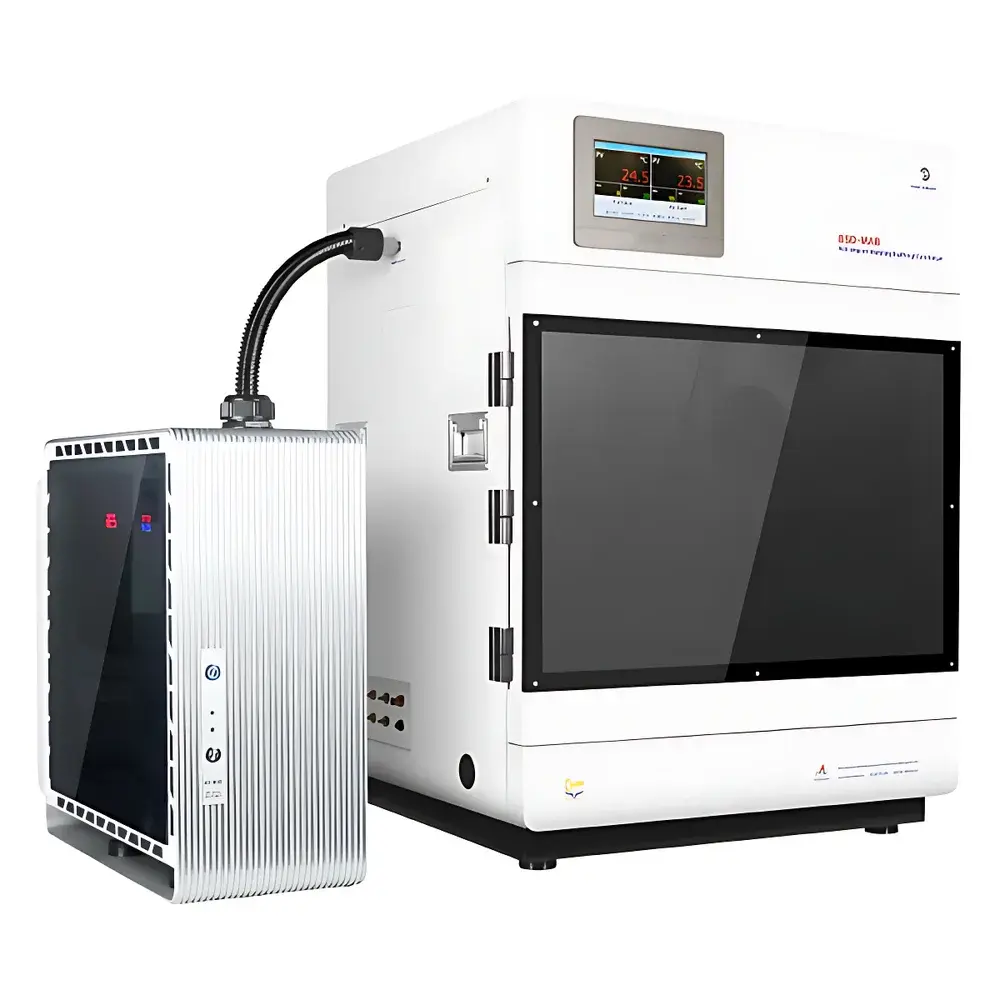
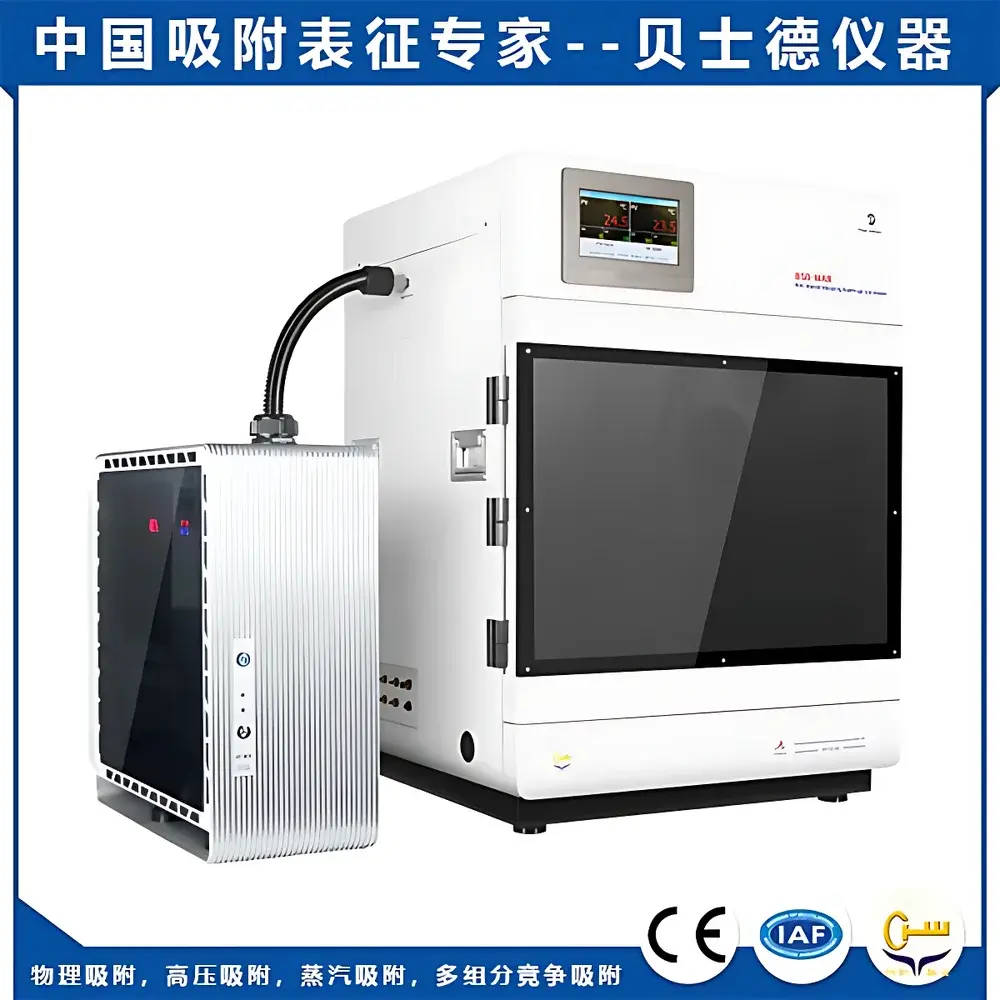
Beishide BSD-MAB1 Multicomponent Competitive Adsorption Analyzer (Breakthrough Curve Analyzer)
| Brand | Beishide Instrument |
|---|---|
| Origin | Beijing, China |
| Manufacturer Type | Direct Manufacturer |
| Model | BSD-MAB1 |
| Gas Range | Binary & Ternary Mixtures Including Gas/Gas, Gas/Vapor, Vapor/Vapor |
| MFC Channels | 4–8 |
| Breakthrough Columns | Standard 2 mL & 8 mL Stainless Steel or Quartz Columns (Custom Volumes Available) |
| Adsorption Pressure | Ambient to 10 MPa |
| Adsorption Temperature | Circulating Water Bath (−20 °C to 80 °C), High-Temperature Furnace (RT to 600 °C |
| Detector Options | Integrated TCD, Optional Online GC or Mass Spectrometer (MS) |
Overview
The Beishide BSD-MAB1 Multicomponent Competitive Adsorption Analyzer is an engineered research platform for dynamic breakthrough curve analysis under industrially relevant conditions. It operates on the principle of fixed-bed adsorption chromatography, where a controlled gas or vapor mixture flows continuously through a packed bed of solid adsorbent, and real-time effluent composition is monitored to generate time-resolved concentration profiles—i.e., breakthrough curves. This method provides quantitative, kinetic, and thermodynamic insight into competitive adsorption behavior among co-present species (e.g., VOCs, SO₂, NH₃, CO₂, H₂O), enabling rigorous evaluation of selectivity, saturation capacity, mass transfer coefficients, and breakthrough time under variable pressure, temperature, flow rate, and concentration gradients. Unlike static equilibrium measurements (e.g., volumetric or gravimetric sorption), the BSD-MAB1 replicates transient operational conditions found in pressure swing adsorption (PSA), temperature swing adsorption (TSA), air purification filters, catalytic guard beds, and industrial gas separation columns—making it indispensable for process scale-up, adsorbent screening, and regulatory-compliant material qualification.
Key Features
- Modular gas delivery architecture with 4–8 independently programmable mass flow controllers (MFCs), supporting precise binary through quaternary gas/vapor mixtures—including corrosive species (SO₂, NH₃) and condensable organics (TVOCs, alcohols, ketones).
- Dual-temperature control system: high-stability circulating water bath (±0.1 °C from −20 °C to 80 °C) combined with optional resistive furnace (up to 600 °C) for in situ thermal regeneration and temperature-programmed desorption (TPD) studies.
- Configurable breakthrough column set: standard stainless steel columns (2 mL, 8 mL); quartz columns available for high-temperature activation (>200 °C) or low-mass sampling; custom volumes (5–100 mL) support lab-scale reactor mimicry.
- Integrated thermal conductivity detector (TCD) with ppm-level sensitivity; fully compatible with external analytical interfaces—including online gas chromatography (GC) and quadrupole mass spectrometry (MS) via standardized 100 kPa sampling port.
- High-pressure capability up to 10 MPa with active pressure regulation, enabling true dynamic PSA simulation and supercritical adsorption investigations.
- Automated adsorbent pre-treatment module: 10-position quartz column activator with purge gas control, vacuum option (<0.1 Pa), and programmable heating ramping for reproducible surface conditioning per ASTM D3612 and ISO 15901-2 guidelines.
Sample Compatibility & Compliance
The BSD-MAB1 accommodates a broad spectrum of adsorbent materials—including activated carbons, zeolites, MOFs, silica gels, metal oxides, and functionalized polymers—and supports both dry and humidified feed streams. It is validated for use with non-corrosive gases (N₂, Ar, He, CO₂, CH₄), polar vapors (H₂O, NH₃, methanol), reactive species (SO₂, NOₓ), and complex organic mixtures (benzene/toluene/xylene, formaldehyde, limonene). All wetted components comply with ASTM E2654 for trace contaminant compatibility, and system design conforms to ISO/IEC 17025 requirements for test method validation. When operated with optional GC or MS detection, data acquisition meets FDA 21 CFR Part 11 audit-trail and electronic signature standards. Calibration protocols align with ISO 6974-2 (gas chromatography) and ISO 13877 (mass spectrometry), ensuring traceability for GLP and GMP environments.
Software & Data Management
The proprietary Beishide ADSControl™ software provides synchronized control of MFCs, temperature zones, pressure regulators, and detectors via PID feedback loops. Real-time breakthrough curve acquisition includes automatic peak integration, front-edge detection, and dynamic capacity calculation (qt, qeq). Export formats include CSV, Excel, and HDF5 for third-party modeling (e.g., Aspen Adsorption, COMSOL Multiphysics). Batch processing enables comparative analysis across multiple runs, while built-in tools support Yoon–Nelson, Thomas, and Bohart–Adams model fitting. Audit logs record all parameter changes, user actions, and calibration events—fully compliant with ALCOA+ principles for data integrity in regulated laboratories.
Applications
- Design and optimization of PSA/TSA cycles for hydrogen purification, biogas upgrading, and oxygen/nitrogen separation.
- Performance benchmarking of next-generation adsorbents (e.g., MOF-808, UiO-66-NH₂, MIL-101(Cr)) against legacy materials under realistic multicomponent feeds.
- Regulatory testing of HVAC filter media for indoor air quality (IAQ) compliance (ASHRAE 145.1, ISO 16000-23).
- Quantification of competitive binding affinities and displacement thresholds in flue gas cleanup (e.g., CO₂ vs. H₂O vs. SO₂ on amine-grafted silicas).
- Accelerated lifetime assessment of automotive cabin air filters exposed to ppb–ppm level VOC cocktails.
- Thermodynamic characterization via TPD experiments to derive isosteric heats of adsorption and adsorption energy distributions.
FAQ
What detection limits does the system achieve for key pollutants?
With integrated TCD, detection limits are 5 × 10⁻¹² g/mL for TVOCs, 14 × 10⁻¹² g/mL for SO₂, and 16 × 10⁻¹² g/mL for NH₃. When coupled to optional INFICON BSD-MASS (1–100 amu), sub-ppb detection is attainable for targeted ions.
Can the system handle steam-containing feeds without condensation artifacts?
Yes—steam generation is controlled via precision saturators with inline temperature stabilization; all downstream lines are actively heated to >100 °C to prevent dew-point-related errors.
Is remote operation and data monitoring supported?
ADSControl™ supports secure LAN/WAN access with role-based authentication, live dashboard streaming, and automated report generation via SMTP or cloud API (AWS S3, Azure Blob).
How is system validation performed prior to user deployment?
Each unit ships with NIST-traceable calibration certificates for MFCs, temperature sensors, and pressure transducers; factory verification includes multi-point breakthrough repeatability tests using certified gas standards.
Are custom column geometries or specialized fittings available?
Yes—Beishide offers OEM engineering services for bespoke column dimensions, internal thermocouple embedding, radial flow configurations, and Hastelloy/Carpenter 20 construction for extreme corrosion resistance.



