
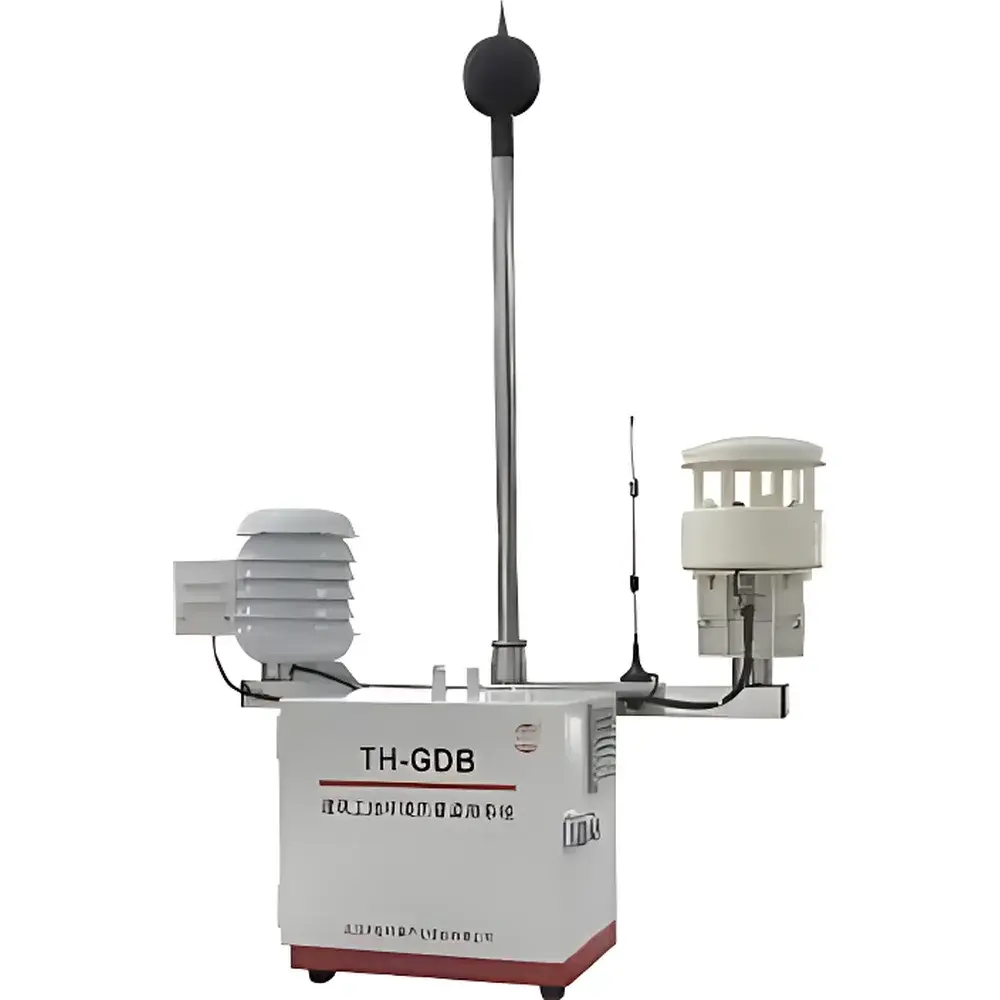
TH-GDB Construction Site Environmental Quality Monitoring System
| Brand | Tianhong |
|---|---|
| Origin | Hubei, China |
| Manufacturer Type | Authorized Distributor |
| Country of Manufacture | China |
| Model | TH-GDB |
| Pricing | Available Upon Request |
Overview
The TH-GDB Construction Site Environmental Quality Monitoring System is an integrated, field-deployable environmental monitoring platform engineered for continuous, real-time assessment of ambient conditions at active construction sites. It operates on a multi-sensor fusion architecture grounded in standardized environmental measurement principles: particulate matter (PM2.5/PM10) detection via laser scattering photometry, broadband acoustic pressure measurement per IEC 61672-1 Class 2 specifications, meteorological parameter acquisition using calibrated thermistor-based temperature/humidity sensors and ultrasonic wind sensors, and geospatial referencing via GPS/GLONASS dual-mode positioning. Designed to comply with China’s Ministry of Ecology and Environment (MEE) Technical Specifications for Ambient Air Quality Monitoring (HJ 653–2013, HJ 93–2013) and aligned with international best practices for urban particulate and noise surveillance, the system delivers synchronized, time-stamped data streams essential for regulatory reporting, compliance verification, and dynamic site management.
Key Features
- Integrated multi-parameter sensing: Simultaneous real-time acquisition of PM2.5, PM10, sound pressure level (SPL), temperature, relative humidity, wind speed/direction, atmospheric pressure, and GPS coordinates.
- Dedicated industrial-grade enclosure rated IP65 for outdoor deployment under harsh construction site conditions—resistant to dust ingress, rain, and mechanical impact.
- Onboard 32-bit embedded microcontroller enabling autonomous sensor calibration, data validation, and protocol-level error handling without external computing resources.
- 7-inch capacitive touchscreen interface with localized English-language UI, supporting direct configuration, historical data review, and alarm threshold adjustment.
- Non-volatile flash memory capable of storing >12 months of 10-minute interval data (≥400,000 records), with automatic power-fail recovery and cold-start resumption.
- Wireless telemetry via LTE Cat-4 (3G/4G) module compliant with ETSI EN 301 908-1, enabling secure remote access to live sensor values, streaming video feeds, and firmware updates.
Sample Compatibility & Compliance
The TH-GDB system is validated for use in heterogeneous urban construction environments—including high-dust excavation zones, concrete pouring areas, pile-driving operations, and material stockpiling yards. Its particulate sensor employs optical compensation algorithms to minimize bias from humidity-induced scattering artifacts, while its noise module applies A-weighting and time-averaging (Leq, Lmax, Lmin) in accordance with ISO 1996-2:2017 and GB/T 3222-2009. All hardware components meet RoHS 2011/65/EU directives. Data integrity protocols support audit-ready logging required under China’s Environmental Information Disclosure Measures (Order No. 35) and are compatible with municipal environmental data platforms adhering to MEE’s “Environmental Monitoring Data Quality Management Technical Guidelines” (HJ 630–2011).
Software & Data Management
The system interfaces with Tianhong’s cloud-based Environmental Data Platform (EDP), accessible via web browser or dedicated desktop client. Raw sensor outputs are ingested in JSON format over HTTPS with TLS 1.2 encryption. The platform provides role-based user permissions, automated daily report generation (PDF/CSV), GIS-mapped visualization of spatial-temporal trends, and configurable SMS/email alerts triggered by exceedance of user-defined thresholds. Audit trails record all configuration changes, data exports, and user logins—supporting GLP-aligned documentation requirements. Data export functions include USB mass-storage mode and SFTP push to third-party databases, ensuring interoperability with existing municipal environmental information systems (e.g., provincial Ecological Environment Monitoring Centers’ ERP integrations).
Applications
- Regulatory compliance monitoring for construction projects subject to local environmental ordinances (e.g., Beijing Municipal Regulations on Dust Control at Construction Sites).
- Preventive risk mitigation: Correlating PM spikes with specific activities (e.g., demolition, earthmoving) to optimize work scheduling and suppressant application timing.
- Community engagement: Public-facing dashboards displaying real-time air/noise metrics near residential perimeters or educational campuses.
- Academic research: Long-term dataset acquisition for studies on urban aerosol dynamics, noise propagation modeling in built environments, or climate–dust interaction analysis.
- Cross-site benchmarking: Aggregated anonymized data across multiple TH-GDB deployments to establish regional baseline profiles for PM and noise exposure.
FAQ
Is the TH-GDB system certified for use in official environmental monitoring networks?
Yes—it meets the technical verification criteria outlined in MEE’s “Technical Requirements for Online Monitoring Equipment for Construction Site Dust and Noise” (HJ 1127–2020) and has passed provincial-level metrological verification for particulate and acoustic sensors.
Can the system operate independently during extended power outages?
It supports 12 V DC backup battery operation (optional) with ≥72-hour runtime; internal EEPROM ensures zero data loss during mains interruption.
Does the platform support integration with third-party SCADA or BMS systems?
Yes—via Modbus TCP (RTU over Ethernet) and RESTful API endpoints for real-time data pull and command injection, documented in the Tianhong Integration Developer Kit (IDK v2.1).
What is the recommended maintenance schedule for field calibration?
Particulate sensors require annual traceable calibration against NIST-traceable reference aerosols; acoustic modules are verified semiannually using Class 1 sound calibrators per IEC 60942.
Are firmware updates delivered automatically or manually?
Firmware patches are distributed via secure OTA (Over-The-Air) mechanism; administrators may schedule updates during low-activity maintenance windows or defer based on operational requirements.
Related Products







