
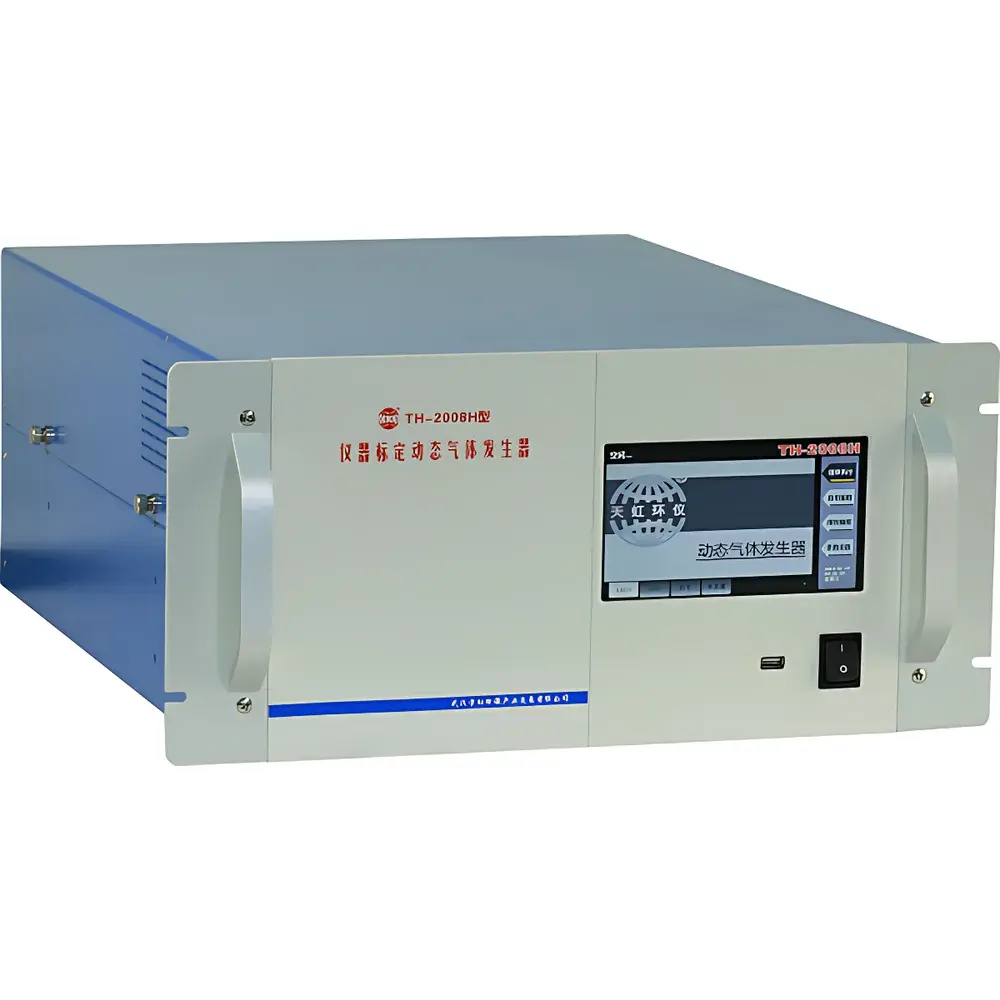
Yuhong TH-2008H Dynamic Gas Generator for Instrument Calibration
| Brand | Yuhong |
|---|---|
| Model | TH-2008H |
| Origin | Hubei, China |
| Flow Control | Dual Mass Flow Controllers (MFCs) |
| O₃ Generation | Integrated ozone generator with 18-point calibration |
| NO₂ Generation | Quantitative NO₂ standard gas via gas-phase titration (GPT) |
| Display | 7-inch full-touch color LCD |
| Interface | Chinese menu system |
| Programmability | Up to 99 program/sequence segments |
| Environmental Compensation | Automatic temperature & pressure compensation |
| Communication | RS232, RS485, USB, Ethernet |
| Remote Capability | Remote zero/span command execution and internal parameter diagnostics |
| Alarm System | Multi-parameter fault alerting |
| Compliance | Designed for EPA, ISO 16140, EN 14625, and US EPA Method 213/214 alignment |
Overview
The Yuhong TH-2008H Dynamic Gas Generator is an engineered calibration platform designed specifically for traceable, on-site verification and performance validation of ambient air monitoring analyzers. It operates on the principle of dynamic dilution—precisely metering certified standard gases (e.g., SO₂, NO, NO₂, O₃, CO) into high-purity zero air using dual mass flow controllers (MFCs), thereby generating stable, gravimetrically traceable concentration outputs across sub-ppb to low-ppm ranges. Unlike static permeation or cylinder-based calibration systems, the TH-2008H enables real-time, programmable gas generation without reliance on physical gas cylinders, minimizing logistical overhead and improving calibration repeatability. Its integrated ozone generation module employs photolytic UV lamp technology, with O₃ output calibrated at 18 discrete concentration points traceable to NIST-certified reference standards. For NO₂ calibration, the unit supports gas-phase titration (GPT) methodology—quantitatively converting NO to NO₂ in a controlled reaction chamber—enabling direct assessment of NOx analyzer converter efficiency per US EPA Method 205 and ISO 16140-2.
Key Features
- Dual high-accuracy MFCs (±1% FS full-scale accuracy) ensure reproducible dilution ratios under variable ambient conditions.
- 7-inch capacitive touch display with intuitive Chinese-language interface—optimized for field technicians conducting routine QA/QC tasks.
- Programmable architecture supporting up to 99 independent program segments and sequence chains, each configurable with target concentration, dwell time, ramp profiles, and MFC setpoints.
- Real-time temperature and barometric pressure compensation applied to all flow calculations—critical for maintaining metrological integrity during outdoor or unconditioned lab deployments.
- Embedded ozone generation subsystem with built-in UV absorption detection and 18-point factory calibration certificate—providing NIST-traceable O₃ output from 10 ppb to 1 ppm.
- Remote operation capability via Ethernet or serial interface: accepts standardized Modbus RTU/TCP commands for zero/span initiation, parameter interrogation, and diagnostic status reporting.
- Comprehensive alarm framework monitors MFC drift, zero-air purity failure, UV lamp degradation, pressure drop across filters, and thermal sensor deviation—logging timestamps and event codes for GLP-compliant audit trails.
Sample Compatibility & Compliance
The TH-2008H is compatible with all major ambient air analyzers requiring dynamic calibration—including chemiluminescence NOx analyzers (Thermo Fisher 42i, Horiba APNA-370), UV photometric O₃ analyzers (2B Technologies 205, EcoPhysics CLD 64), pulsed fluorescence SO₂ instruments (Teledyne API 100E), and NDIR CO analyzers (Sick GMS800). Its design aligns with international regulatory frameworks: calibration protocols conform to ISO 16140 (validation of alternative methods), EN 14625 (ambient air—determination of ozone), and US EPA Performance Evaluation Protocols (PEP) for continuous emission monitoring systems (CEMS). All firmware and calibration records support 21 CFR Part 11-compliant electronic signatures when deployed with validated LIMS integration.
Software & Data Management
The device includes embedded firmware with non-volatile memory for storing ≥10,000 calibration events—including date/time stamp, operator ID, target gas species, nominal concentration, actual measured output (where integrated sensors are active), and pass/fail status against user-defined tolerance bands (e.g., ±2% for O₃, ±5% for NO₂). Data export is supported via USB flash drive (CSV format) or network transfer (FTP/SFTP). Optional PC software provides graphical trend analysis, certificate generation (PDF with digital signature), and automated report compilation aligned with ISO/IEC 17025 documentation requirements. Audit logs retain full history of configuration changes, calibration updates, and firmware revisions—enabling full traceability during third-party accreditation audits.
Applications
- Routine calibration and linearity verification of fixed-site ambient air quality monitoring stations (AQS).
- Field validation of mobile monitoring platforms and drone-mounted sensor arrays.
- Performance testing of NOx converter efficiency using gas-phase titration—critical for regulatory compliance under EU Directive 2008/50/EC.
- Multi-gas interference studies requiring simultaneous or sequential delivery of SO₂/NO/O₃/CO blends at precisely defined ratios.
- Method development and inter-laboratory comparison exercises where dynamic gas generation eliminates cylinder-to-cylinder variability.
- Training and certification programs for environmental laboratory personnel accredited to ISO/IEC 17025.
FAQ
Does the TH-2008H require external zero air supply?
Yes—it must be connected to a certified zero air source meeting EPA Method 205 specifications (hydrocarbon-free, <0.1 ppb NOx, <0.5 ppb SO₂, dew point ≤ –40°C). Internal zero air generation is not provided.
Can it calibrate multi-component analyzers simultaneously?
It generates one target gas species per calibration cycle; however, programmable sequences allow rapid sequential calibration of SO₂, NO, NO₂, O₃, and CO within a single automated run.
Is ozone calibration traceable to national standards?
Yes—the integrated O₃ generator is calibrated at 18 concentration points using a NIST-traceable transfer standard photometer (e.g., Dasibi 1008-UV), with full calibration certificate supplied.
What communication protocols does it support for SCADA integration?
Modbus RTU (RS485), Modbus TCP (Ethernet), and ASCII command sets over RS232/USB—enabling seamless integration into industrial control networks and central data acquisition systems.
How often does the UV lamp in the ozone module require replacement?
Rated lifetime is ≥10,000 hours; lamp status and cumulative operating hours are monitored and reported in real time via the diagnostic interface.







