
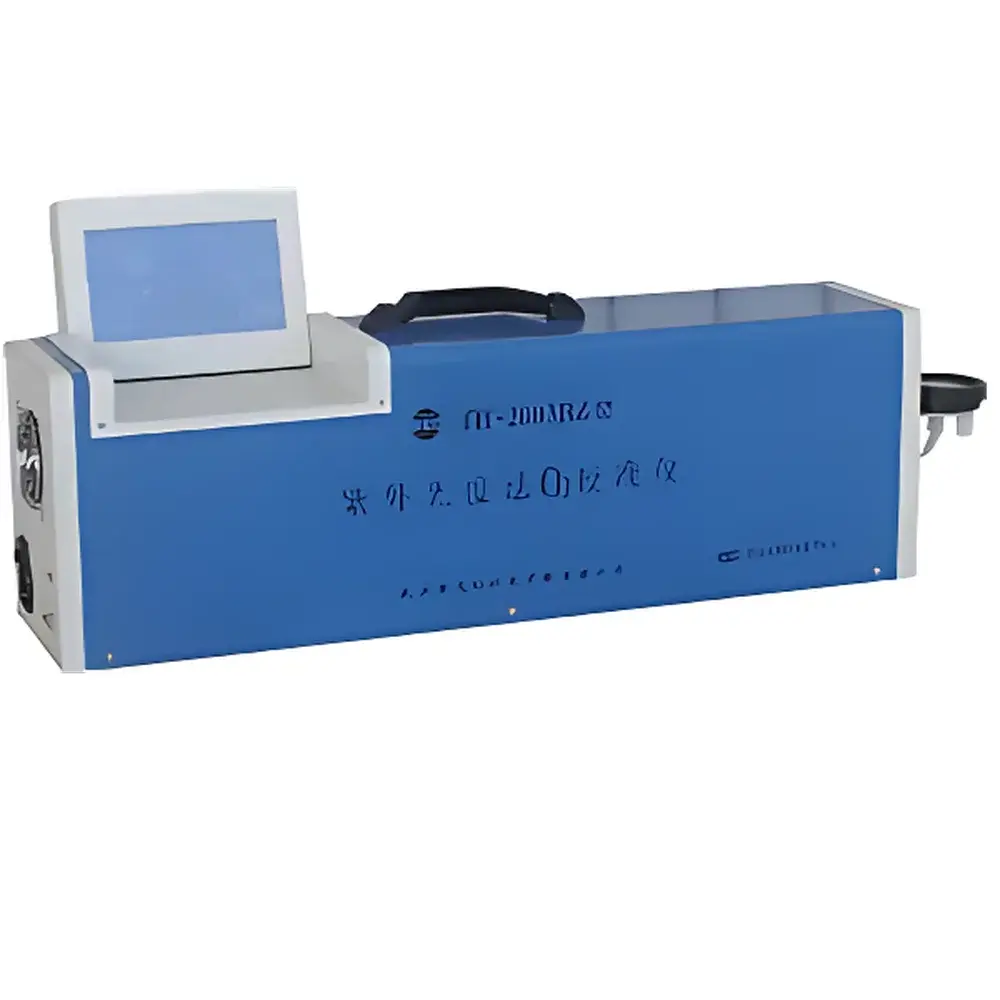
Tianhong TH-2003BZ(SRP) Primary Ozone Calibration System
| Brand | Tianhong |
|---|---|
| Origin | Hubei, China |
| Type | Fixed-Mount Primary Calibration System |
| Compliance | GB 3095-2012, HJ 654-2013 |
| Core Components | SRP Main Unit, Zero Air Generation System, High-Accuracy Pressure Sensor, UV Photometer Reference Standard, Control & Data Acquisition Workstation |
| Gas Path Materials | PTFE/PVDF Valves & Fittings |
| Flow Control | Digital Mass Flow Controllers (MFCs) |
| Interface | 7-inch Touchscreen (Bilingual Chinese/English GUI) |
| Environmental Compensation | Automatic Temperature & Pressure Compensation |
| Alarm Function | Multi-Parameter Real-Time Alerting |
| Zero Air Specification | Dry, High-Purity (>99.999%), Stable Flow Output |
Overview
The Tianhong TH-2003BZ(SRP) Primary Ozone Calibration System is a traceable, laboratory-grade reference standard designed to perform primary-level calibration of ozone (O₃) analyzers used in ambient air quality monitoring networks. It operates on the principle of ultraviolet (UV) photometry at 254 nm—internationally recognized as the definitive method for ozone quantification per ISO 13964 and EPA Method EQOA-01. Unlike transfer standards or permeation-based generators, this system establishes ozone concentration through direct, real-time UV absorbance measurement of a dynamically generated gas stream, enabling NIST-traceable calibration with documented uncertainty budgets. The SRP (Standard Reference Photometer) architecture integrates a high-stability UV photometer as the primary reference, eliminating reliance on secondary ozone generators or chemical titration. Its fixed-mount configuration supports continuous operation within certified air quality laboratories, regulatory testing facilities, and national metrology institutes requiring compliance with GLP and ISO/IEC 17025 accreditation requirements.
Key Features
- Integrated SRP main unit featuring a dual-beam UV photometer calibrated against national ozone standards, delivering measurement repeatability ≤ ±0.5% of full scale under controlled environmental conditions.
- Digital mass flow controllers (MFCs) with <0.2% full-scale accuracy and <0.1% linearity error, ensuring precise stoichiometric dilution of ozone into zero air across dynamic ranges from 0–500 nmol/mol.
- Automated temperature and pressure compensation aligned with ideal gas law corrections, referenced to integrated high-accuracy sensors (±0.1°C, ±0.05 kPa).
- Bilingual touchscreen interface (7-inch capacitive display) supporting both Chinese and English operational menus, with intuitive navigation for calibration sequence initiation, parameter logging, and diagnostic status review.
- Chemically inert gas path constructed entirely from PTFE and PVDF components—including solenoid valves, fittings, and reaction cells—to prevent catalytic decomposition or surface adsorption of ozone.
- Zero air generation subsystem producing ≥20 L/min of dry (<−70°C dew point), hydrocarbon-free (<0.1 ppb THC), particle-free (<0.01 µm filter) air meeting ISO 8573-1 Class 1 specifications.
- Multi-parameter alarm system monitoring critical variables including UV lamp intensity drift, photometer signal-to-noise ratio degradation, MFC response time deviation, and zero air purity failure.
Sample Compatibility & Compliance
The TH-2003BZ(SRP) is engineered for compatibility with all UV photometric ozone analyzers compliant with EN 14625, ASTM D5012, and US EPA Reference Method EQOA-01. It supports calibration verification of both portable and fixed-site monitors deployed in national air quality networks. The system meets the technical validation criteria specified in HJ 654-2013 for gaseous pollutant continuous emission monitoring systems and satisfies the reference standard requirements outlined in GB 3095-2012 for ambient ozone concentration assessment. All calibration records are timestamped, digitally signed, and stored with full audit trail functionality—supporting compliance with FDA 21 CFR Part 11 when configured with validated software modules.
Software & Data Management
The embedded workstation runs a deterministic real-time operating system with deterministic data acquisition at 10 Hz sampling rate. Calibration sequences generate structured XML reports containing raw photometer voltage outputs, compensated concentration values, MFC setpoints and actuals, environmental sensor readings, and system health metadata. Export formats include CSV, PDF (with digital signature), and ASTM E2500-compliant electronic lab notebook (ELN) packages. Data integrity is enforced via SHA-256 hashing of each calibration session, with optional integration into LIMS platforms via OPC UA or Modbus TCP protocols. Audit logs record user login events, parameter modifications, and report generation actions—fully traceable for GLP/GMP audits.
Applications
- Primary calibration and periodic verification of ambient ozone analyzers in national air quality monitoring stations.
- Validation of ozone generator output stability and linearity in instrument manufacturer R&D labs.
- Uncertainty budget development for metrological traceability in regional calibration centers.
- Supporting inter-laboratory comparison exercises organized by CNAS or APAC under ILAC MRA frameworks.
- Field-deployable reference support for mobile calibration vans servicing remote monitoring sites.
- Training platform for QA/QC personnel on ozone measurement fundamentals and calibration best practices.
FAQ
What ozone concentration range can the TH-2003BZ(SRP) generate and measure?
The system delivers and certifies ozone concentrations from 0 to 500 nmol/mol (0–1000 ppb) with expanded uncertainty ≤ ±1.2% (k=2) relative to NIM (National Institute of Metrology, China) ozone standards.
Is the UV photometer internally calibrated or requires external recalibration?
The SRP photometer undergoes factory calibration using NIM-traceable ozone standards; annual recalibration is recommended and supported via NIM-certified service contracts.
Can the system be integrated with third-party data acquisition software?
Yes—via RS-232, Ethernet (TCP/IP), or optional USB-C interface, supporting SCPI command sets and ASCII-based data streaming protocols.
Does the zero air generator meet ISO 8573-1 Class 1 requirements?
Yes—the integrated zero air subsystem achieves ISO 8573-1:2010 Class 1 for particles, water, and oil, verified by independent third-party testing reports.
What maintenance intervals are recommended for long-term operational reliability?
UV lamp replacement every 12 months; MFC recalibration every 6 months; zero air filter replacement every 3 months under continuous operation; full system performance verification annually.
Related Products







