
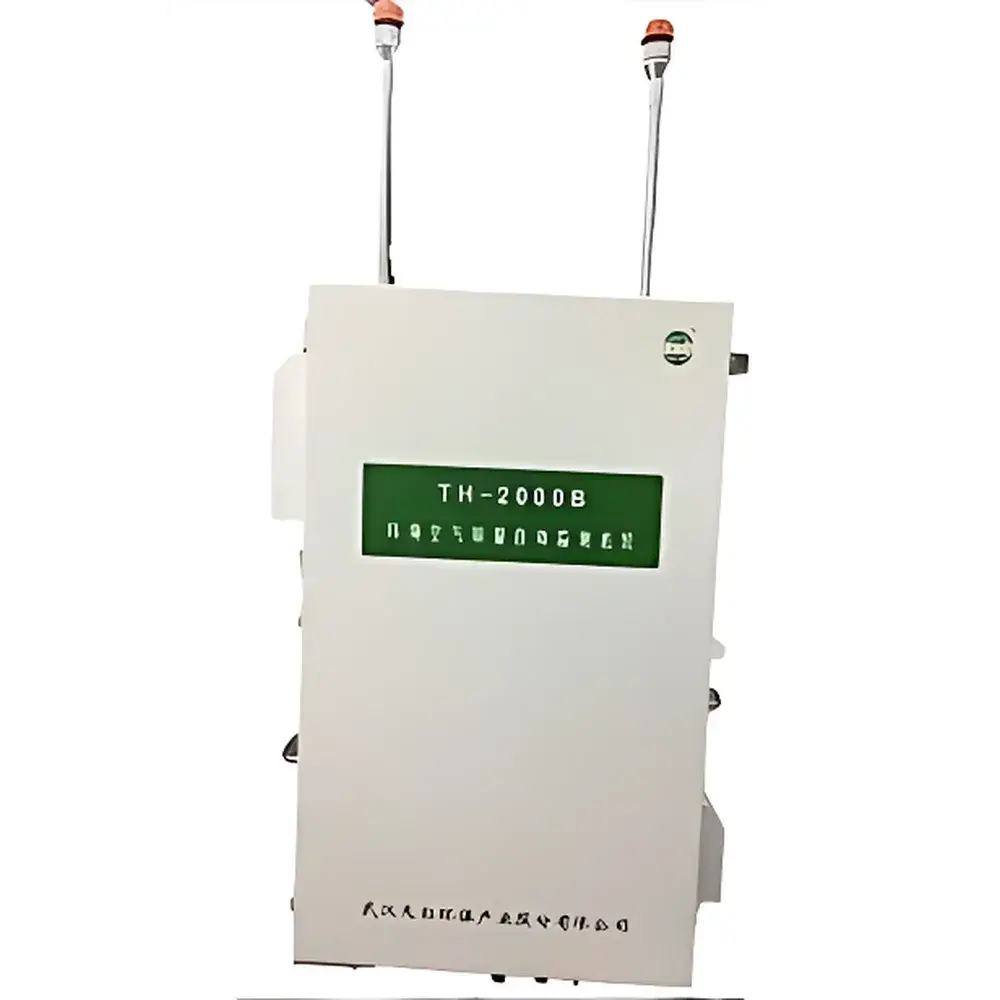
Tianhong TH-2000B Automatic Ambient Air Quality Monitoring System
| Brand | Tianhong |
|---|---|
| Model | TH-2000B |
| Origin | Hubei, China |
| Measured Pollutants | PM₂.₅, PM₁₀, SO₂, NO₂, NO, O₃, CO, VOCs |
| Operating Temperature Range | −40 °C to +50 °C |
| Display | 7.0-inch TFT color touchscreen (Chinese UI) |
| Detection Principles | Laser scattering (particulates), electrochemical sensors (CO, NO, NO₂, O₃, SO₂), PID (VOCs) |
| Meteorological Parameters | Wind speed, wind direction, ambient temperature, relative humidity, atmospheric pressure |
| Communication Interfaces | RS232/RS485, USB, GPRS, Ethernet |
| Enclosure Rating | IP65-equivalent weatherproof design for unattended outdoor operation |
Overview
The Tianhong TH-2000B Automatic Ambient Air Quality Monitoring System is a fully integrated, fixed-site environmental monitoring platform engineered for continuous, real-time assessment of ambient air composition in regulatory, municipal, and industrial settings. It operates on multi-principle detection architecture: laser diffraction and Mie scattering for PM₂.₅ and PM₁₀ mass concentration quantification; electrochemical cells for selective, stable measurement of reactive gases including carbon monoxide (CO), nitrogen oxides (NO, NO₂), sulfur dioxide (SO₂), and ozone (O₃); and photoionization detection (PID) with 10.6 eV lamp for broad-spectrum volatile organic compound (VOC) screening. The system incorporates a calibrated meteorological sensor suite—measuring wind speed and direction, ambient temperature, relative humidity, and barometric pressure—to support source attribution, dispersion modeling, and data normalization per ISO 12039 and EN 14625 standards.
Key Features
- Industrial-grade environmental enclosure rated for continuous outdoor deployment under extreme climatic conditions (−40 °C to +50 °C), featuring active thermal stabilization to maintain sensor accuracy and optical path integrity across operational temperature ranges.
- 7.0-inch high-resolution TFT color touchscreen with intuitive Chinese-language menu interface—designed for field technicians with minimal training requirements and optimized for glove-compatible touch interaction.
- Multi-modal gas and particulate detection architecture compliant with reference method equivalency principles outlined in EPA Method TO-15 (VOCs), EN 14625 (O₃), and ISO 7203 (electrochemical gas sensors).
- Dual redundancy in data communication: primary Ethernet with TCP/IP stack for LAN/WAN integration and secondary GPRS fallback for remote telemetry in low-infrastructure zones.
- Modular hardware architecture enabling field-upgradable sensor cartridges—including optional expansion to H₂S, HF, HCl, and NH₃—without system downtime or firmware reflash.
- Self-diagnostics engine continuously monitors sensor drift, zero/span stability, flow rate consistency, and power supply integrity, generating automated maintenance alerts via Syslog or SNMP trap.
Sample Compatibility & Compliance
The TH-2000B is validated for ambient air sampling at standard temperature and pressure (STP: 25 °C, 101.325 kPa) with volumetric flow control (±2% accuracy). All gas sensors undergo factory calibration against NIST-traceable standards; particulate channels are aligned to gravimetric reference methods per ISO 10473. The system meets CE marking requirements under Directive 2014/30/EU (EMC) and 2014/35/EU (LVD), and its data acquisition firmware supports audit-ready logging for GLP-compliant operations. While not certified to US EPA Federal Reference Methods (FRMs), it satisfies performance criteria for supplemental monitoring networks under 40 CFR Part 58, Subpart E, and aligns with China’s HJ 653–2013 technical specification for ambient air quality monitoring stations.
Software & Data Management
The embedded monitoring software employs a layered, object-oriented architecture: the Device Abstraction Layer (DAL) isolates hardware drivers from application logic; the Data Acquisition Engine handles real-time timestamping, unit conversion, and linearization per sensor-specific calibration curves; and the Application Service Layer provides web-based configuration, alarm management, and export functions (CSV, XML, JSON). All raw and processed data are stored locally on industrial-grade microSD with cyclic overwrite policy (configurable retention: 30–180 days). Remote access supports HTTPS-secured API endpoints compliant with RESTful conventions, enabling integration into third-party SCADA, EMS, or cloud analytics platforms. Audit trails record all user-initiated actions—including calibration events, parameter changes, and firmware updates—with immutable timestamps and operator ID tagging per FDA 21 CFR Part 11 Annex 11 principles.
Applications
- Urban and regional ambient air quality networks operated by environmental protection bureaus for compliance reporting against national ambient air quality standards (e.g., China’s GB 3095–2012).
- Industrial fence-line monitoring for petrochemical, pharmaceutical, and semiconductor facilities requiring continuous emission tracking and early warning of process upsets.
- Construction site and landfill perimeter monitoring to verify dust suppression efficacy and VOC fugitive emission controls.
- Research-grade longitudinal studies where co-located meteorological data enables wind-rose analysis, pollutant transport modeling, and correlation with health outcome datasets.
- Emergency response deployment during chemical incidents, wildfires, or industrial accidents—leveraging rapid setup time (<30 min), battery-backed operation (optional), and GPRS-based alert broadcasting.
FAQ
Does the TH-2000B meet U.S. EPA or European Union regulatory certification requirements for official compliance monitoring?
No. It is designed as a reference-grade supplemental monitor and does not hold FRM/FEM designation from the U.S. EPA or Type Approval under EU Directive 2008/50/EC. Its use is appropriate for trend analysis, hotspot identification, and pre-compliance screening.
Can the system operate without internet connectivity?
Yes. Local data logging, touchscreen operation, and internal alarm triggering function independently of network connection. GPRS or Ethernet are required only for remote data retrieval or centralized fleet management.
What is the recommended calibration interval for electrochemical and PID sensors?
Tianhong recommends zero/span verification every 7 days and full calibration every 90 days using certified gas standards traceable to national metrology institutes. Particulate channel alignment should be performed quarterly using polystyrene latex (PSL) aerosol reference material.
Is meteorological data synchronized with pollutant measurements at the millisecond level?
Yes. All analog and digital sensor inputs are acquired on a common 100 Hz sampling clock, with GPS-synchronized UTC timestamps applied to each 1-second averaged record before storage or transmission.







