
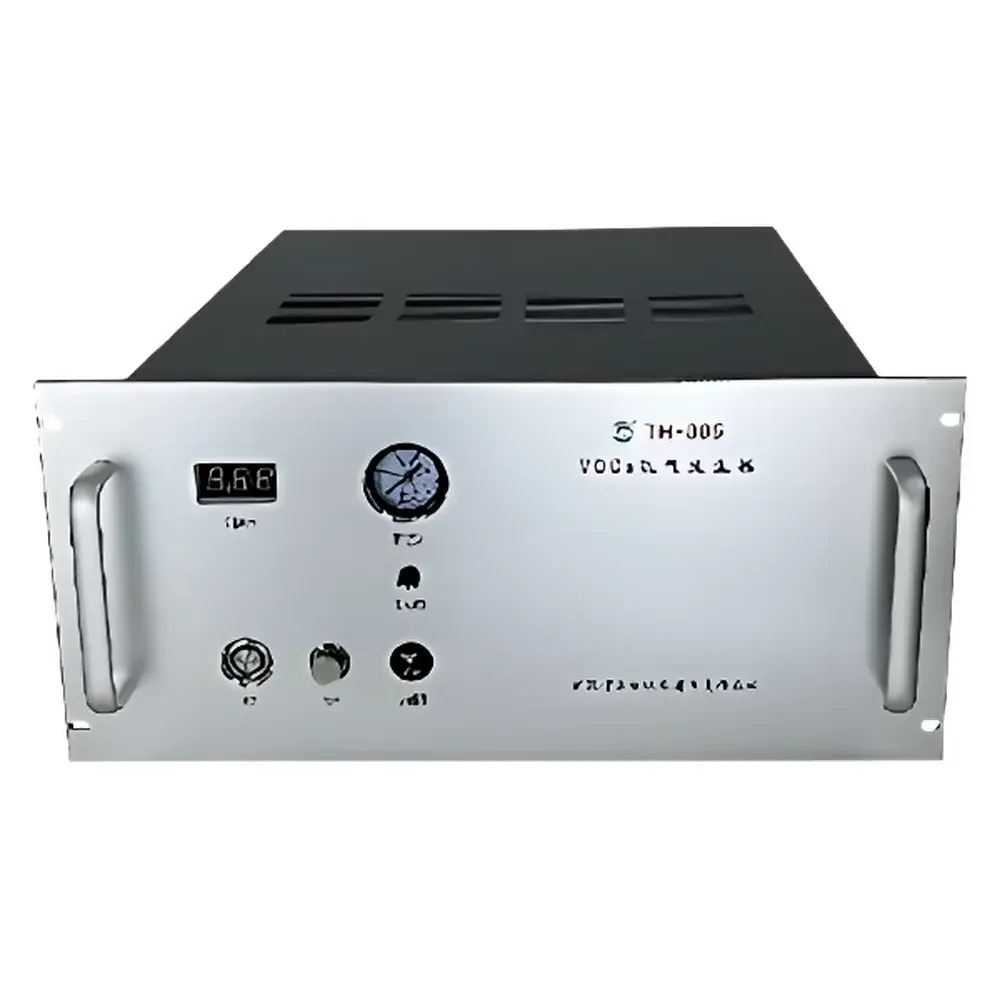
Tianhong TH-305 VOCs Hydrogen Generator
| Brand | Tianhong |
|---|---|
| Origin | Hubei, China |
| Model | TH-305 VOCs Hydrogen Generator |
| Hydrogen Purity | ≥99.999% |
| Flow Rate Range | 0–300 mL/min |
| Output Control | Automatic Flow Tracking & Electrolyzer Power Modulation |
| Display | LCD with Real-time Parameter Monitoring |
| Safety Protections | Overpressure, Overtemperature, Low-Water, and High-Water Level Interlocks |
| Power Supply | AC 220 V ±10%, 50 Hz |
| Dimensions | 360 × 280 × 520 mm |
| Weight | ~22 kg |
| Compliance | CE-marked (per EN 61000-6-3/6-4, EN 61010-1), Designed for GLP-Compatible Lab Environments |
Overview
The Tianhong TH-305 VOCs Hydrogen Generator is a laboratory-grade electrolytic hydrogen source engineered specifically for gas chromatography (GC) and volatile organic compounds (VOCs) analysis systems requiring ultra-high-purity carrier or fuel gas. It employs solid polymer electrolyte (SPE) membrane technology to generate hydrogen on-demand from deionized or double-distilled water—eliminating the logistical, safety, and regulatory burdens associated with compressed hydrogen cylinders. The core electrochemical process follows the principle of proton exchange membrane (PEM) water electrolysis: at the anode, water undergoes oxidation (2H₂O → 4H⁺ + 4e⁻ + O₂); protons migrate across the SPE membrane under applied electric field; at the cathode, protons combine with electrons to form molecular hydrogen (4H⁺ + 4e⁻ → 2H₂). Oxygen is vented separately, while generated hydrogen passes through an integrated gas–water separator and particulate filter to deliver ≥99.999% pure H₂—meeting ASTM D7217 and ISO 8573-1 Class 1 requirements for GC carrier gas purity.
Key Features
- Ultra-high hydrogen purity (≥99.999%) validated by in-line residual oxygen and moisture monitoring—critical for flame ionization detector (FID) stability and low-background VOC quantification.
- Wide, continuously adjustable flow range of 0–300 mL/min with closed-loop digital flow control—enabling seamless integration with multi-channel GC systems and dynamic method changes without manual recalibration.
- Intelligent power modulation: electrolyzer input power scales precisely with real-time hydrogen demand, reducing thermal stress and extending membrane electrode assembly (MEA) service life beyond 15,000 operational hours under typical lab usage.
- Integrated 4.3-inch TFT LCD interface displaying real-time values for output pressure (0–0.4 MPa), flow rate, electrolyzer temperature, water level, and system status codes—supporting immediate diagnostics and preventive maintenance scheduling.
- Comprehensive hardware-based safety architecture including dual-pressure transducers (primary + backup), PT100 temperature sensors at both electrolyzer zones, capacitive water-level detection, and fail-safe solenoid shutoff valves compliant with IEC 61508 SIL 2 functional safety principles.
Sample Compatibility & Compliance
The TH-305 is designed for continuous operation with Type I or II ultrapure water (resistivity ≥18.2 MΩ·cm, TOC < 5 ppb) and is compatible with all major GC platforms used in EPA Method 8260D, TO-14A, TO-15, and ISO 16000-6 VOC testing workflows. It meets electromagnetic compatibility (EMC) requirements per EN 61000-6-3 (emission) and EN 61000-6-4 (immunity), and electrical safety per EN 61010-1 for laboratory equipment. While not FDA 21 CFR Part 11 certified out-of-the-box, its event-logged operational parameters (start/stop timestamps, pressure excursions, fault codes) support audit-ready documentation when paired with validated LIMS or ELN systems under GLP/GMP frameworks.
Software & Data Management
The TH-305 operates as a standalone instrument with no proprietary software dependency. All operational data—including cumulative runtime, total hydrogen volume delivered, number of safety interlock activations, and historical max/min temperature/pressure—are stored in non-volatile memory and accessible via the front-panel interface. Optional RS-232 or USB-to-serial interface (available upon request) enables integration with third-party SCADA or lab automation systems for remote status polling and alarm forwarding. No cloud connectivity or firmware updates are required; firmware revisions follow ISO/IEC 17025 traceable change control procedures documented in the instrument’s technical file.
Applications
- Carrier gas supply for capillary GC and GC–MS systems analyzing ambient air, indoor air, soil headspace, and wastewater extracts per U.S. EPA and EU EN standards.
- Fuel gas for FID and photoionization detectors (PID) in portable and fixed VOC monitoring stations.
- Hydrogen source for catalytic methanizers in CO/CO₂ analysis modules requiring stoichiometric H₂ addition.
- On-site calibration gas generation in mobile environmental labs where cylinder logistics are impractical.
- Research-grade hydrogen supply for method development in atmospheric chemistry and emission source profiling studies.
FAQ
What type of water is required for optimal performance?
Deionized or double-distilled water meeting ASTM D1193 Type I specifications (resistivity ≥18.2 MΩ·cm at 25 °C, silica < 10 µg/L) is mandatory. Tap water or reverse-osmosis-only water will cause rapid membrane fouling and void warranty.
Can the TH-305 be used with GC systems requiring >300 mL/min flow?
No. For applications exceeding 300 mL/min, parallel deployment of two TH-305 units with synchronized pressure regulation is recommended—consult Tianhong Application Engineering for manifold design guidance.
Is routine maintenance required beyond water refills?
Yes. Annual replacement of the gas–water separator hydrophobic membrane and biannual inspection of the SPE stack seal integrity are specified in the Operation & Maintenance Manual (Rev. 3.1, 2023) to ensure long-term purity compliance.
Does the generator produce oxygen as a byproduct?
Yes. Oxygen is vented separately through a dedicated exhaust port equipped with a flame arrestor and back-pressure regulator set to 0.02 MPa—must be routed to a fume hood or external vent per local fire codes.
How is hydrogen purity verified during operation?
Purity is maintained by design—not measured in real time. Validation relies on periodic第三方 verification using GC–TCD per ISO 8573-5 Annex B, recommended every 6 months or after 2,000 operating hours, whichever occurs first.







