
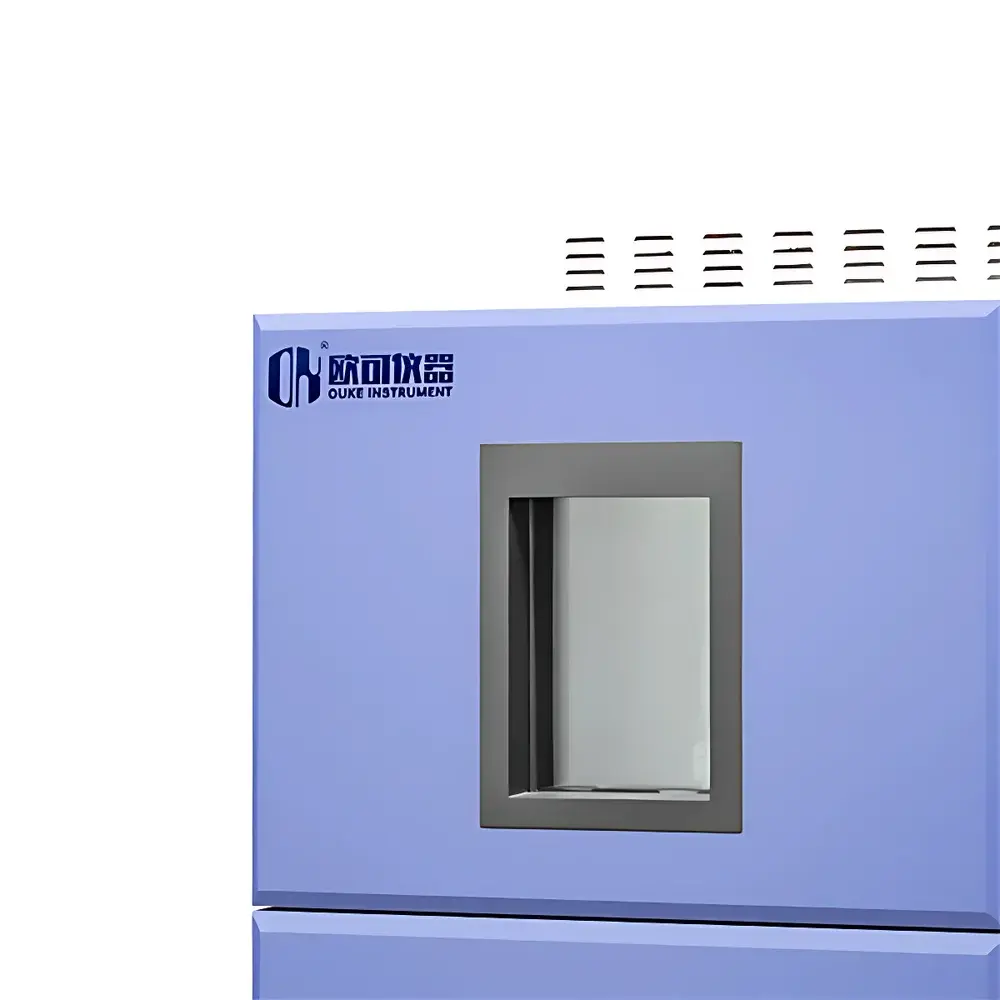
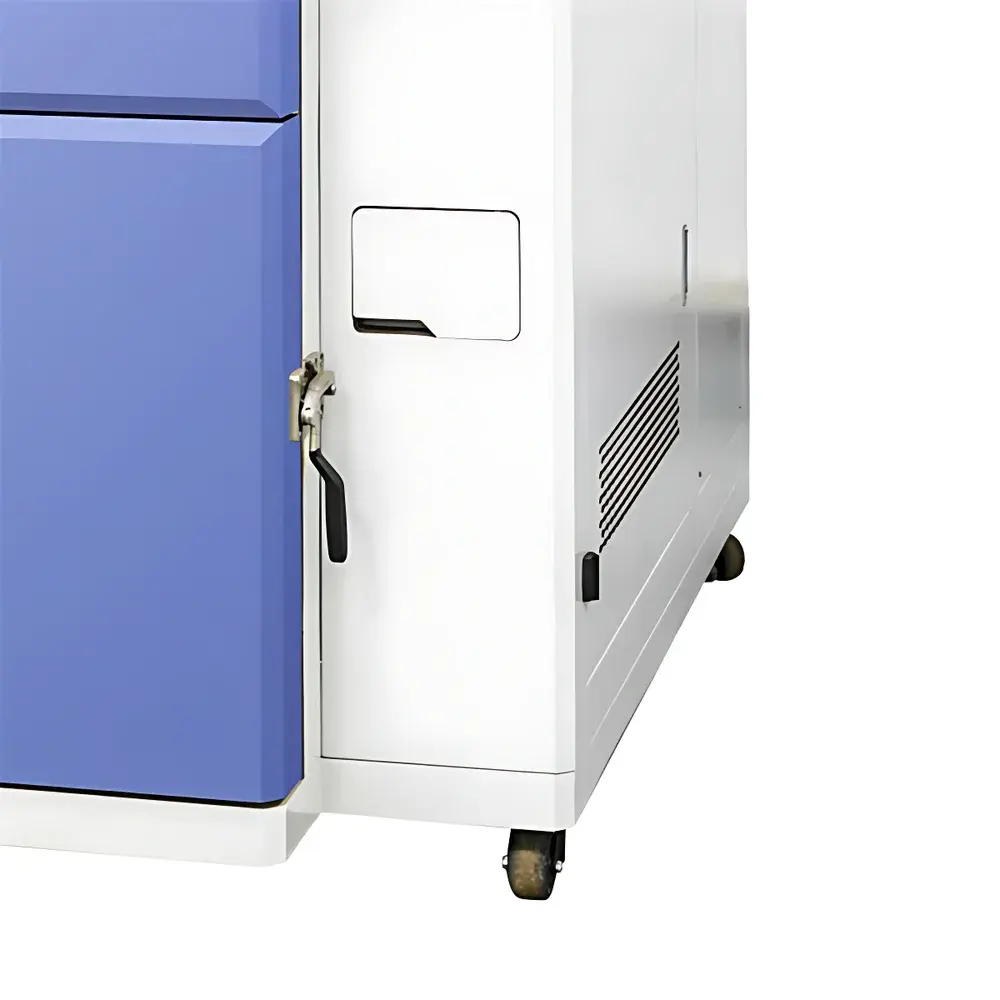
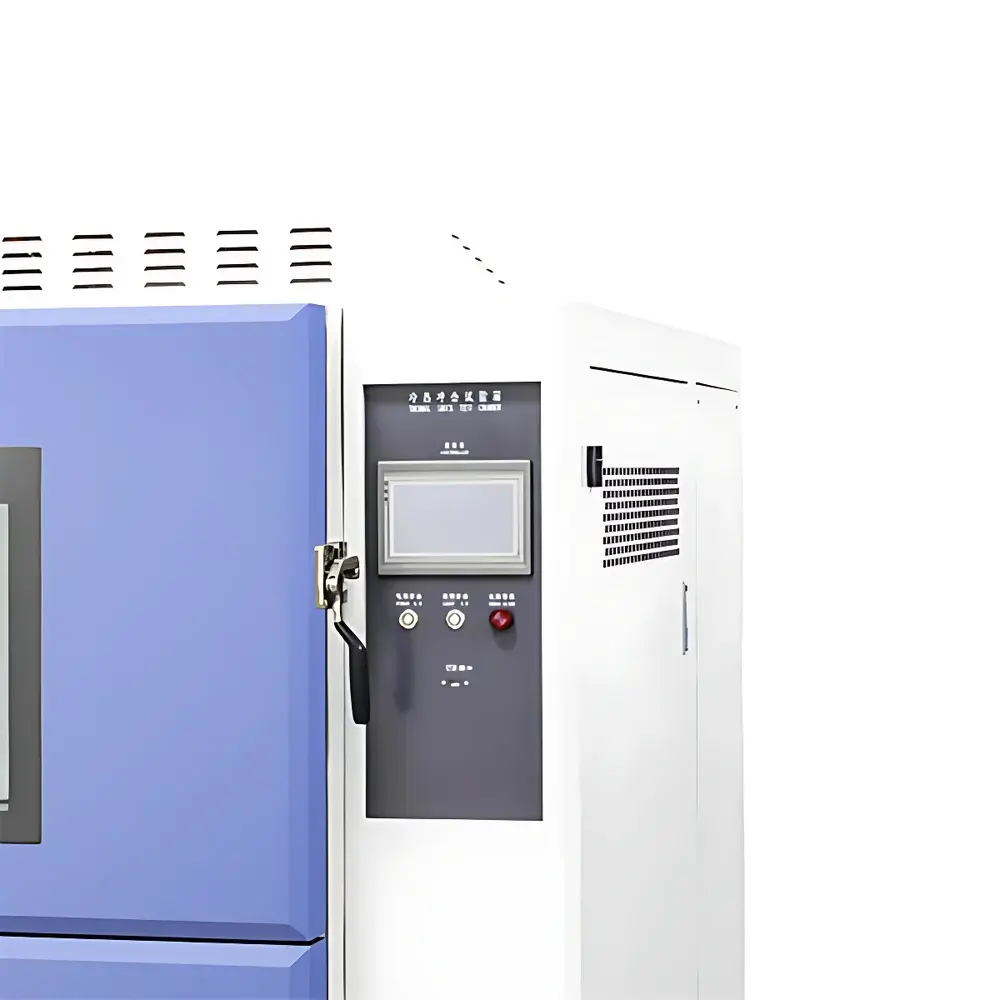
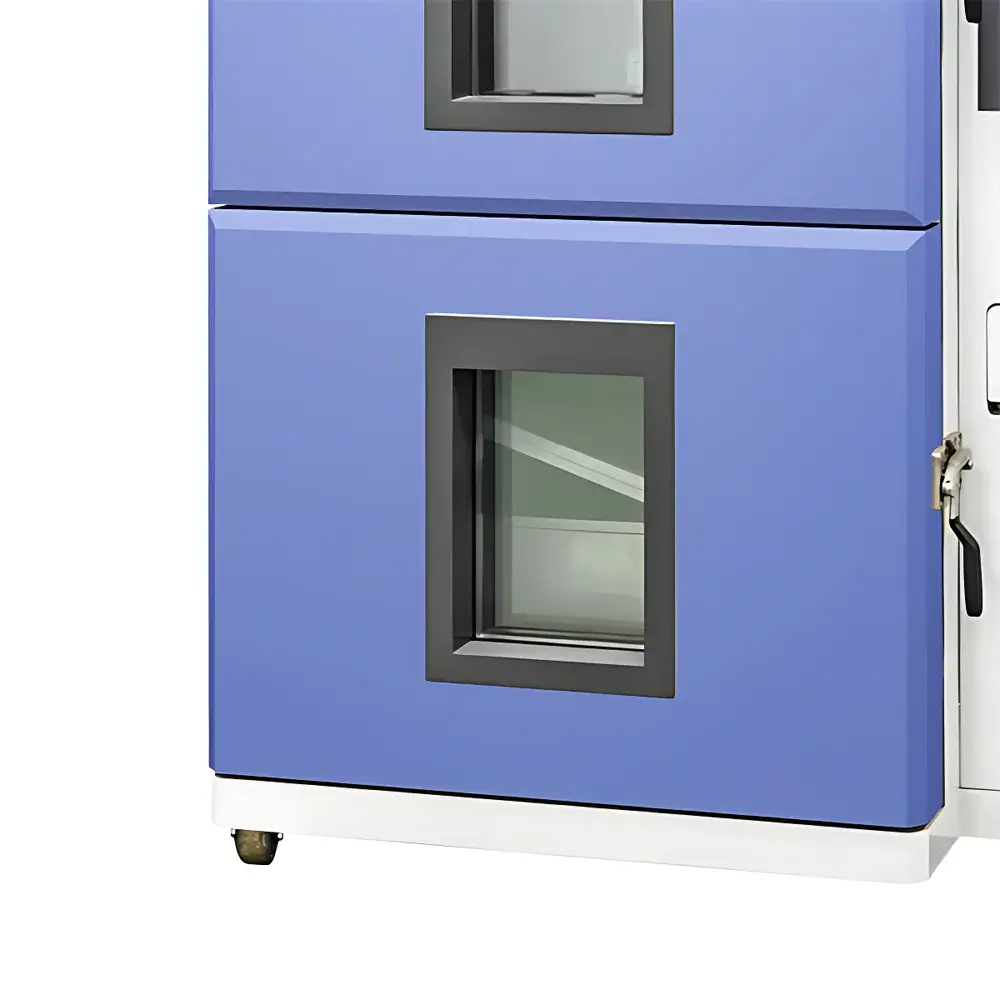
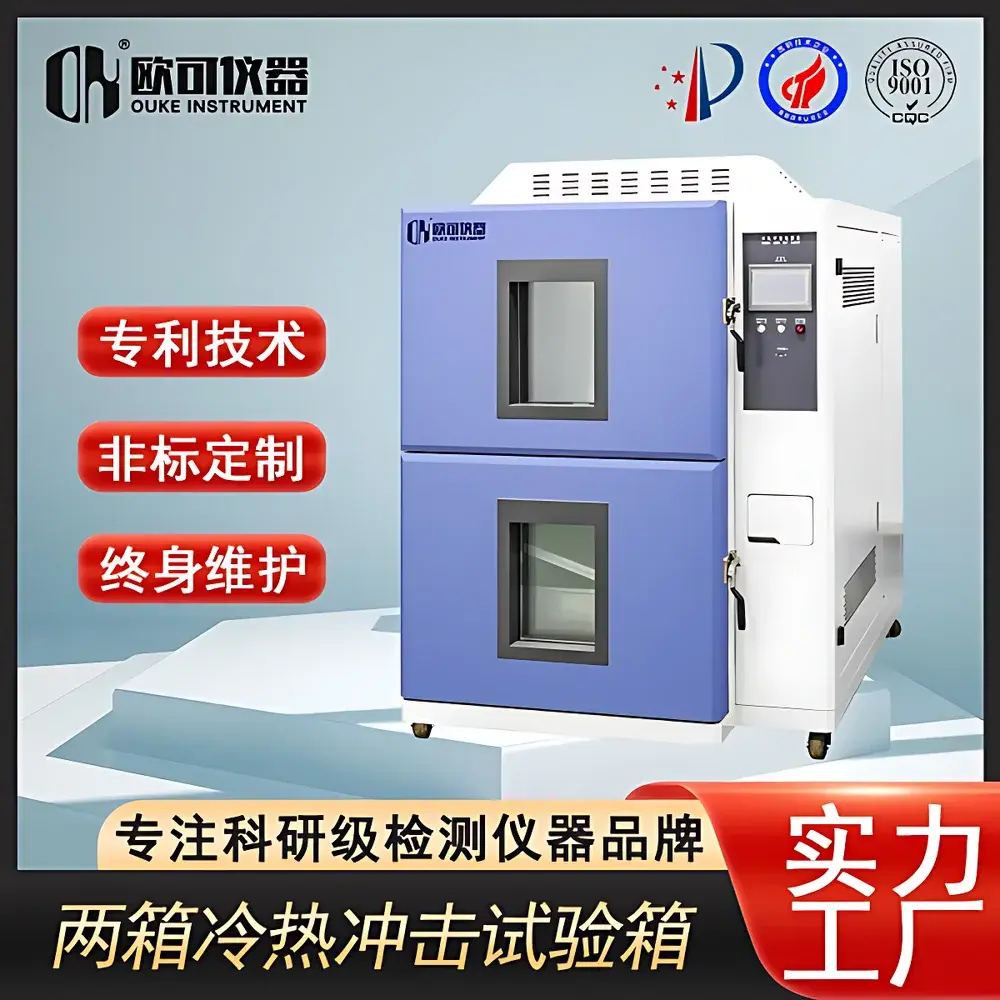
OK-TS-4 Two-Zone Thermal Shock Test Chamber
| Brand | OK Instruments |
|---|---|
| Origin | Guangdong, China |
| Manufacturer Type | Direct Manufacturer |
| Model | OK-TS-4 |
| Price | USD 12,500 (FOB Guangdong) |
| High-Temperature Range | +150 °C |
| Low-Temperature Range | −50 °C |
| Thermal Shock Range | −50 °C to +150 °C |
| Temperature Stability | ±2 °C |
| Heating Rate | 10 °C/min |
| Cooling Rate | 10 °C/min |
Overview
The OK-TS-4 Two-Zone Thermal Shock Test Chamber is an electromechanically actuated, dual-chamber environmental test system engineered for accelerated reliability assessment under extreme thermal transients. It operates on the sample-transfer principle: two thermally isolated chambers—one maintained at a stable high temperature (+150 °C), the other at a stable low temperature (−50 °C)—are linked by a motorized lift basket mechanism. During testing, the sample carrier rapidly transitions between chambers in ≤10 seconds, subjecting specimens to abrupt thermal gradients exceeding 200 °C within sub-10-second intervals. This architecture conforms to the fundamental requirement of IEC 60068-2-14 (Test N: Change of Temperature) and provides superior thermal step fidelity compared to air-mix or single-chamber ramp-based systems. The chamber’s design prioritizes thermal inertia minimization in the transition phase while maintaining steady-state stability in both zones—enabling reproducible stress application critical for failure mode analysis in mission-critical components.
Key Features
- Dual independent thermal zones: Separately controlled high-temperature (+150 °C) and low-temperature (−50 °C) chambers with PID-regulated heating/cooling circuits and insulated partition walls.
- High-speed basket transfer mechanism: Servo-driven vertical lift system achieving ≤10 s transfer time between zones—meeting Class 2 requirements per IEC 60068-2-14 for “rapid change” thermal shock profiles.
- Thermal stability & uniformity: ±2 °C chamber stability under static conditions; ≤±1.5 °C temperature uniformity across 300 × 300 × 300 mm usable volume (W×D×H).
- Controlled ramp rates: Programmable heating and cooling rates up to 10 °C/min—verified per ASTM E1530 Annex A2 for thermal response calibration.
- Robust mechanical architecture: Stainless-steel interior, reinforced insulated door seals, and maintenance-accessible refrigeration components (semi-hermetic scroll compressor, copper-aluminum finned condenser).
- Integrated safety redundancy: Dual independent overtemperature cutoffs (mechanical and electronic), high/low pressure switches for refrigerant circuit, emergency stop with hardware interlock, and door-open inhibition during active transfer.
Sample Compatibility & Compliance
The OK-TS-4 accommodates samples up to 15 kg total mass on its stainless-steel lift basket (standard 300 × 300 mm platform). It supports rigid and semi-rigid specimens including PCB assemblies, automotive ECUs, semiconductor packages (QFP, BGA, CSP), aerospace avionics modules, and polymer composites. The chamber satisfies core compliance requirements for qualification testing under:
- IEC 60068-2-14 (Environmental testing – Part 2-14: Tests – Test N: Change of temperature)
- GB/T 2423.22 (Chinese national standard equivalent to IEC 60068-2-14)
- ISO 16750-4 (Road vehicles – Environmental conditions and testing for electrical and electronic equipment – Part 4: Climatic loads)
- GMW 3172 (General Motors global specification for thermal shock endurance)
- MIL-STD-810G/H Method 503.5 (Temperature Shock)
- JESD22-A104 (JEDEC Solid State Technology Association standard for temperature cycling)
No internal airflow fans or ductwork contact the sample during transfer—eliminating convective perturbation and ensuring that thermal stress arises solely from conductive/convective exchange with chamber walls and ambient gas, consistent with real-world thermal shock exposure scenarios.
Software & Data Management
The OK-TS-4 is equipped with a 7-inch industrial-grade capacitive touchscreen controller running OK-TCM v3.2 firmware. It supports up to 99 programmable test cycles, each comprising configurable dwell times (1–999 minutes per zone), transfer direction sequence (high→low→high or low→high→low), and repeat count. All setpoints, actual chamber temperatures, basket position status, and alarm events are timestamped and logged internally (≥30 days at 10-second resolution). Data export is available via USB 2.0 to CSV format. Optional Ethernet interface enables remote monitoring and integration into centralized lab management systems compliant with ISO/IEC 17025 documentation traceability requirements. Audit trail functionality—including user login history, parameter modification logs, and calibration event records—supports GLP/GMP-aligned validation protocols where required.
Applications
The OK-TS-4 delivers deterministic thermal shock stress essential for identifying latent defects such as intermetallic delamination, solder joint fatigue, die attach cracking, conformal coating microfracture, and coefficient-of-thermal-expansion (CTE) mismatch failures. Its primary deployment domains include:
- Electronics manufacturing: Qualification of IC packaging, wafer-level chips, flex-rigid PCBs, and optoelectronic modules prior to release.
- Automotive Tier-1 suppliers: Validation of ADAS sensors, battery management systems (BMS), and power electronics under ISO 16750-4 Level 3 thermal shock conditions.
- Aerospace component testing: Screening of flight-critical avionics housings and RF front-end modules against MIL-STD-810G thermal shock thresholds.
- Materials R&D labs: Accelerated aging studies of thermoset resins, fiber-reinforced polymers, and thermal interface materials (TIMs) under cyclic ΔT extremes.
- Quality assurance laboratories: In-process reliability screening per JESD22-A104 for high-volume consumer electronics production lines.
FAQ
What distinguishes a two-zone thermal shock chamber from a three-zone (air-transfer) system?
The OK-TS-4 uses physical sample movement between two thermally stabilized chambers, delivering faster temperature stabilization post-transfer (<5 s recovery to ±2 °C) and eliminating air turbulence-induced measurement uncertainty. Three-zone systems rely on airflow redirection, resulting in longer thermal settling times and potential convective loading artifacts.
Is the OK-TS-4 suitable for testing devices with attached cables or optical fibers?
Yes—but cable routing must accommodate vertical basket travel (standard stroke: 400 mm). Optional extended-stroke configurations and custom basket fixtures are available for tethered DUTs.
Does the system support automated data export for regulatory submissions?
Yes. Raw temperature/time logs and cycle execution reports are exportable in CSV format with ISO 8601 timestamps, compatible with FDA 21 CFR Part 11-compliant review workflows when paired with validated third-party LIMS software.
What maintenance intervals are recommended for long-term operational reliability?
Compressor oil and refrigerant filter replacement every 24 months; chamber door gasket inspection every 6 months; calibration verification of all PT100 sensors annually per ISO/IEC 17025 procedures.
Can the OK-TS-4 be integrated into an existing environmental test lab network?
Yes. Modbus TCP and RS-485 interfaces are standard; optional OPC UA gateway support enables seamless integration with LabVIEW, MATLAB, or enterprise MES platforms.



