
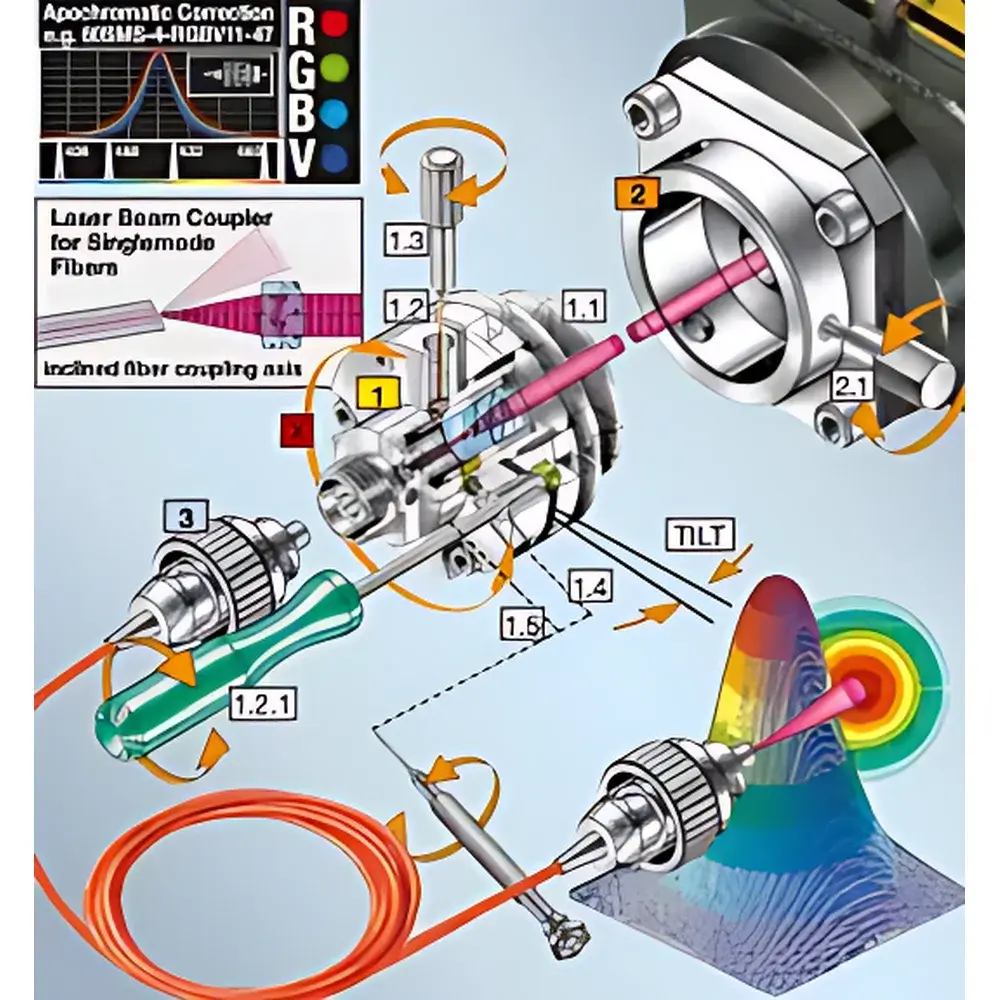
Schafter+Kirchhoff 60FC-0-M5-33 Fiber Coupler and Collimator
| Brand | Schafter+Kirchhoff |
|---|---|
| Origin | Germany |
| Model | 60FC-0-M5-33 (and variants) |
| Lens Options | 17 achromatic & apochromatic types |
| Material Options | Nickel alloy, stainless steel, titanium |
| Bearing Type | Carbide |
| Locking | Focus position lock & fiber clamping |
| AR Coating | >99.9% transmission (typical, wavelength-dependent) |
| Beam Diameter Range (collimated output) | 3.6–36 mm |
| Focal Spot Diameter Range | 20–200 µm |
| Wavelength Compatibility | UV-VIS-NIR (model-specific, e.g., RGBV: 400–670 nm) |
| NA Support | Up to 0.22 (fiber-dependent) |
| Adjustment | Precision threaded, rotation-free lens translation |
| Polarization Alignment | Integrated polarization-maintaining fiber interface |
Overview
The Schafter+Kirchhoff 60FC-0-M5-33 is a high-precision, modular fiber coupler and collimator system engineered for demanding laser beam conditioning applications in research and industrial photonics. Based on Couette-type optical alignment principles and precision mechanical metrology, this instrument enables deterministic coupling of free-space laser beams into single-mode or multimode fibers, as well as high-fidelity collimation of divergent fiber outputs. Its core architecture integrates kinematic tilt-and-focus adjustment with sub-microradian angular stability and sub-micrometer axial repeatability—critical for maintaining mode-matching efficiency in interferometric setups, atomic physics experiments, and ultrafast laser delivery systems. Designed and manufactured in Germany, the 60FC series complies with DIN ISO 10110 optical surface specifications and adheres to RoHS-compliant material sourcing protocols.
Key Features
- Integrated dual-axis tilt and axial focus adjustment via differential micrometer drives—enabling real-time optimization of coupling efficiency without mechanical hysteresis.
- 17 interchangeable collimating/coupling lenses—including achromatic doublets (ACR), apochromatic triplets (APO), and RGBV-corrected optics—covering spectral ranges from 350 nm to 1100 nm.
- Rotation-free lens translation mechanism using hardened carbide bearings and precision-ground threads—ensuring zero beam walk-off during focal tuning.
- Material options include nickel alloy (for thermal stability), stainless steel (for vacuum compatibility), and titanium (for weight-sensitive platforms).
- Fiber clamping system with integrated strain relief and longitudinal locking—preventing drift under vibration or thermal cycling.
- Anti-reflection coatings optimized per lens variant: typical average transmission >99.9% across specified bandwidths (e.g., 400–670 nm for RGBV optics).
- Polarization-maintaining (PM) fiber interface with angular vernier scale for ±0.1° polarization axis alignment relative to mechanical reference.
Sample Compatibility & Compliance
The 60FC-0-M5-33 supports standard SMF-28, HI1060, PM980, and large-mode-area (LMA) fibers with outer diameters from 125 µm to 1000 µm. It accommodates numerical apertures up to 0.22 and input beam diameters from 0.8 mm to 6 mm (dependent on lens selection). All metallic components meet ASTM F899 surgical stainless steel specifications where applicable; titanium variants conform to ASTM B348 Grade 5. The system is compatible with UHV environments (<10⁻⁷ mbar) when equipped with vacuum-rated seals and outgassing-tested adhesives. Mechanical design follows ISO 9001:2015 production controls and is traceable to DKD/DAkkS-accredited calibration standards for angular and positional metrology.
Software & Data Management
While the 60FC-0-M5-33 operates as a purely manual, analog-optomechanical system, its performance parameters are fully documented in Schafter+Kirchhoff’s Traceable Optical Characterization Reports (TOCRs)—including measured wavefront error (≤λ/10 RMS @ 633 nm), focal shift vs. temperature (±0.3 µm/°C), and long-term positional drift (<50 nm over 1000 h at 23 °C). These reports support GLP/GMP audit requirements and are provided with each unit. Integration with automated stages (e.g., Thorlabs K10CR1, Newport CONEX-AG-PS) is supported via standardized M42×0.75 and SM1 threading, enabling closed-loop alignment workflows compatible with LabVIEW™, Python-based PyVISA control stacks, and MATLAB® Instrument Control Toolbox.
Applications
- Laser diode and DPSS laser coupling into single-mode fiber for telecom, sensing, and quantum optics.
- Beam combining/splitting in multi-laser interferometers and optical lattice setups.
- Magneto-optical trap (MOT) beam delivery requiring elliptical, linear, or cross-shaped collimated profiles—enabled by optional cylindrical or anamorphic lens modules.
- Polarization-resolved spectroscopy and ellipsometry using integrated quarter-wave or half-wave plate carriers (Multicube™ platform compatible).
- Free-space-to-fiber coupling in airborne or microgravity experiments, validated per ESA ECSS-E-ST-32-01C environmental test profiles.
- High-power laser delivery (up to 50 W CW, depending on coating and lens material) with thermal lensing mitigation through low-absorption fused silica substrates.
FAQ
What wavelength ranges are supported by the standard 60FC lens options?
Standard configurations cover 350–700 nm (UV-VIS), 650–1050 nm (VIS-NIR), and 1030–1100 nm (Yb-fiber band); RGBV-corrected optics operate from 400–670 nm.
Can the 60FC be used with polarization-maintaining fibers?
Yes—models with PM fiber ports include a calibrated rotational mount for aligning the slow/fast axis within ±0.1° of the mechanical datum.
Is vacuum compatibility available?
Vacuum-rated versions (UHV-compatible up to 10⁻⁸ mbar) are available with titanium housings, metal-sealed fiber feedthroughs, and bake-out certified lubricants.
How is focus position locked without compromising repeatability?
A dual-action locking ring applies axial preload to the lens cell while preserving micrometer thread engagement—achieving <100 nm positional hysteresis over 1000 cycles.
Do you provide measurement reports for individual units?
Each unit ships with a Traceable Optical Characterization Report (TOCR), including interferometric wavefront data, focal length verification, and AR coating transmission spectra.




