
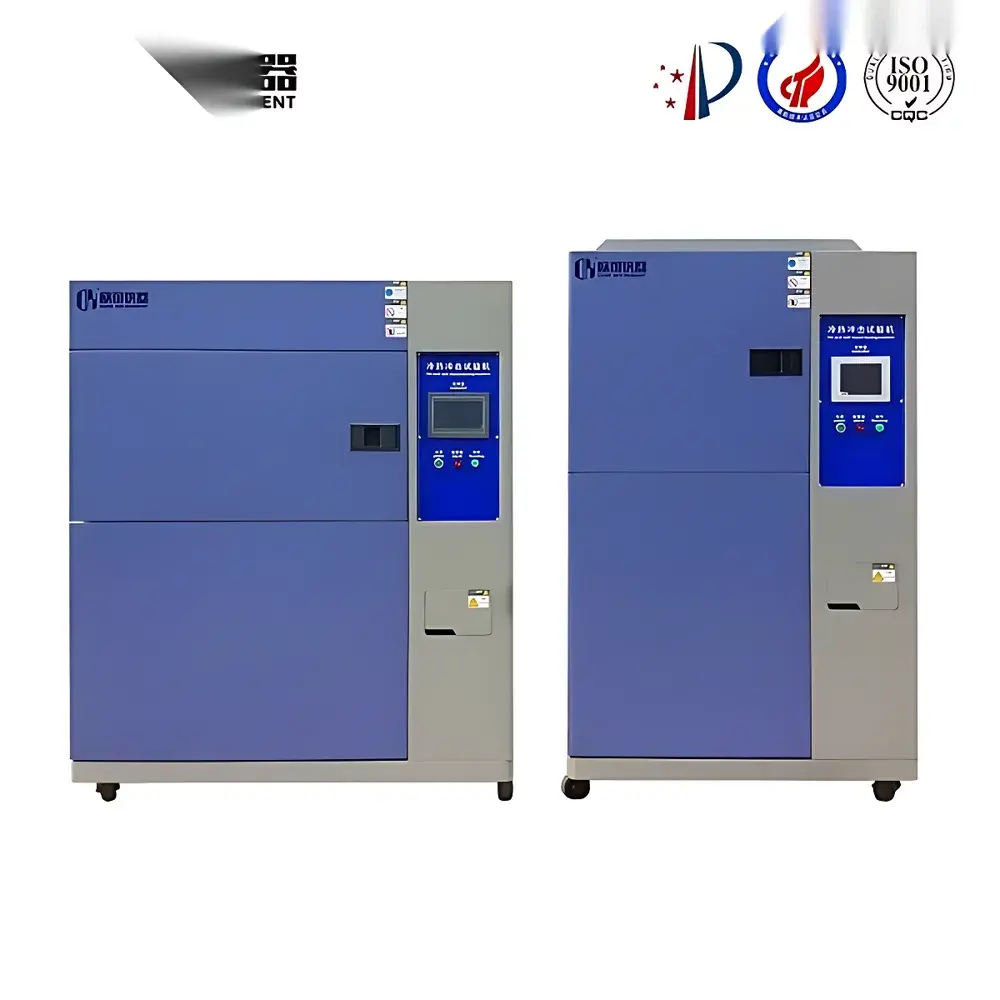
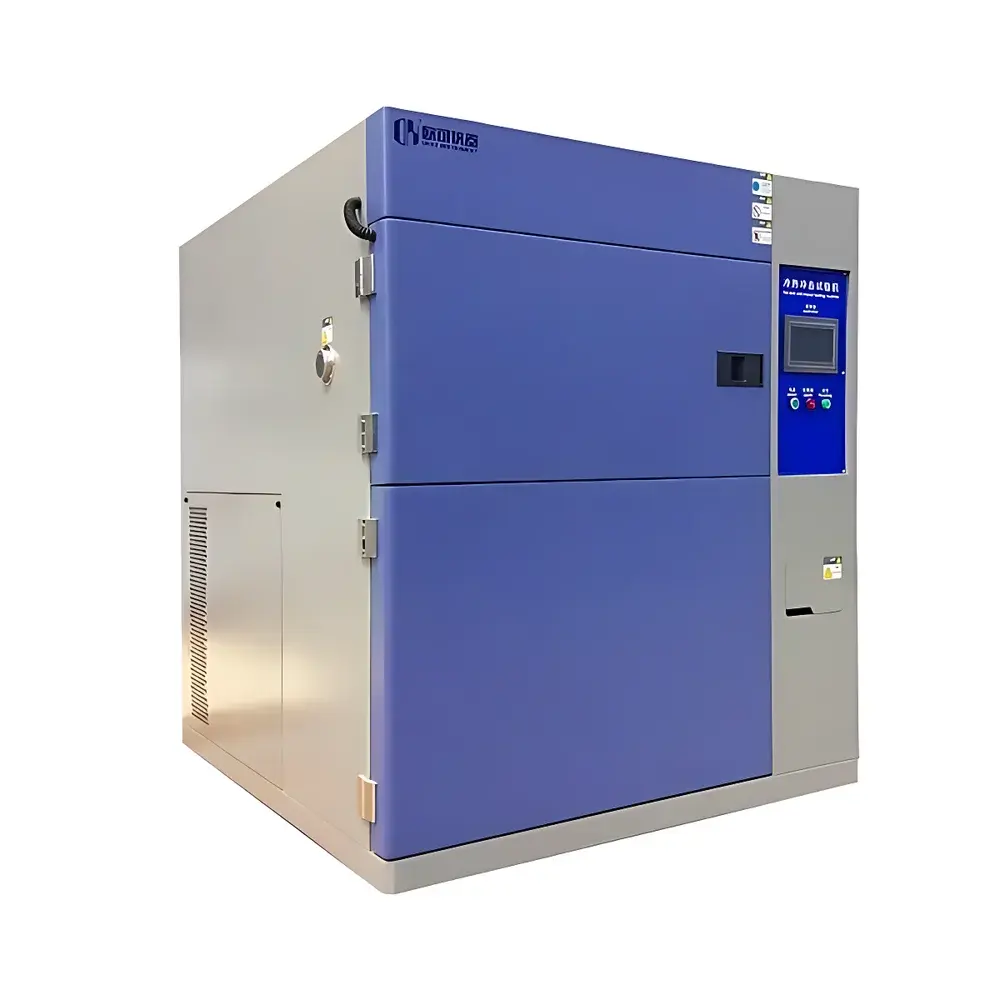
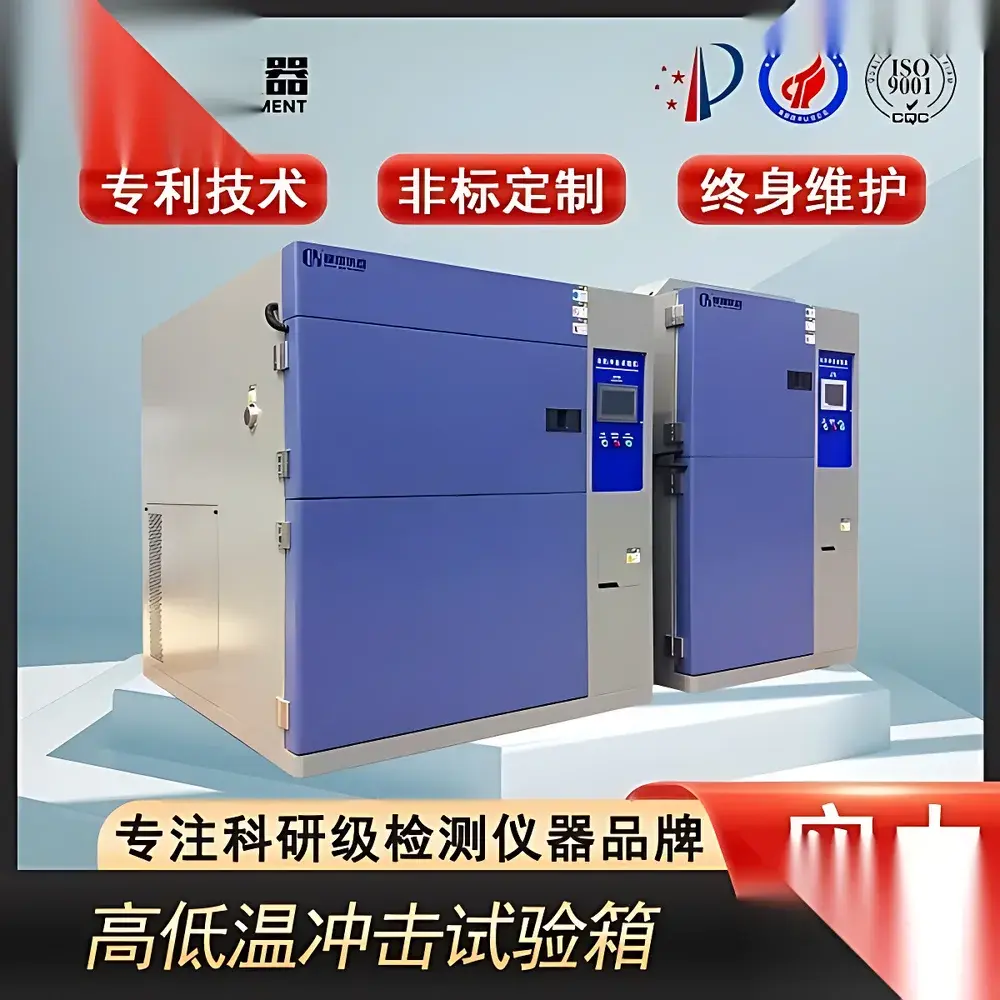
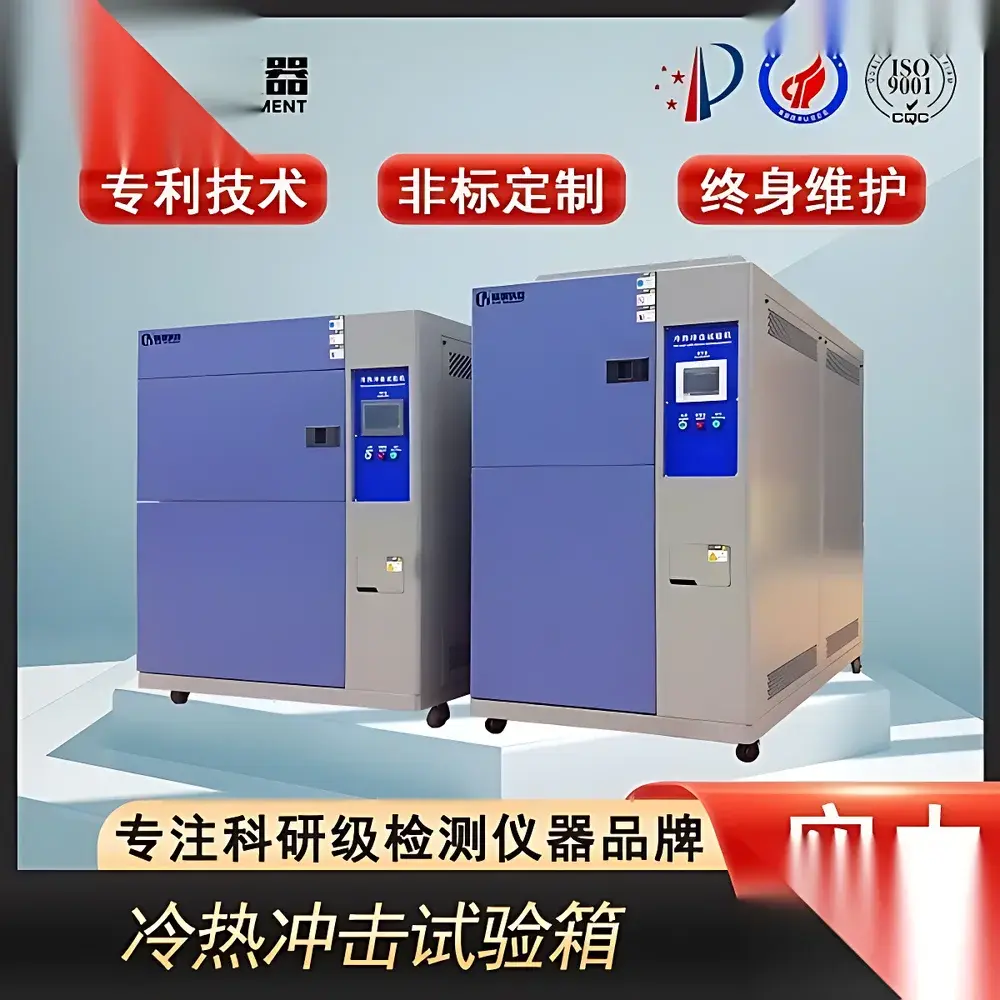
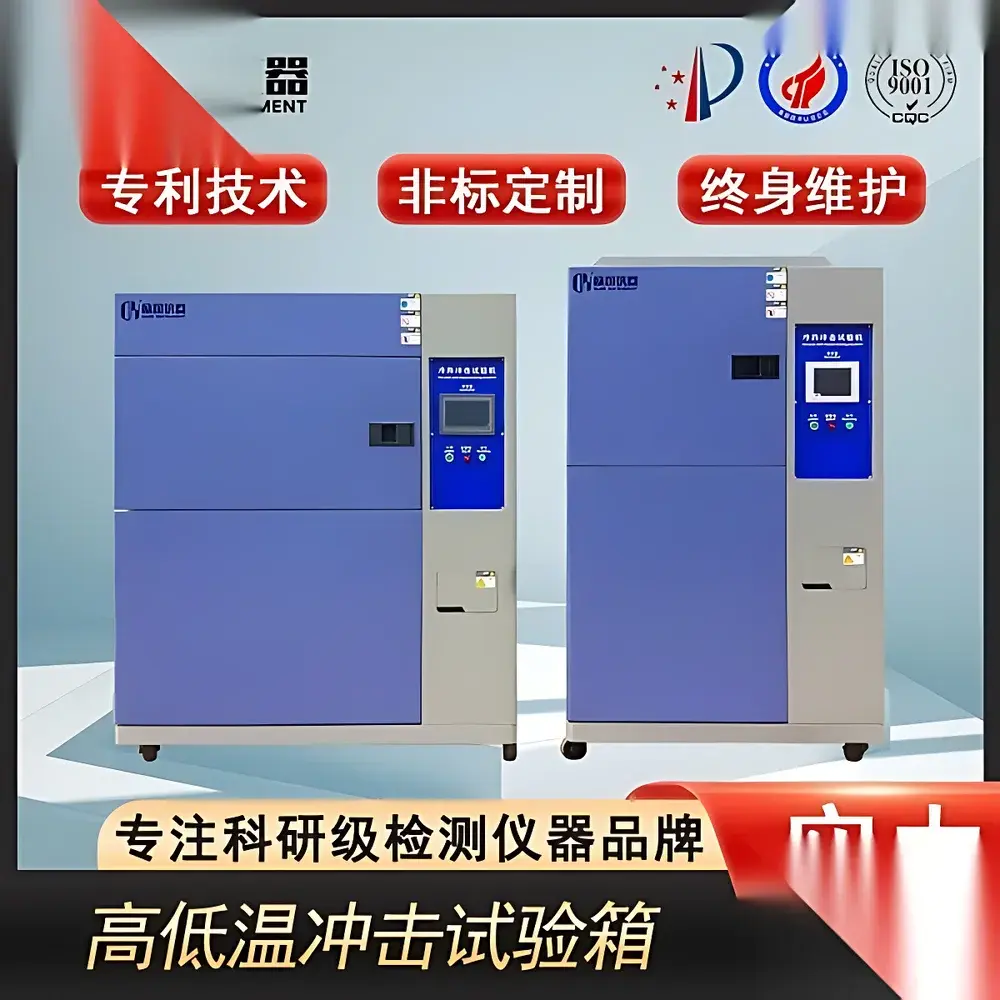
OK-TS Series Thermal Shock Test Chamber
| Brand | Other Brands |
|---|---|
| Origin | Imported |
| Manufacturer Type | General Distributor |
| Price | USD 11,200 (FOB) |
| Working Chamber Dimensions | OK-TS-100A: 450×450×500 mm |
| OK-TS-225A | 600×600×600 mm |
| OK-TS-500A | 800×800×800 mm |
| OK-TS-010A | 1000×1000×1000 mm |
| External Dimensions | 1560–2110 × 870–1420 × 1545–2665 mm |
| Refrigeration System | Dual-stage cascade refrigeration with two Copeland ZB semi-hermetic scroll compressors |
| Oil Separator | ALCO (USA/EU) high-efficiency coalescing oil separator |
| Temperature Range | –65 °C to +150 °C (standard) |
| Transfer Time | ≤15 s (typical, between chambers) |
| Temperature Recovery Time | ≤5 min (to ±0.5 °C of setpoint after transfer) |
| Compliance | ASTM D5229/D5229M, ISO 16750-4, MIL-STD-810H Method 503.5, IEC 60068-2-14 |
Overview
The OK-TS Series Thermal Shock Test Chamber is an engineered environmental simulation system designed for rapid, repeatable, and highly controlled thermal cycling between extreme low and high temperature zones. Based on the principle of mechanical thermal shock—where specimens undergo abrupt transitions between independently conditioned hot and cold chambers—the system quantifies material integrity under accelerated thermal stress. Unlike single-chamber ramp-rate systems, the OK-TS employs a dual-zone, lift-type or rotary basket transfer mechanism to achieve sub-15-second transitions, minimizing dwell time in intermediate temperatures and ensuring true step-change thermal loading. This architecture conforms to the physical basis of thermal fatigue testing as defined in ASTM D5229 (for polymer composites) and MIL-STD-810H Method 503.5 (for electronic and electro-mechanical assemblies). The chamber is calibrated and validated for use in qualification-level testing, supporting both development-stage failure analysis and production-line incoming inspection protocols.
Key Features
- Dual independent temperature zones: High-temperature chamber (up to +180 °C) and low-temperature chamber (down to –70 °C), each with dedicated heating and refrigeration circuits.
- Cascade refrigeration architecture utilizing two Copeland ZB semi-hermetic scroll compressors—ensuring stable low-temperature performance, reduced oil carryover, and extended compressor service life.
- ALCO (USA/EU) high-efficiency coalescing oil separator integrated into the refrigerant circuit to prevent lubricant migration into heat exchangers and maintain consistent evaporator/condenser thermal efficiency.
- Stainless steel 304 inner chamber construction with seamless welding and electro-polished finish, compliant with ISO 14644-1 Class 8 cleanroom requirements for semiconductor and medical device testing environments.
- Programmable controller with Ethernet interface, supporting Modbus TCP and optional RS-485 communication for integration into factory MES or LabVantage LIMS platforms.
- Real-time monitoring of chamber pressure differentials, refrigerant superheat/subcooling, and motor winding temperature—enabling predictive maintenance alerts per ISO 13374-1 guidelines.
Sample Compatibility & Compliance
The OK-TS Series accommodates test specimens ranging from surface-mount IC packages (e.g., QFN, BGA) to automotive ECUs, aerospace composite panels, and ceramic insulators. Standard basket configurations support samples up to 20 kg per cycle; custom fixtures are available for DIN 40050-9 or SAE J2340 mounting. The system meets the environmental stress screening (ESS) requirements of MIL-STD-810H Method 503.5 (Thermal Shock), ISO 16750-4 (Road Vehicles—Environmental Conditions), and IEC 60068-2-14 (Change of Temperature). It supports full traceability under GLP/GMP frameworks when paired with optional 21 CFR Part 11-compliant software modules—including electronic signatures, audit trails, and immutable data archiving. Calibration certificates are traceable to NIST standards via accredited third-party laboratories (ISO/IEC 17025).
Software & Data Management
Equipped with proprietary TSC-Manager v4.2 software, the system delivers deterministic test sequencing, real-time deviation alarms (±0.3 °C tolerance band), and automated report generation in PDF/A-1b and CSV formats. All test logs—including chamber thermocouple readings (Type T, Class 1), compressor run-hours, and door open/close timestamps—are stored with SHA-256 hash verification to satisfy FDA 21 CFR Part 11 data integrity requirements. Remote access is enabled via TLS 1.2-secured web interface, allowing lab managers to initiate, pause, or abort tests from desktop or mobile clients without compromising local network segmentation policies.
Applications
- Qualification testing of solder joint reliability in lead-free PCBAs per JEDEC J-STD-020 and IPC-9701.
- Evaluation of coefficient of thermal expansion (CTE) mismatch in multi-material stacks (e.g., SiC-on-Si substrates, MEMS packaging).
- Accelerated aging of polymer encapsulants and conformal coatings used in automotive ADAS sensors.
- Validation of hermetic seal integrity in medical implant housings exposed to sterilization cycles.
- Failure mode identification in thin-film resistors and MLC capacitors subjected to repeated thermal gradients.
- Supporting AEC-Q200 stress testing for passive components in electric vehicle power electronics.
FAQ
What is the typical thermal transfer time between chambers?
Standard models achieve ≤15 seconds for specimen transfer between hot and cold zones, verified per IEC 60068-2-14 Annex B.
Can the system operate continuously at –65 °C in the cold chamber while maintaining +150 °C in the hot chamber?
Yes—the dual independent refrigeration and heating circuits allow simultaneous steady-state operation across the full specified range without cross-contamination or thermal bleed.
Is calibration documentation provided with shipment?
Each unit ships with a factory calibration certificate (traceable to NIST), including point verification at –40 °C, 25 °C, and +125 °C using certified reference thermometers (±0.15 °C uncertainty).
Does the controller support custom test profiles with variable dwell times and ramp rates?
Yes—TSC-Manager allows creation of multi-segment profiles with up to 999 steps, programmable dwell durations (1 s to 999 h), and user-defined transition logic (e.g., “hold until thermal equilibrium confirmed by 3-point spatial averaging”).
What maintenance intervals are recommended for the ALCO oil separator?
Under continuous operation, ALCO recommends replacement every 12,000 operating hours or biannually—whichever occurs first—per manufacturer’s service bulletin ALCO-OS-2023-07.



