
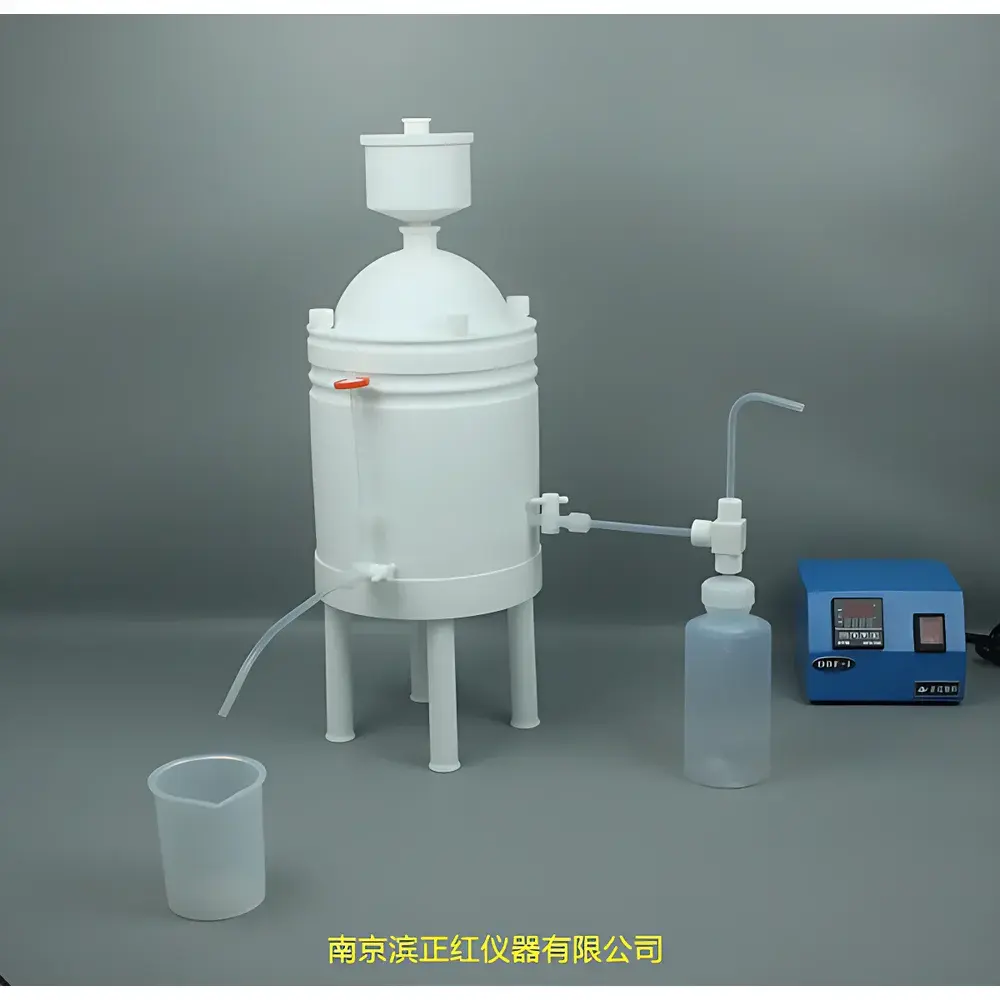
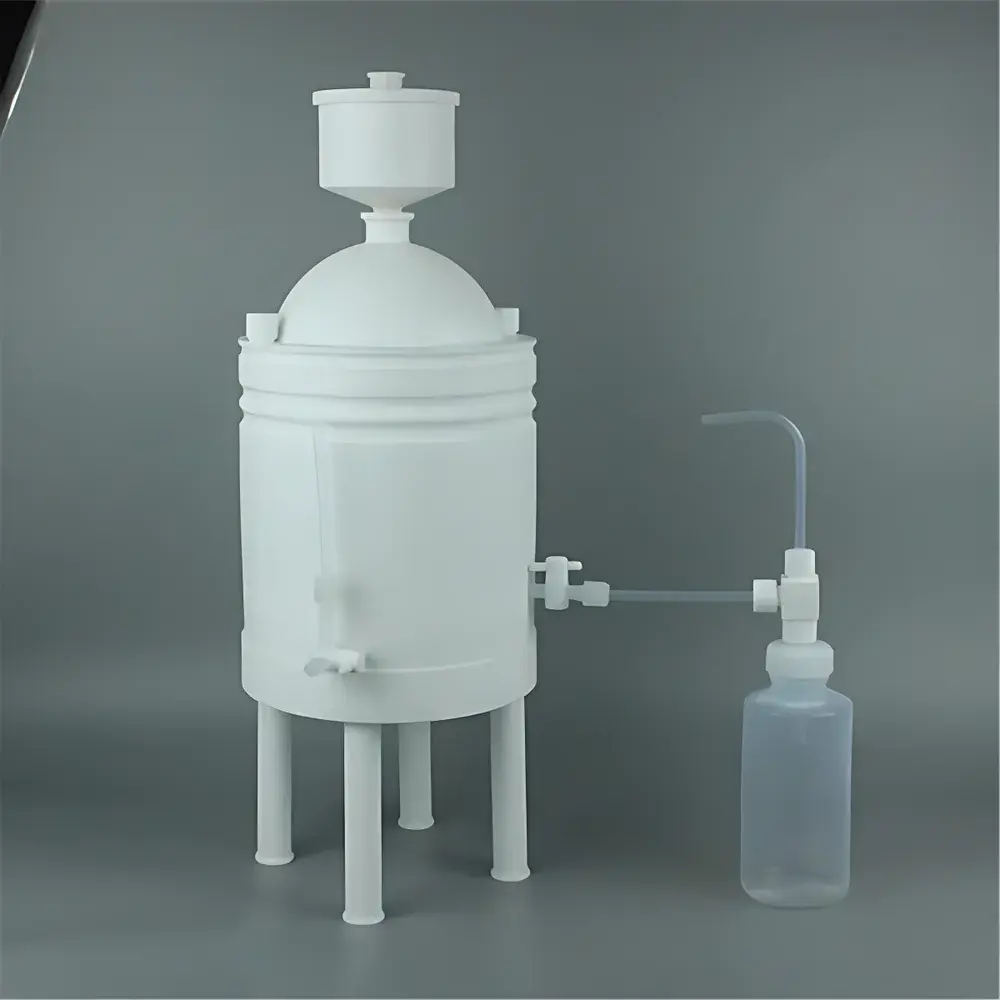
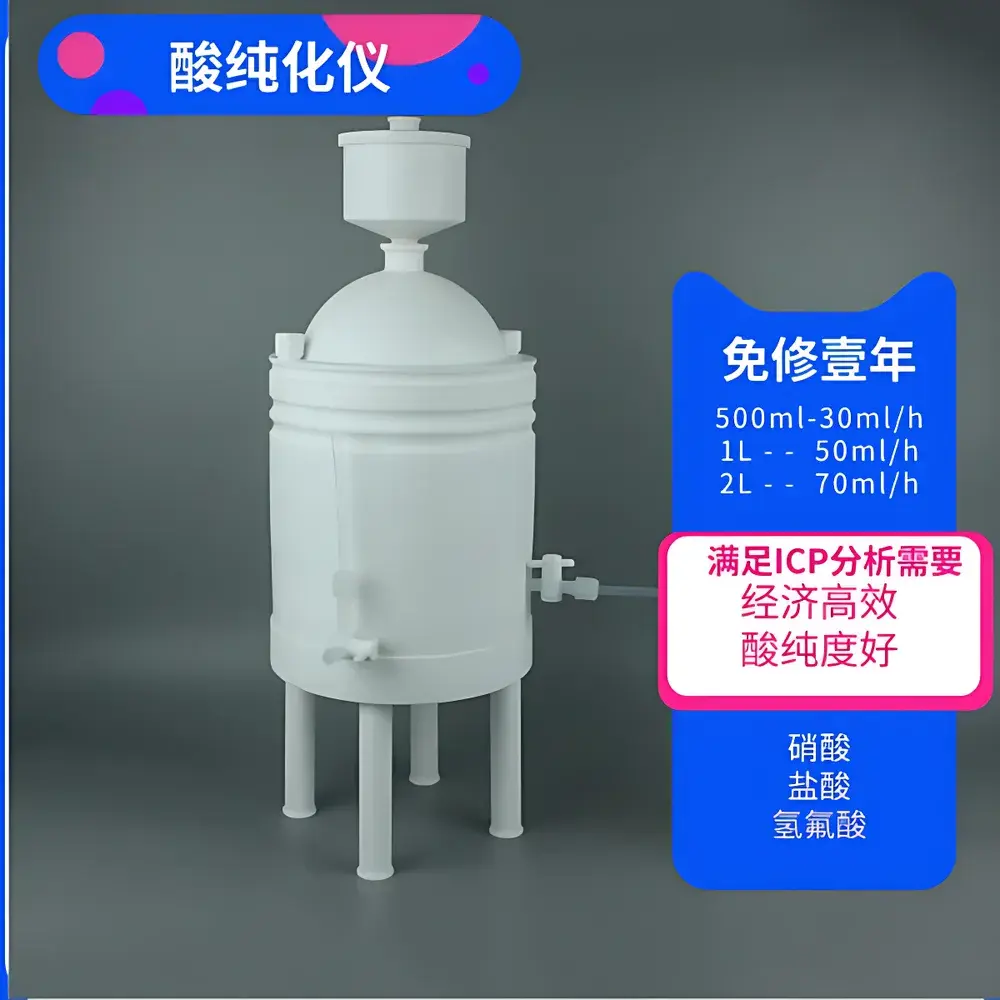
Binzhenghong CH-II High-Purity Acid Distillation System for ICP, Trace & Ultra-Trace Analysis
| Brand | Binzhenghong |
|---|---|
| Origin | Jiangsu, China |
| Manufacturer Type | Manufacturer |
| Country of Origin | China |
| Model | CH-II |
| Capacity | 1000 mL |
| Production Rate | 50 mL/h |
| Temperature Control | PID digital display |
| Temperature Accuracy | ±1 °C |
| Construction Materials | FEP, PTFE, silicone rubber |
| Voltage | 220 V / 50 Hz |
| Power | 350 W |
| Compliance | Designed for ISO/IEC 17025-compliant trace metal laboratories |
| Sample Compatibility | HNO₃, HCl, HF, alkaline solutions, and select organic solvents |
Overview
The Binzhenghong CH-II High-Purity Acid Distillation System is a laboratory-grade sub-boiling distillation apparatus engineered for the production of ultra-trace–grade mineral acids required in inductively coupled plasma (ICP), ICP-mass spectrometry (ICP-MS), and other high-sensitivity elemental analysis workflows. It operates on the principle of sub-boiling distillation—maintaining acid solution temperature below its atmospheric boiling point to minimize volatile impurity carryover while enabling selective vaporization and condensation of the target acid. This thermally controlled, closed-loop process ensures minimal exposure to ambient contaminants and eliminates airborne particulate or metallic interference during purification. Unlike conventional reflux or open-vessel distillation, the CH-II system employs radiative heating with precise PID-regulated thermal management to achieve stable, repeatable evaporation kinetics—critical for achieving consistent sub-part-per-quadrillion (sub-ppt) metal impurity levels in final distillates.
Key Features
- Fully enclosed, inert-material distillation chamber constructed entirely from fluoropolymer components—including FEP (fluorinated ethylene propylene) and PTFE (polytetrafluoroethylene)—ensuring zero metal leaching, negligible adsorption, and chemical resistance to aggressive reagents such as hydrofluoric acid (HF), nitric acid (HNO₃), and hydrochloric acid (HCl).
- Integrated PID digital temperature controller with ±1 °C accuracy, enabling reproducible thermal profiles across batches and supporting method transfer between laboratories.
- Self-protecting dry-run prevention mechanism that automatically halts heating upon detection of low liquid level—preventing overheating, material degradation, or thermal shock to fluoropolymer components.
- Modular, tool-free disassembly design for routine cleaning and maintenance; all wetted parts are accessible without specialized tools, reducing downtime and mitigating long-term metal accumulation in the evaporation cavity.
- Single-pass distillation achieves typical reduction of transition metal impurities from ~10 ppb in commercial “ultrapure” acid to ≤0.01 ppb (10 pg/g) in distillate—as verified by independent ICP-MS analysis at accredited geochemical laboratories.
Sample Compatibility & Compliance
The CH-II system is validated for use with high-purity grade HNO₃, HCl, HF, ammonium hydroxide (NH₄OH), and selected low-boiling organic solvents compatible with fluoropolymer construction. Its design aligns with analytical requirements specified in ASTM D5127 (Standard Guide for Ultra-Trace Analysis), ISO 17025 Clause 7.2.2 (Method Validation), and USP / (Elemental Impurities). While not certified to FDA 21 CFR Part 11, the system supports GLP/GMP-aligned documentation practices when paired with laboratory information management systems (LIMS) and electronic batch records. All contact surfaces meet USP Class VI biocompatibility standards and exhibit extractables profiles consistent with ICH Q5A guidelines for critical reagent manufacturing.
Software & Data Management
The CH-II is a hardware-only instrument with no embedded firmware or proprietary software. Temperature setpoints, runtime duration, and operational status are managed via front-panel LED display and tactile push-button interface—eliminating cybersecurity vulnerabilities associated with networked controllers. For auditability, users are advised to record operational parameters (initial fill volume, setpoint temperature, distillation time, final yield) in bound logbooks or LIMS-integrated electronic notebooks. The system’s deterministic thermal behavior enables full traceability of each distillation run under ISO/IEC 17025 clause 7.7 (Ensuring Validity of Results) when combined with calibrated reference thermometers and volumetric calibration of collection vessels.
Applications
- Preparation of matrix-matched calibration standards and blanks for ICP-MS quantification at sub-femtogram detection limits.
- Purification of acids used in digestion protocols for geological, environmental, and biological samples where spectral interferences from polyatomic ions (e.g., 40Ar35Cl+, 40Ca16O1H+) must be suppressed.
- Generation of ultra-low-background reagents for cleanroom-based semiconductor metrology and nuclear forensics sample preparation.
- Reclamation of partially contaminated acid stocks in resource-constrained academic or regulatory labs—reducing recurring procurement costs without compromising analytical integrity.
- Supporting method development for EPA Method 200.8, ISO 15586, and EN ISO 17294-2 compliant water and soil testing programs.
FAQ
What acid types can be purified using the CH-II system?
The CH-II is validated for HNO₃, HCl, HF, NH₄OH, and select low-boiling organics (e.g., methanol, acetone) compatible with FEP/PTFE. It is not suitable for sulfuric, phosphoric, or perchloric acids due to thermal decomposition risks and material compatibility limitations.
How many distillation cycles are recommended for ultra-trace applications?
A single pass typically reduces metals to ≤0.01 ppb. For applications requiring <0.005 ppb (e.g., U/Pb geochronology), double distillation is recommended—using freshly cleaned FEP collection vessels between passes.
Is the CH-II compliant with ISO/IEC 17025 requirements?
Yes—the system’s design, material certification, and thermal stability support method validation per ISO/IEC 17025:2017 Clause 7.2.2. Users must perform in-house verification of distillate purity using certified reference materials (CRMs) such as NIST SRM 3100 series.
Can the unit be operated continuously?
No. Continuous operation is not advised. Maximum recommended duty cycle is 8 hours per day with ≥2-hour cooldown intervals to preserve heater longevity and fluoropolymer integrity.
What maintenance is required?
Weekly visual inspection of FEP gaskets and condenser alignment; monthly disassembly and immersion cleaning of all wetted parts in 10% v/v HNO₃ followed by triple-rinsing with 18.2 MΩ·cm water. Heater elements require no servicing but should be verified annually with a calibrated infrared thermometer.
Related Products







