
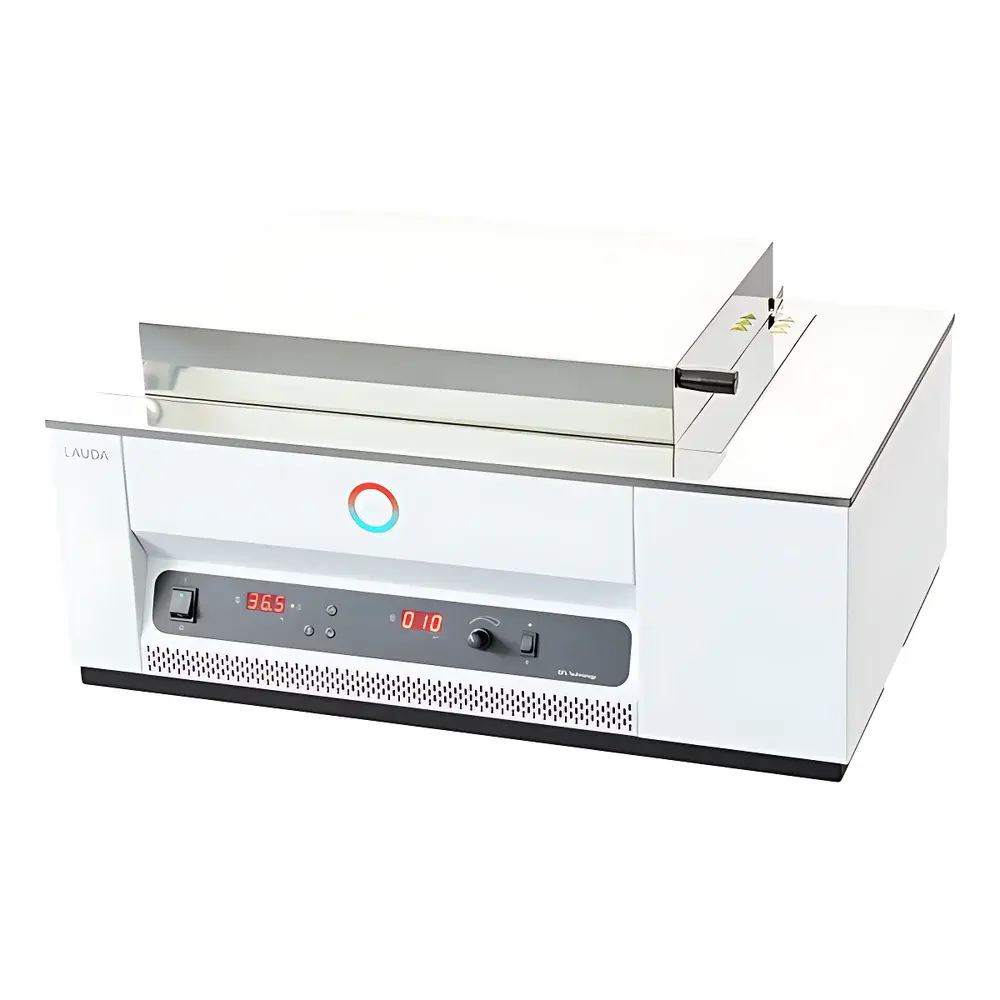
LAUDA Hydro H 20 SOW Shaking Water Bath
| Brand | LAUDA |
|---|---|
| Origin | Germany |
| Model | H 20 SOW |
| Temperature Range | 25–99.9 °C (10–99.9 °C with external chiller) |
| Temperature Stability | ±0.1 °C |
| Bath Volume | 8.5–23.1 L |
| Heating Power | 1.5 kW |
| Dimensions (W×D×H) | 635×505×400 mm |
| Weight | 40 kg |
| Oscillation Type | Linear, Reciprocating or Orbital |
| Speed Range | 10–250 rpm |
| Amplitude | 14 mm |
| Bath Internal Dimensions | 450×300×155 mm |
| Max. Immersion Depth | 195 mm |
| Construction | Stainless Steel (AISI 304) Bath, Lid, Shaking Tray & Heating Elements |
| Standard Features | Integrated Cooling Coil, Drain Valve, Condensate Channel Lid, Over-Temp & Dry-Run Protection |
| Compliance | CE, IEC 61010-1, EN 61326-1 |
Overview
The LAUDA Hydro H 20 SOW is a precision-engineered shaking water bath designed for demanding laboratory applications requiring simultaneous temperature control and mechanical agitation. Built in Germany to ISO 9001-certified manufacturing standards, it operates on the principle of convective heat transfer within a thermostatically regulated stainless steel bath, combined with a low-vibration linear reciprocating or orbital shaking mechanism. Its dual-control architecture enables independent regulation of thermal and mechanical parameters—temperature setpoints are maintained via PID-controlled heating and optional external cooling integration, while oscillation speed and motion profile are adjusted via a dedicated digital controller with soft-start functionality. The system supports stable operation across a broad working range (10–99.9 °C when coupled with a LAUDA Microcool chiller; 25–99.9 °C in standard configuration), making it suitable for enzyme kinetics, cell culture suspension, solubility testing, extraction protocols, and accelerated stability studies under GLP-compliant workflows.
Key Features
- Precision temperature control with ±0.1 °C stability, digitally adjustable in 0.1 °C increments via LED display and tactile membrane keypad
- Three-mode oscillation drive (linear, reciprocating, orbital) with continuously variable speed (10–250 rpm) and fixed 14 mm amplitude
- Integrated stainless steel cooling coil (AISI 304) enabling connection to external chillers (e.g., LAUDA Microcool series) to extend low-temperature capability down to 10 °C
- Full stainless steel construction: bath vessel, lid frame, shaking tray, heating elements, and drain valve—all fabricated from corrosion-resistant AISI 304 stainless steel
- Dual safety architecture: electronic over-temperature cutoff, dry-run protection, motor overload detection, and automatic shutdown upon lid removal
- Ergonomic design with large open-top bath (450 × 300 × 155 mm internal), removable shaking basket, and condensate-channel lid to prevent droplet contamination of samples
- Drain valve positioned at bath base and rear-mounted service port for coolant hose routing and maintenance access
Sample Compatibility & Compliance
The H 20 SOW accommodates a wide variety of sample containers—including test tubes (13–31 mm diameter), conical flasks (25–1000 mL), and custom vessels—via interchangeable stainless steel racks and clamping accessories (e.g., A000023 oscillation plate, A000025–A000031 flask holders). All contact surfaces comply with USP material classification for pharmaceutical use. The unit meets IEC 61010-1 (Safety Requirements for Electrical Equipment for Measurement, Control, and Laboratory Use) and EN 61326-1 (EMC requirements for laboratory equipment). Its closed-loop temperature control architecture supports audit-ready documentation when used in regulated environments governed by FDA 21 CFR Part 11, EU Annex 11, or ISO/IEC 17025, particularly when paired with LAUDA’s optional data logging software and calibrated PT100 probe.
Software & Data Management
While the H 20 SOW operates as a standalone instrument with local digital controls, it is compatible with LAUDA’s PC-based HydroLink software suite (optional) for remote parameter monitoring, real-time graphing of temperature and speed profiles, and export of timestamped CSV logs. When integrated into networked lab infrastructures, the device supports RS232/RS485 communication protocols for centralized control via LIMS or ELN platforms. All operational events—including setpoint changes, alarm triggers, and power cycles—are internally logged with time stamps. For GxP-regulated labs, optional firmware upgrades enable electronic signature support, user-level access control, and 21 CFR Part 11–compliant audit trails when deployed with validated software configurations.
Applications
- Biological sample incubation requiring gentle mixing (e.g., bacterial growth assays, hybridization reactions, antigen-antibody binding)
- Pharmaceutical dissolution testing per USP , including paddle-over-disc and flow-through cell setups requiring precise thermal environment control
- Chemical synthesis and reaction optimization where temperature-dependent kinetics must be coupled with uniform mass transfer
- Environmental testing of material degradation under thermally cycled agitation (e.g., polymer leaching, coating adhesion studies)
- Food science applications such as fat extraction (Soxhlet-compatible protocols), enzymatic hydrolysis, and microbial enrichment
- Quality control laboratories performing ASTM D445 (kinematic viscosity), ISO 3104, or IP 71 standard methods requiring controlled bath conditions
FAQ
What is the minimum operating temperature when using an external chiller?
The H 20 SOW achieves a verified minimum operating temperature of 10 °C when connected to a LAUDA Microcool chiller or equivalent recirculating cooler with sufficient capacity (≥1 kW cooling power at 10 °C).
Is the bath volume adjustable, and how is it configured?
The usable bath volume ranges from 8.5 L (minimum fill level for safe heater operation) to 23.1 L (maximum fill height of 195 mm above bath base); volume is manually adjusted via water level, with optional A000024 level controller available for automated replenishment.
Can the oscillation mode be changed during operation?
Yes—the linear, reciprocating, and orbital modes are selectable via front-panel menu without interrupting temperature control; mode switching is confirmed by icon feedback on the LED display.
What materials are in direct contact with the bath fluid?
All wetted components—including the bath tank, lid, shaking tray, heating rods, drain valve, and cooling coil—are constructed from electropolished AISI 304 stainless steel, ensuring resistance to deionized water, buffered saline, and common aqueous reagents.
Does the unit support validation documentation packages?
LAUDA provides IQ/OQ documentation templates compliant with ISO 13485 and GAMP 5 guidelines; full validation support—including factory calibration certificates traceable to DKD/DAkkS standards—is available upon request for regulated installations.



