
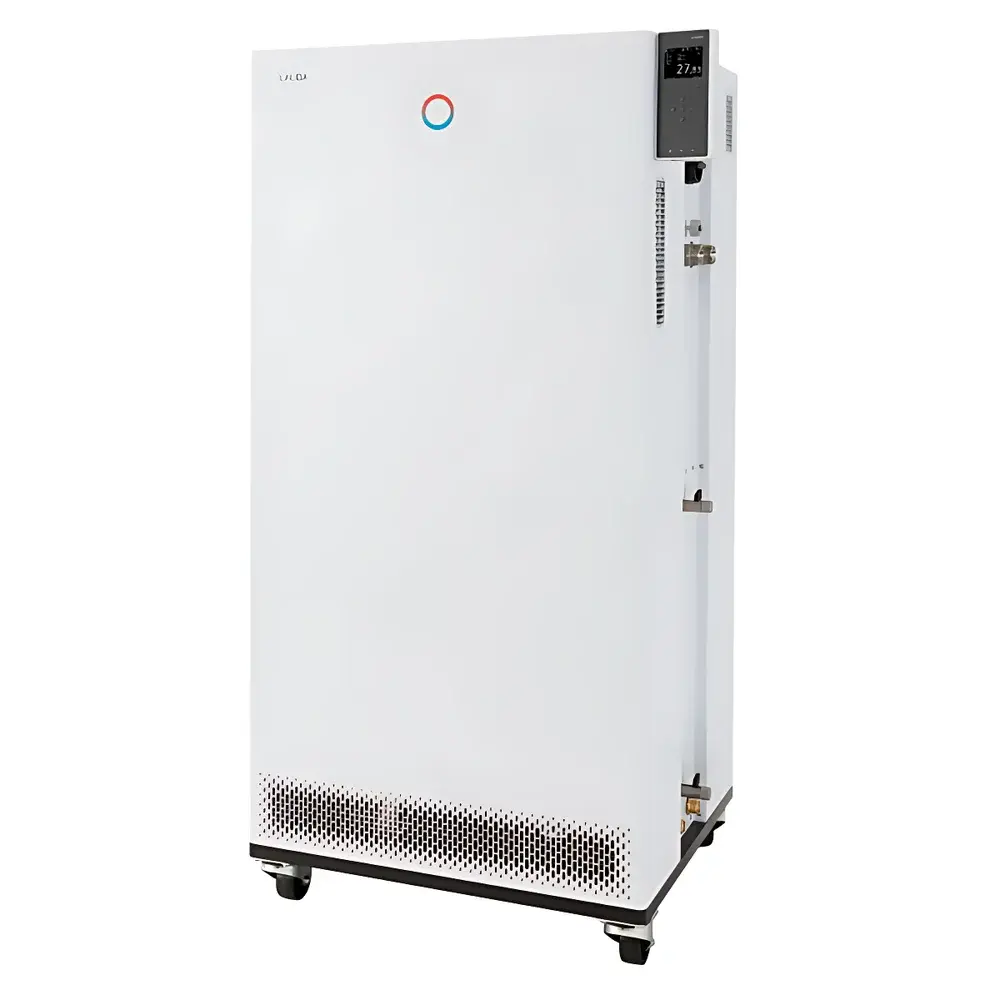
LAUDA Integral XT IN 1850 XTW Integrated Circulating Chiller & Temperature Controller
| Brand | LAUDA |
|---|---|
| Origin | Germany |
| Model | IN 1850 XTW |
| Cooling Method | Water-Cooled |
| Temperature Range | –50 °C to +220 °C |
| Refrigeration Capacity | 20,000 W |
| Temperature Stability | ±0.05 °C |
| Circulating Pump Pressure | 6.0 bar |
| Circulating Pump Flow Rate | 120 L/min |
| Bath Volume | 8.0–28.6 L |
| Operation Mode | Continuous |
Overview
The LAUDA Integral XT IN 1850 XTW is a high-performance, integrated circulating chiller and dynamic temperature controller engineered for demanding industrial process applications and advanced laboratory environments. Designed and manufactured in Germany, this unit employs a dual-circuit architecture combining a high-efficiency refrigeration system with an electric heating module and a magnetically coupled, multi-stage variable-speed circulation pump. Its core thermal management principle relies on stratified cold-oil layer sealing—enabling stable operation across an exceptionally wide temperature span (–50 °C to +220 °C) without thermal shock or fluid degradation. Unlike conventional chillers limited by single-phase refrigerant cycles or fixed-pump architectures, the Integral XT utilizes active flow compensation and adaptive power modulation (PowerAdapt) to maintain precise setpoint adherence during rapid ramping, overshoot-sensitive reactions, or exothermic/endothermic process transitions. It meets the mechanical, thermal, and safety requirements of continuous-duty operation in R&D pilot plants, chemical synthesis, material testing, and pharmaceutical process validation.
Key Features
- Eight-stage magnetically coupled Variopump with digital pressure/flow monitoring and programmable output staging—ensures consistent delivery under high backpressure (up to 6.0 bar) and low-flow conditions.
- Integrated bypass valve with electronic actuation enables real-time optimization of flow distribution between internal cooling loop and external process circuit.
- Full-featured TFT color display with graphical temperature curve plotting, six-language UI (English, German, French, Spanish, Italian, Russian), and intuitive soft-key navigation.
- Advanced PID controller with auto-tuning capability and adaptive parameter adjustment based on load dynamics and thermal inertia profiles.
- SmartCool digital compressor management system—reduces energy consumption via intelligent on/off cycling, partial-load staging, and predictive thermal load estimation.
- Dual Pt100 input support: one integrated sensor for bath control, plus optional external Pt100 interface (via modular expansion port) for process-loop feedback.
- Built-in web server compliant with HTTP/HTTPS protocols—enables secure remote monitoring and control via browser on PC, tablet, or smartphone within local network infrastructure.
- Comprehensive safety architecture including dual-level overtemperature protection (adjustable threshold + hardware-fused cutoff), audible alarm, and floating fault contact output.
- USB 2.0 and Ethernet (RJ45) as standard interfaces; optional field-upgradable modules for RS-232/485, Profibus DP, analog I/O, dry-contact, or EtherCAT communication.
- 150-segment programmable timer supporting up to five independent temperature/time profiles—ideal for automated reaction sequences, aging tests, or thermal cycling protocols.
Sample Compatibility & Compliance
The Integral XT IN 1850 XTW is compatible with a broad range of heat transfer fluids—including silicone oils, glycol/water mixtures, and specialized synthetic heat transfer media—subject to flash point, viscosity, and thermal stability constraints at extreme temperatures. Its sealed cold-layer design minimizes oxidation and vapor loss, extending fluid service life. The unit complies with EU Machinery Directive 2006/42/EC, Low Voltage Directive 2014/35/EU, and Electromagnetic Compatibility Directive 2014/30/EU. It supports GLP/GMP-aligned workflows through audit-trail-capable data logging (via optional LAUDA LabSoft software), time-stamped event records, and user-access-controlled configuration changes. While not intrinsically rated for hazardous areas, its overtemperature safeguards and non-sparking pump design make it suitable for use with flammable and non-flammable liquids when installed per IEC 60079-14 guidelines.
Software & Data Management
The device operates natively with embedded firmware supporting full local control and network-based supervision. When paired with LAUDA LabSoft (v5.0+), users gain access to extended functionality: centralized fleet management, CSV/Excel export of time-series temperature/pressure/flow data, customizable alarm thresholds, PDF report generation, and integration into SCADA or MES platforms via OPC UA or Modbus TCP. All network communications employ TLS 1.2 encryption and session authentication, satisfying data integrity requirements under FDA 21 CFR Part 11 for electronic records and signatures. Internal memory retains >30 days of high-resolution operational logs (1-second sampling interval), accessible via USB export or web interface download.
Applications
- Dynamic temperature control of jacketed reactors, calorimeters, and extruders in fine chemical and polymer synthesis.
- Thermal conditioning of optical components, laser diodes, and semiconductor test fixtures requiring sub-0.1 °C stability.
- Accelerated aging studies per ASTM D573, ISO 188, and IEC 60068-2-1/2 for elastomers, adhesives, and encapsulation materials.
- Calibration of thermocouples, RTDs, and infrared sensors across extended temperature ranges under ISO/IEC 17025-accredited labs.
- Support of high-throughput screening systems where sequential sample thermal preconditioning must be tightly synchronized with analytical instrumentation.
FAQ
What is the minimum and maximum working fluid volume required for stable operation?
The system requires a minimum fill volume of 8.0 L to ensure adequate thermal mass and pump priming; maximum capacity is 28.6 L—optimized for minimal internal dead volume and rapid thermal response.
Can the Integral XT operate unattended for extended periods?
Yes—its continuous-duty rating, redundant safety logic, self-diagnostics, and remote monitoring capabilities enable fully autonomous 24/7 operation in validated environments.
Is the unit compatible with third-party process controllers?
Yes—via optional RS-485, analog (0–10 V / 4–20 mA), or EtherCAT modules, enabling seamless integration into distributed control systems (DCS) or PLC-based automation architectures.
How does the SmartCool system reduce energy consumption?
By dynamically modulating compressor duty cycle based on real-time thermal load, ambient conditions, and historical usage patterns—achieving up to 25% lower average power draw compared to fixed-speed cooling systems.
Does the device support traceable calibration documentation?
While the unit itself does not include factory calibration certificates, its Pt100 inputs are compatible with NIST-traceable reference probes; full metrological traceability can be established using LAUDA’s certified calibration services and LabSoft validation packages.



