
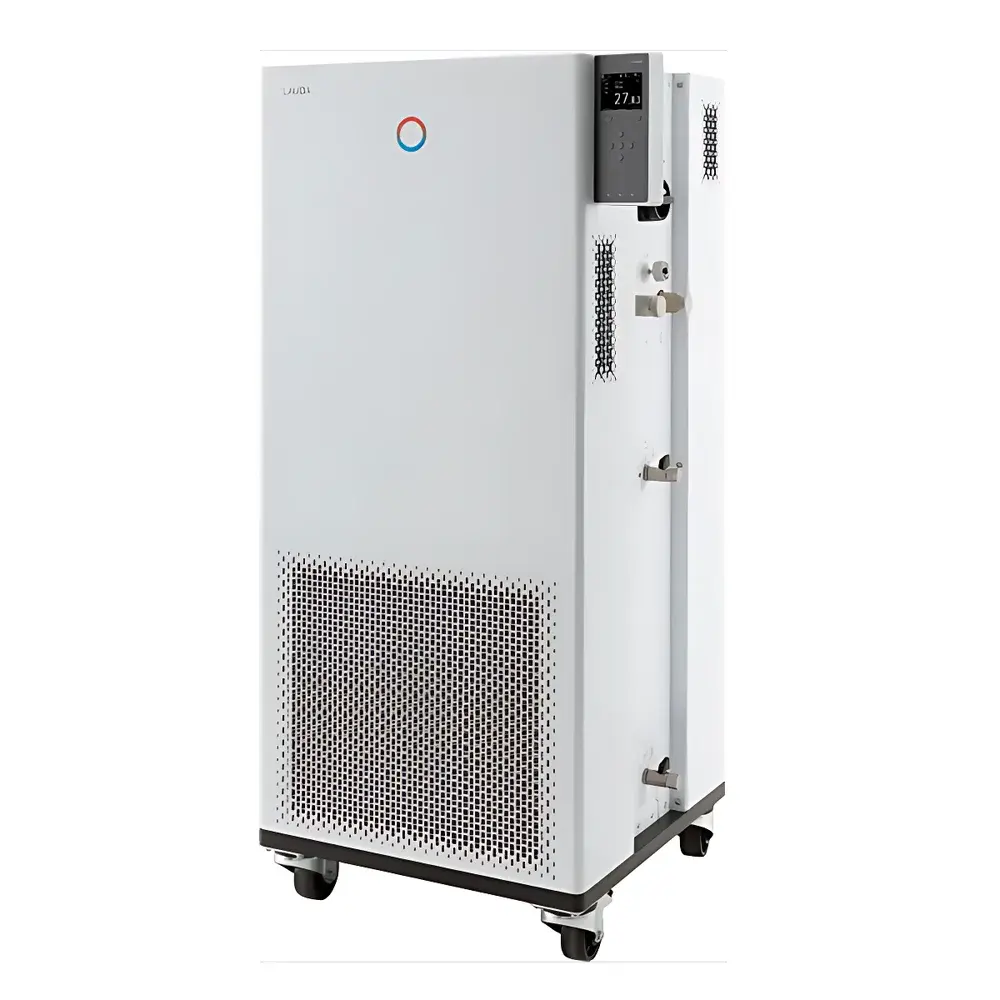
LAUDA Integral XT IN 950 XTW High-Low Temperature Circulating Chiller
| Brand | LAUDA |
|---|---|
| Origin | Germany |
| Model | IN 950 XTW |
| Cooling Method | Water-Cooled |
| Temperature Range | -50 °C to 220 °C |
| Refrigeration Capacity | 9500 W |
| Temperature Stability | ±0.05 °C |
| Circulation Pump Pressure | 3.1 bar |
| Circulation Flow Rate | 65 L/min |
| Reservoir Volume | 4.8–17.2 L |
| Operation Mode | Continuous |
Overview
The LAUDA Integral XT IN 950 XTW is a high-performance, water-cooled circulating chiller engineered for dynamic temperature control in demanding laboratory and industrial process applications. It operates on the principle of active thermal management via closed-loop circulation of heat-transfer fluid—enabled by an integrated refrigeration system combined with electric heating and precise electronic PID regulation. Designed for seamless integration into reaction calorimetry, material testing, spectroscopy, and pilot-scale synthesis systems, the IN 950 XTW delivers exceptional thermal stability (±0.05 °C) across an ultra-wide operating range from –50 °C to +220 °C. Its core architecture employs a patented cold-oil layer flow sealing mechanism, which minimizes vapor pressure risks and extends safe operational limits for both flammable and non-flammable heat-transfer media—including silicone oils, glycols, and specialized synthetic fluids.
Key Features
- Integrated water-cooled refrigeration system with R-449A refrigerant (GWP 1397), compliant with EU F-Gas Regulation (EU No. 517/2014)
- LAUDA Variopump with 8-stage magnetically coupled variable-speed drive—capable of maintaining stable flow (up to 65 L/min) and pressure (up to 3.1 bar) under high external backpressure conditions
- Full-electronic PID controller with adaptive tuning function; supports both internal bath control and external process loop regulation
- SmartCool digital compressor management system optimizes energy consumption via intelligent on/off cycling and load-matching algorithms
- PowerAdapt technology dynamically adjusts heater output to match available supply capacity (max. 8 kW heating power; total max. power draw: 11 kW at 16 A)
- TFT color display with real-time dual-value visualization (setpoint vs. actual), graphical temperature curve logging, and intuitive text-based menu navigation in six languages
- Integrated network server supporting browser-based remote operation via LAN—accessible from PCs, tablets, or smartphones without proprietary software
- Dual Pt100 input capability: one built-in sensor + one optional external probe via modular interface (standard Pt100 port included)
- Programmable scheduler with up to 150 time-temperature segments distributed across five independent programs
- Comprehensive safety architecture including adjustable overtemperature protection (Tmax key), acoustic alarm, floating fault contacts, and self-diagnostic startup assistant
Sample Compatibility & Compliance
The IN 950 XTW is compatible with a broad spectrum of heat-transfer fluids—including water-glycol mixtures, mineral oils, silicone oils (e.g., DC200 series), and fluorinated solvents—subject to user-defined flash point and viscosity constraints. Its sealed flow path, low internal volume design, and cold-layer sealing technology reduce fluid degradation and evaporation risk during extended high-temperature operation. The unit meets IEC 61000-6-2 (EMC immunity) and IEC 61000-6-4 (EMC emissions) standards. Electrical safety complies with IEC 61010-1 for laboratory equipment. Optional interface modules (RS-232/485, Profibus, EtherCAT, analog I/O) support integration into automated manufacturing environments governed by ISO 9001 or GMP frameworks. Data integrity features—including encrypted web communication and audit-ready event logging—are aligned with FDA 21 CFR Part 11 requirements when used with validated configurations.
Software & Data Management
No proprietary software installation is required. All configuration, monitoring, and control functions are accessible through a secure embedded web server using standard HTTPS protocols with TLS 1.2 encryption. User authentication includes role-based access control (administrator/operator modes). Temperature profiles, pump status, alarm history, and system diagnostics are logged locally and exportable in CSV format via USB or Ethernet. Optional LAUDA LabSoft software (sold separately) enables advanced multi-unit fleet monitoring, automated report generation, and compliance documentation for GLP/GMP workflows. Remote firmware updates can be performed over the network with SHA-256 signature verification.
Applications
- Reaction calorimetry and kinetic studies requiring rapid ramping (e.g., exothermic polymerization, hydrogenation)
- Material testing under thermal stress (e.g., DSC sample prep, rheometer temperature control, tensile test chambers)
- Spectroscopic instrumentation cooling (FTIR, Raman, UV-Vis spectrophotometers)
- Pharmaceutical process development (crystallization, lyophilization support, dissolution testing)
- Electronics thermal cycling and reliability testing
- Pilot-scale chemical synthesis with jacketed reactors and continuous flow systems
FAQ
What is the minimum and maximum recommended heat-transfer fluid volume?
The reservoir accommodates 4.8 L (minimum fill level) to 17.2 L (maximum capacity); optimal performance is achieved at ≥12 L for full thermal mass stability.
Can the unit operate unattended for extended periods?
Yes—designed for continuous 24/7 operation with redundant safety layers including dual Pt100 monitoring, overtemperature cutoff, and automatic compressor shutdown on coolant flow loss.
Is the system compatible with hazardous area environments?
The base unit is rated for general-purpose indoor use (IP20). For Zone 1/2 classified areas, consult LAUDA’s ATEX-certified variants (e.g., Integral XT Ex models) and associated explosion-proof interface options.
How is temperature uniformity maintained across large external circuits?
Through active flow-pressure compensation via the integrated bypass valve and real-time PID adaptation—ensuring consistent setpoint tracking even with variable external pressure drops up to 3.1 bar.
Does the device support validation documentation for regulated industries?
Yes—factory calibration certificates (traceable to DAkkS-accredited standards), IQ/OQ templates, and electronic audit trails are available upon request for pharmaceutical, biotech, and medical device applications.



