
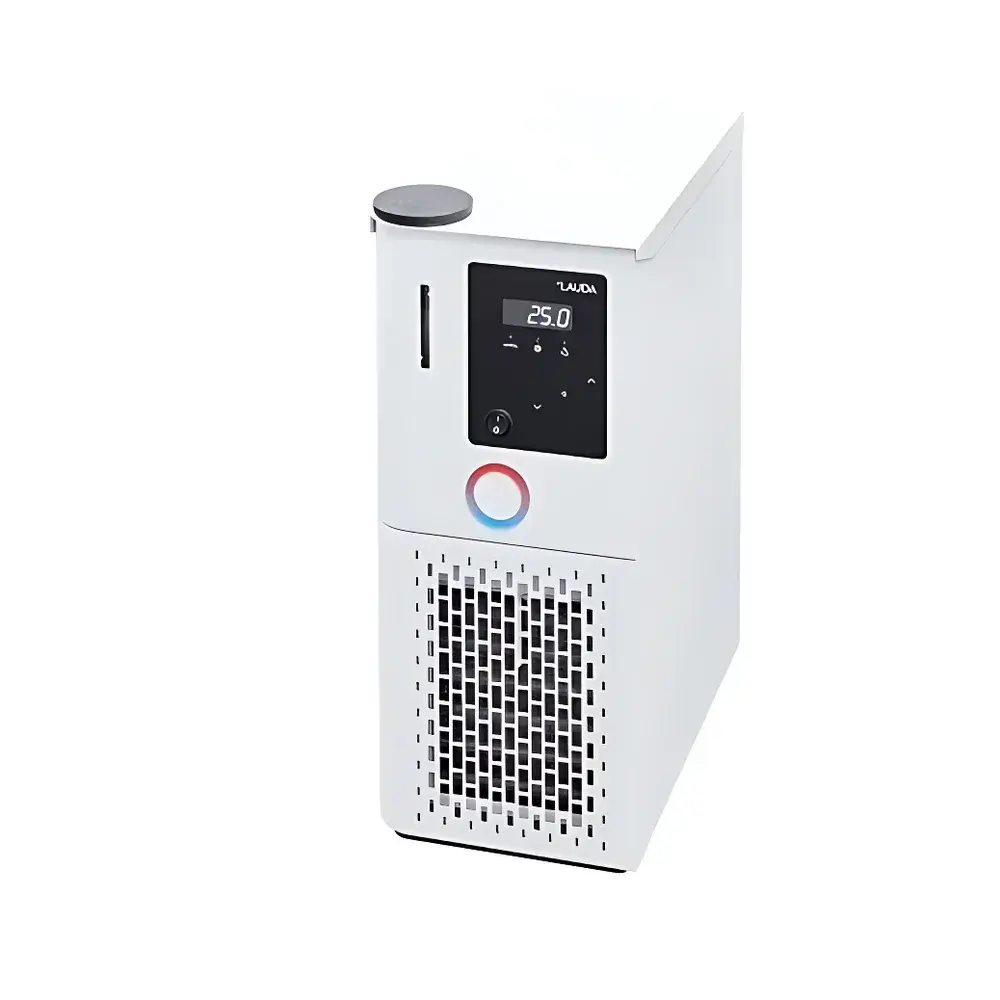
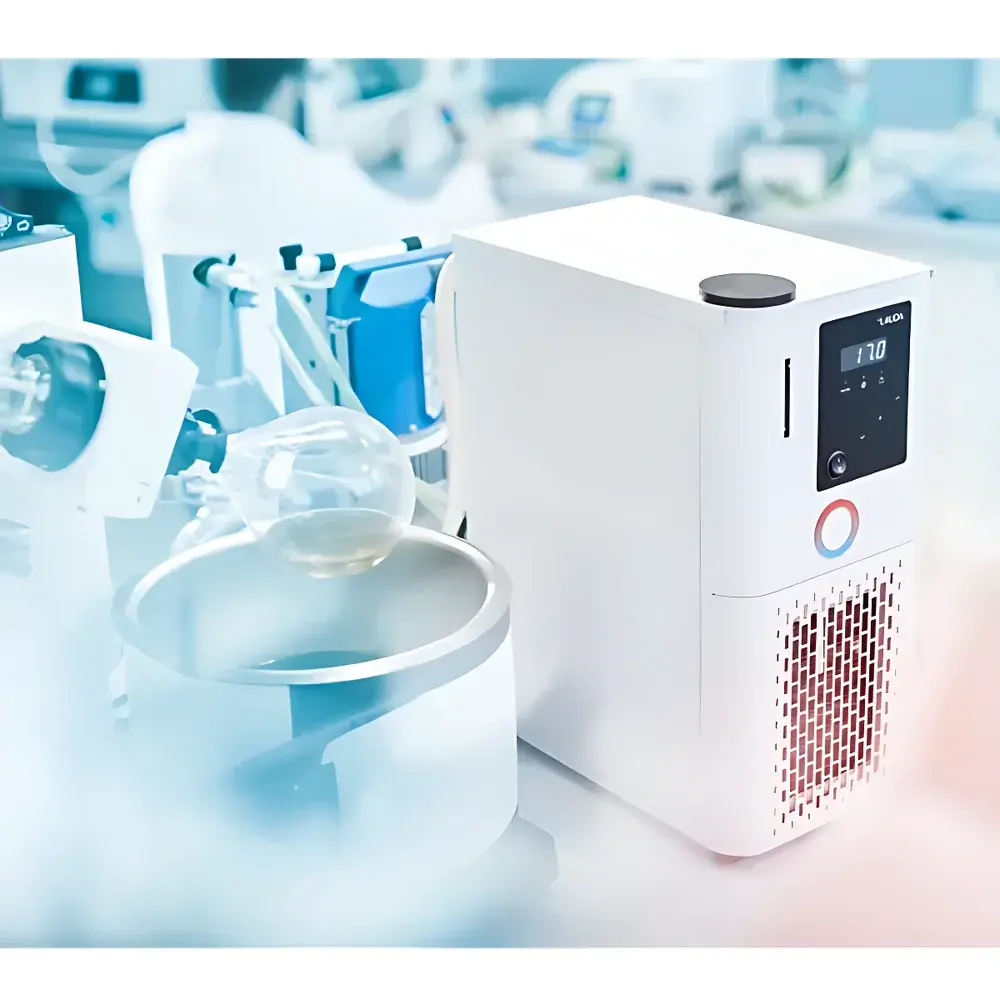
LAUDA Microcool MC 250 Circulating Chiller
| Brand | LAUDA |
|---|---|
| Origin | Germany |
| Model | MC 250 |
| Cooling Method | Air-Cooled |
| Temperature Range | –10 to 40 °C |
| Refrigeration Capacity | 0.25 kW at 20 °C (ethanol) |
| Temperature Stability | ±0.5 K |
| Pump Max. Pressure | 0.35 bar |
| Pump Flow Rate | 16 L/min |
| Reservoir Volume | 2.0–4.0 L |
| Power Supply | 230 V, 50 Hz |
| Refrigerant | R-134a (0.085 kg) |
| Dimensions (W×D×H) | 200 × 350 × 465 mm |
| Weight | 25 kg |
| Noise Level | 60 dB(A) |
| Max. Power Consumption | 0.23 kW |
Overview
The LAUDA Microcool MC 250 is a compact, air-cooled circulating chiller engineered for precise thermal management in laboratory environments. Designed around a closed-loop refrigeration cycle using R-134a refrigerant and an electronically controlled expansion valve, it delivers stable temperature control across a wide operational range of –10 °C to +40 °C. Its core architecture integrates a hermetically sealed magnetic-coupled centrifugal pump—eliminating mechanical shaft seals and associated leakage risks—ensuring long-term reliability when circulating aqueous or water/ethylene glycol mixtures. The unit operates continuously under load, supporting critical applications such as rotary evaporation, distillation condensation, spectroscopic detector cooling, and chromatographic column temperature regulation. With a footprint of only 200 × 350 mm, the MC 250 is optimized for benchtop integration without compromising thermal performance or system integrity.
Key Features
- Magnetic-coupled centrifugal pump with brushless DC motor: eliminates seal wear, prevents fluid leakage, and ensures maintenance-free operation over extended duty cycles.
- High-contrast backlit liquid level window with integrated LED illumination: enables real-time visual monitoring of reservoir fill level under variable ambient lighting conditions.
- Full electronic PID controller with intuitive three-button interface and LED display: supports simultaneous readout of setpoint and actual bath temperature with ±0.5 K stability under steady-state conditions.
- Comprehensive safety system: includes low-level fluid alarm, pump overtemperature cutoff, automatic shutdown on reservoir emptying, and electromechanical fault contact output for external interlock integration.
- RS-232 serial interface (standard): enables remote parameter setting, real-time temperature logging, and alarm status reporting via host PC or lab automation software.
- Thermally insulated reservoir with top-fill port and rear-mounted quick-connect fluid ports (M10 external thread): simplifies setup, minimizes heat ingress, and supports standardized hose coupling protocols.
Sample Compatibility & Compliance
The MC 250 is validated for use with non-flammable heat transfer fluids—including deionized water, 30% aqueous ethylene glycol solutions, and ethanol—within its specified operating envelope. It complies with IEC 61010-1:2010 for electrical safety in laboratory equipment and meets CE marking requirements under the EU Machinery Directive 2006/42/EC and EMC Directive 2014/30/EU. While not intrinsically rated for hazardous locations, its design excludes ignition sources and conforms to EN 60079-0 general requirements for non-explosive atmospheres. The unit supports GLP-compliant workflows through traceable temperature logging (via RS-232), configurable start/stop timers, and auditable alarm event records—facilitating alignment with ISO/IEC 17025 quality management systems.
Software & Data Management
Although the MC 250 does not include embedded graphical software, its RS-232 interface provides full ASCII command protocol access per LAUDA’s documented SCPI-like instruction set. This allows seamless integration with third-party data acquisition platforms (e.g., LabVIEW, MATLAB, Python-based PySerial scripts) for scheduled temperature profiling, multi-unit synchronization, and automated calibration verification. All temperature setpoints, pump activation states, and alarm triggers are timestamped internally; logged data can be exported for audit trail generation in regulated environments adhering to FDA 21 CFR Part 11 principles—provided the host system implements appropriate electronic signature and audit log controls.
Applications
- Rotary evaporation: maintains consistent condenser temperature during solvent recovery, improving yield and reproducibility across volatile organic compounds.
- HPLC and UHPLC column ovens: stabilizes retention time by minimizing thermal drift in analytical separation systems.
- FTIR and Raman spectrometer detector cooling: reduces dark current noise in MCT and InSb detectors during long-integration measurements.
- Calorimetry support: serves as a stable cold sink for isothermal titration calorimeters (ITC) and differential scanning calorimeters (DSC) requiring auxiliary temperature referencing.
- Small-scale reactor jacketing: provides scalable thermal control for benchtop synthesis reactors up to 5 L volume with compatible circulation manifolds.
FAQ
What heat transfer fluids are approved for use with the MC 250?
Deionized water, 20–40% ethylene glycol/water mixtures, and ethanol are supported. Glycerol-based or oil-based fluids are not recommended due to viscosity limitations and potential pump compatibility issues.
Can the MC 250 operate unattended overnight?
Yes—its continuous-duty compressor, auto-restart function after power interruption, and programmable timer-based on/off scheduling make it suitable for unattended operation within validated temperature ranges.
Is the RS-232 interface compatible with modern Windows/Linux systems?
Yes, using standard USB-to-RS-232 adapters and terminal emulation software (e.g., Tera Term, PuTTY) or custom Python/LabVIEW drivers compliant with LAUDA’s documented ASCII command syntax.
Does the unit meet energy efficiency standards for EU laboratories?
It complies with EU Ecodesign Directive 2019/2023 for refrigerating appliances, achieving an Energy Efficiency Index (EEI) below threshold limits for Class A chillers in its capacity class.
How often should the refrigerant charge be verified?
Under normal operation and absence of physical damage, R-134a charge remains stable for >10 years. Verification is recommended only if cooling capacity degrades significantly or compressor current draw exceeds 1.5 A under nominal load.



