
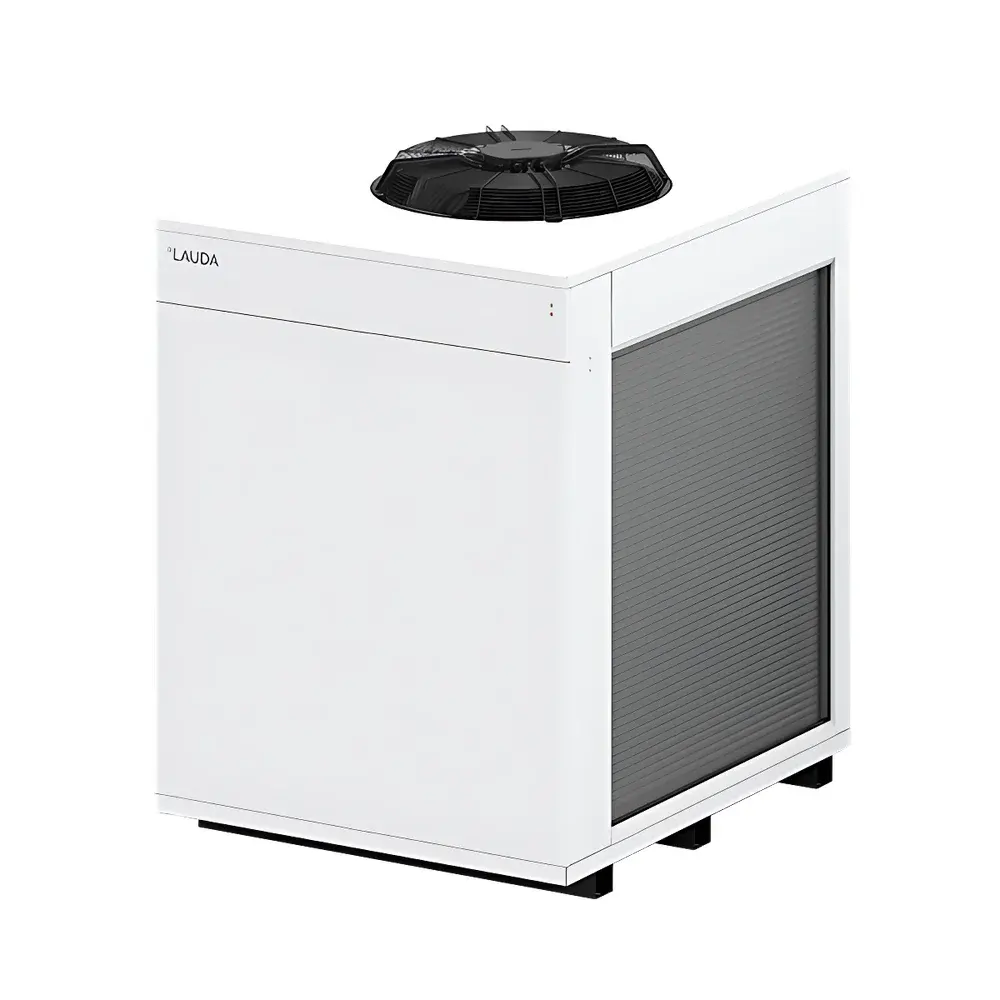
LAUDA UC 100 Ultracool Energy-Efficient Circulating Chiller
| Brand | LAUDA |
|---|---|
| Origin | Germany |
| Model | UC 100 |
| Type | Split-System Circulating Chiller |
| Cooling Method | Water-Cooled |
| Temperature Control Range | −10 to 35 °C |
| Refrigeration Capacity | 100.0 kW (at 10 °C outlet water temperature) |
| Temperature Stability | ±0.5 °C |
| Circulation Pump Pressure | 5.4 bar |
| Circulation Flow Rate | 300 L/min |
| Reservoir Volume | 125 L |
| Operation Mode | Continuous |
Overview
The LAUDA UC 100 Ultracool is a high-performance, energy-optimized split-system circulating chiller engineered for precision thermal management in demanding laboratory and industrial process environments. Based on LAUDA’s proprietary thermodynamic architecture and compliant with EU Ecodesign Directive (EU No. 2016/2281), the UC 100 employs variable-speed scroll compressors, electronically controlled expansion valves, and adaptive fan speed regulation to dynamically match cooling output to real-time thermal load. Its core measurement principle relies on closed-loop refrigerant cycle thermodynamics—specifically subcritical R-513A operation—combined with PID-controlled water-side temperature regulation to deliver stable, repeatable heat extraction across continuous operation. Designed for integration into automated infrastructure, the UC 100 serves as a critical thermal subsystem for equipment requiring consistent coolant supply at tightly bounded temperatures—such as laser sources, analytical instrumentation, and electrochemical reactors—where deviations beyond ±0.5 °C could compromise process fidelity or measurement repeatability.
Key Features
- Energy efficiency up to 50% higher than conventional chillers under comparable operating conditions, validated per EN 14511 and EU SEPR (Seasonal Energy Performance Ratio) methodology
- Split-system configuration enables flexible installation: condenser unit outdoors (IP54-rated enclosure) and evaporator/pump module indoors
- Integrated high-capacity circulation pump delivering 300 L/min at 5.4 bar pressure, optimized for low-pressure-drop external loops up to 200 m total equivalent length
- 125 L stainless steel reservoir with level monitoring, anti-corrosion treatment, and integrated air venting to prevent cavitation
- Intelligent control system supporting Modbus TCP, BACnet MS/TP, and Ethernet/IP protocols for seamless PLC or SCADA integration
- Pre-certified for compliance with IEC 61000-6-2 (EMC immunity) and IEC 61000-6-4 (EMC emissions), suitable for shared utility environments
Sample Compatibility & Compliance
The UC 100 is compatible with standard aqueous glycol mixtures (up to 35% v/v ethylene or propylene glycol), deionized water, and other non-aggressive heat transfer fluids meeting ASTM D1384 corrosion inhibition requirements. It supports direct connection to OEM equipment interfaces—including laser diode stacks, UV-curing lamps, and CNC spindle coolants—without intermediary heat exchangers in most configurations. The unit conforms to ISO 5170-2 for industrial chiller performance testing, meets CE marking requirements under the Machinery Directive 2006/42/EC and Low Voltage Directive 2014/35/EU, and includes factory documentation traceable to DIN EN ISO/IEC 17025–accredited calibration procedures for temperature and flow sensors.
Software & Data Management
The UC 100 features LAUDA’s CloudLink™ firmware platform, enabling secure remote access via web browser or LAUDA Cloud mobile application. All operational parameters—including inlet/outlet temperatures, compressor run hours, energy consumption (kWh), and fault logs—are timestamped and stored locally (SD card) and optionally synchronized to LAUDA Cloud for long-term trend analysis. Audit trails comply with FDA 21 CFR Part 11 requirements when deployed with user authentication, electronic signatures, and immutable log archiving enabled. Historical data exports support CSV and OPC UA formats, facilitating integration into LIMS or MES systems for thermal process validation and PQ documentation.
Applications
- Laser material processing systems (CO₂, fiber, and ultrafast lasers) requiring stable coolant temperature to maintain beam quality and optical alignment
- Analytical instruments including ICP-MS, XRD, and high-field NMR spectrometers where thermal drift affects signal-to-noise ratio and spectral resolution
- Electrochemical test stations and fuel cell R&D rigs demanding precise cathode/anode coolant temperature control
- Digital printing presses and UV-curing lines requiring rapid thermal response during duty-cycle transitions
- Hydrogen generation electrolyzers operating under dynamic load profiles, where coolant stability directly impacts membrane hydration and efficiency
- Automated packaging machinery with servo-driven components sensitive to thermal expansion-induced positional error
FAQ
What refrigerant does the UC 100 use, and is it compliant with F-Gas Regulation (EU) No. 517/2014?
The UC 100 uses R-513A—a low-GWP (GWP = 631), ASHRAE A1 safety-class refrigerant—fully compliant with EU F-Gas phase-down schedules through 2030.
Can the UC 100 operate continuously at −10 °C outlet temperature with full 100 kW capacity?
No. Rated capacity of 100 kW applies at 10 °C outlet with 25 °C ambient condensing conditions. At −10 °C outlet, capacity reduces to approximately 62 kW (per AHRI 550/590 performance map); derating curves are provided in the technical manual.
Is the internal pump compatible with abrasive or high-conductivity process fluids?
The standard pump is designed for clean, non-abrasive, low-conductivity fluids (e.g., 20% glycol/water). For aggressive media, LAUDA offers optional ceramic-shafted pumps and EPDM/NBR seal kits—contact engineering support for fluid compatibility assessment.
Does the UC 100 support redundant communication paths for mission-critical installations?
Yes. Dual Ethernet ports enable primary/backup network routing; Modbus RTU over RS-485 is available as a hardware-failover interface.
How is temperature stability of ±0.5 °C verified during factory acceptance testing?
Stability is measured per ISO 5170-2 Annex C using calibrated Class A Pt100 probes placed at inlet and outlet manifolds under steady-state load, with data logged at 1-second intervals over 120 minutes.



