
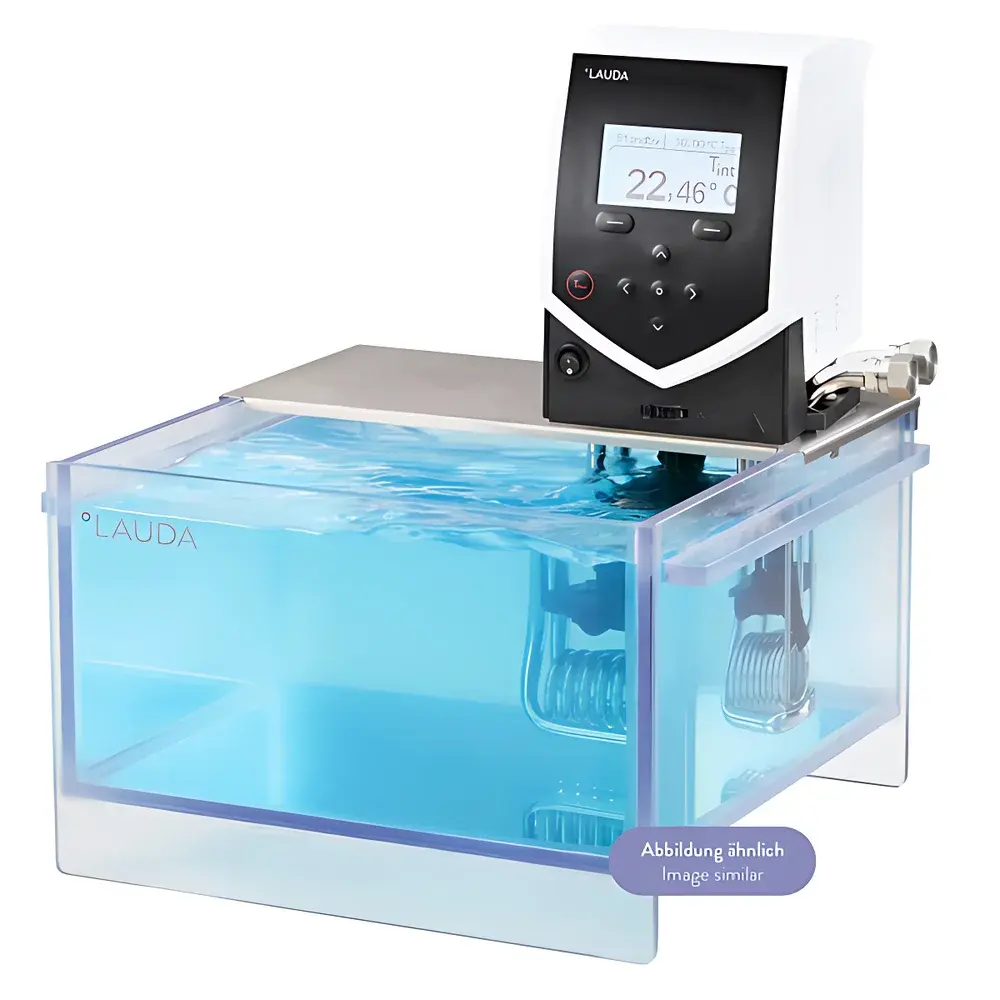
LAUDA ET 20 S Transparent Circulating Water Bath
| Brand | LAUDA |
|---|---|
| Origin | Germany |
| Model | ET 20 S |
| Temperature Range | 20–100 °C |
| Temperature Stability | ±0.01 °C |
| Bath Volume | 20.0 L |
| Heating Power | 2.0 kW |
| Dimensions (W×D×H) | 322×506×389 mm |
| Display | Monochrome Graphic LCD |
| Pump | Vario® 6-stage adjustable circulation pump |
| Safety Class | III (for flammable & non-flammable liquids) |
| Interface | Standard USB |
| Programmable Controller | 1 program, up to 20 segments |
| Bath Material | Polycarbonate |
| Weight | 10 kg |
| Power Supply | 230 V, 50/60 Hz |
Overview
The LAUDA ET 20 S Transparent Circulating Water Bath is a precision-engineered temperature control system designed for laboratory applications requiring stable, uniform thermal environments across a wide operating range (20–100 °C). Based on LAUDA’s ECO platform, the ET 20 S employs a fully electronic PID controller with microprocessor-based regulation to achieve exceptional temperature stability of ±0.01 °C—critical for kinetic studies, calibration procedures, enzymatic assays, and material testing where thermal drift must be minimized. Its transparent polycarbonate bath enables real-time visual monitoring of samples and circulation dynamics without compromising structural integrity or chemical resistance. Unlike conventional water baths with fixed flow paths, the ET 20 S integrates LAUDA’s Vario® pump technology, allowing dynamic, in-operation adjustment of internal recirculation and external loop flow rates via an intuitive front-panel flow distributor—eliminating manual valve manipulation and reducing operator intervention during extended experiments.
Key Features
- Monochrome graphic LCD display showing simultaneous setpoint and actual temperature values with intuitive menu navigation
- Full electronic PID controller with programmable overtemperature protection (Tmax key) and configurable safety cutoffs
- Vario® 6-stage adjustable pump delivering up to 22 L/min at 0.6 bar max pressure—optimized for both low-flow precision applications and high-demand external loops
- Safety Class III certification per DIN EN 61010-1, enabling safe operation with flammable solvents (e.g., ethanol, acetone) and aqueous media
- Integrated cooling coil for active heat dissipation—supporting rapid cooldown cycles and extended operation near upper temperature limits
- Standard USB interface with firmware-upgradable communication options: RS232/485, Profibus DP, Ethernet-USB, analog/digital I/O, and Pt100/LiBus modules for centralized lab automation
- Built-in programmable timer supporting one multi-segment protocol (up to 20 steps), facilitating unattended ramp-hold-cool sequences compliant with ASTM E2877 and ISO 17025 workflows
- Ergonomic design with tool-free access to service points and modular electronics architecture for field-upgradable functionality
Sample Compatibility & Compliance
The ET 20 S accommodates a broad spectrum of sample formats—including glassware (beakers, flasks, cuvettes), immersion probes, reaction vessels, and externally connected jacketed reactors—thanks to its 20 L bath volume (300 × 350 × 160 mm usable interior) and flexible dual-loop flow management. The polycarbonate bath resists hydrolysis, mild acids, and common organic solvents, while maintaining optical clarity for process observation. All electrical and thermal safety systems conform to IEC 61010-1:2010 and carry CE marking under the EU Low Voltage and EMC Directives. For regulated environments, the device supports audit-ready data logging when paired with LAUDA’s WinControl software (optional), enabling full traceability aligned with FDA 21 CFR Part 11 requirements—including electronic signatures, user access levels, and immutable event logs.
Software & Data Management
Through its native USB port, the ET 20 S connects seamlessly to Windows-based PCs running LAUDA WinControl software—a validated application for remote configuration, real-time monitoring, and automated data capture. Logged parameters include temperature setpoint, actual bath temperature, pump speed, elapsed time, and alarm status—exportable as CSV or PDF reports. Optional interface modules enable integration into SCADA systems or LIMS platforms via Modbus TCP or OPC UA protocols. Firmware updates are performed via USB stick, ensuring long-term compatibility with evolving lab IT infrastructure and cybersecurity standards (e.g., TLS 1.2 encryption for Ethernet-enabled variants).
Applications
- Calibration of thermometers, RTDs, and thermocouples per ISO/IEC 17025 accredited procedures
- Temperature-dependent viscosity measurements using rotational rheometers coupled via external circulation
- Stability testing of pharmaceutical formulations under ICH Q1A(R2) conditions
- Enzyme activity assays requiring precise thermal control over extended incubation periods
- Material testing of polymers and composites during thermal transition analysis (e.g., Tg determination)
- Supporting HPLC column ovens and GC injector blocks via external recirculation loops
- Environmental simulation for accelerated aging studies per ASTM D3418 and ISO 294-4
FAQ
What is the maximum allowable external loop pressure for the ET 20 S?
The integrated Vario® pump delivers up to 0.6 bar maximum pressure—sufficient for most jacketed reactors and inline heat exchangers with standard tubing (ID ≥ 6 mm). For higher backpressure applications, consult LAUDA’s technical documentation for flow-rate derating curves.
Can the ET 20 S operate continuously at 100 °C?
Yes, continuous operation at 100 °C is supported provided ambient temperature remains ≤40 °C and the cooling coil is connected to a suitable coolant source (e.g., tap water or chiller) to manage heat rejection.
Is the bath fluid level sensor included as standard?
No—the ET 20 S does not feature an automatic low-level shutoff. Users must manually maintain fluid volume between 15–20 L as indicated by the internal scale; operation below minimum fill compromises thermal uniformity and may trigger overtemperature alarms.
Does the device support GLP-compliant electronic record keeping?
When used with WinControl software and configured with audit trail enabled, the system meets core GLP requirements for data integrity, user authentication, and change control—subject to site-specific validation per OECD Principles of GLP.
How is temperature uniformity verified across the bath volume?
LAUDA provides factory calibration certificates specifying axial/radial uniformity (±0.02 °C at 37 °C, ±0.05 °C at 100 °C) measured per DIN 12876-1. Users may perform in-house verification using NIST-traceable multi-point probe arrays.



